
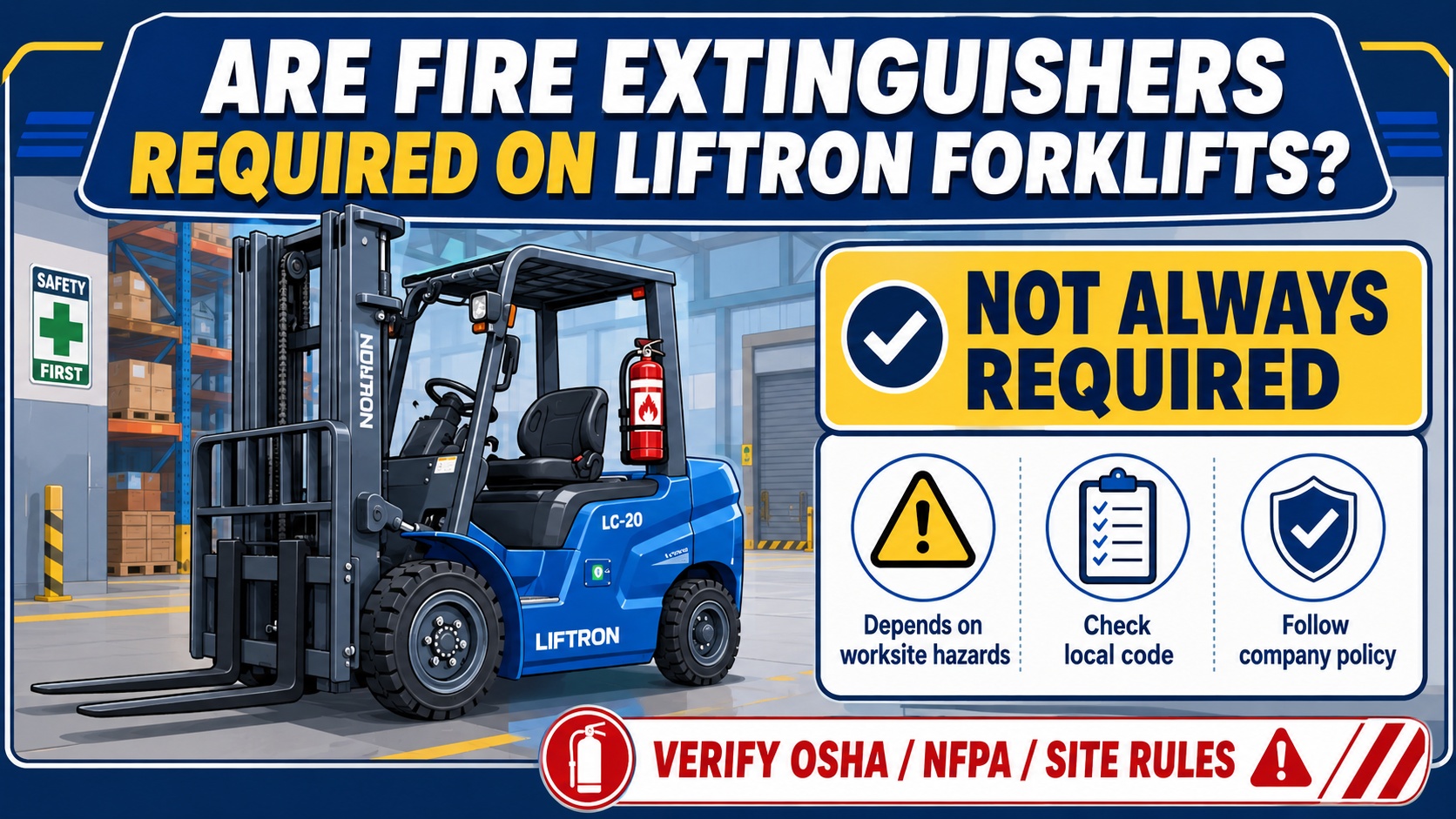
Are fire extinguishers required on liftron forklifts
When operating a Liftron Material Handling forklift, workplace safety regulations often raise the question: Are fire extinguishers required on Liftron forklifts? The answer depends on local fire codes, Occupational Safety and Health Administration (OSHA) standards, and the specific operating environment. This article explores legal requirements, industry best practices, and how to ensure compliance while maximizing fleet safety.
Understanding OSHA and Fire Extinguisher Requirements
OSHA’s general industry standard (29 CFR 1910.157) mandates that portable fire extinguishers must be provided in workplaces where potential fire hazards exist. However, this regulation does not explicitly require extinguishers on every powered industrial truck, including forklifts like those from Liftron. Instead, OSHA focuses on the availability of extinguishers within the travel path. For example, if a Liftron forklift operates in a warehouse with a fire extinguisher mounted on a nearby wall (within 75 feet of travel), the vehicle itself may not need one. However, operations where the forklift works in remote areas or near high-hazard materials—such as flammable liquids or combustible dust—often require a unit on board.
Many states adopt additional fire codes through the National Fire Protection Association (NFPA). NFPA 10 (Standard for Portable Fire Extinguishers) does not directly mandate extinguishers on lift trucks, but it recommends providing them for mobile equipment used in hazardous locations. To stay compliant, always check your local authority having jurisdiction (AHJ), as requirements can vary by municipality or industry sector.
When Are Fire Extinguishers Essential on Liftron Forklifts?
The need for an onboard extinguisher becomes critical in several scenarios. First, if your Liftron DL SERIES operates in an environment classified as a hazardous location (e.g., chemical plants, fuel storage areas), a fire extinguisher may be a regulatory requirement under NFPA 505. Second, if the forklift is used for outdoor applications or in large facilities where the nearest wall-mounted extinguisher exceeds 75 feet of travel distance, OSHA’s interpretation suggests that a portable extinguisher should be carried on the vehicle. Third, in warehouses containing lithium-ion battery charging stations, the potential for thermal runaway incidents makes an onboard Class ABC or Class D extinguisher a prudent safety measure.
Types of Fire Extinguishers Suitable for Liftron Forklifts
Selecting the correct extinguisher type is crucial. For general use, a 5- or 10-pound ABC dry chemical extinguisher is common because it handles ordinary combustibles (wood, paper), flammable liquids, and electrical fires. However, if the forklift is equipped with lithium-ion batteries (like the Liftron DL SERIES), a Class D extinguisher designed for metal fires or a specialized lithium-ion fire suppression agent may be recommended. Note that water-based extinguishers must never be used on electrical fires, so steer clear of water or foam types unless the forklift is certified for such agents.
| Extinguisher Class | Fire Type | Recommended for Liftron Forklifts? |
|---|---|---|
| Class A | Ordinary combustibles | Yes, but not solely for battery fires |
| Class B | Flammable liquids | Yes, common in warehouses |
| Class C | Electrical fires | Yes, for battery compartments |
| Class D | Combustible metals (e.g., lithium) | Recommended for lithium-ion batteries |
| ABC multi-purpose | Combination of A, B, C | Most common choice |
Mounting and Accessibility Considerations
If you decide to equip a Liftron forklift with a fire extinguisher, proper mounting is essential. The extinguisher must be secured to prevent movement during operation—use a bracket that bolts to the overhead guard or the vehicle chassis. Ensure it is easily accessible without requiring the operator to leave the seat for standard reach. OSHA requires extinguishers to be mounted within 75 feet of travel, so a centrally located unit on the forklift satisfies this rule. Also check that the extinguisher is not obstructed by forks, hoses, or cargo.
Inspections, Maintenance, and Training
Merely having an extinguisher on board is not enough. OSHA mandates monthly visual inspections to ensure the extinguisher is in its designated place, has a full charge, and is free of damage. Annual maintenance by a certified professional is also required. Additionally, operators must be trained on how to use the extinguisher—the PASS technique (Pull, Aim, Squeeze, Sweep) should be part of onboarding. For operators of electric forklifts like the Liftron DL SERIES, training should specifically address lithium-ion battery fire response, as standard ABC extinguishers may not fully suppress thermal runaway.
Liftron Forklift Features That Enhance Fire Safety
Modern electric forklifts like those from Liftron Material Handling incorporate built-in safety features that reduce fire risk. The Liftron DL SERIES, for example, utilizes intelligent battery management systems (BMS) that monitor temperature, voltage, and current to prevent overheating. This lowers the probability of a battery fire compared to older lead-acid models. However, no system is fail-proof, so an onboard extinguisher remains a valuable backup. Additionally, some Liftron models offer optional fire suppression systems that integrate with the BMS to automatically release agent into the battery compartment in case of thermal runaway.
Common Misconceptions About Forklift Fire Extinguishers
- Myth: All forklifts automatically come with fire extinguishers. Fact: Extinguishers are aftermarket additions unless explicitly ordered.
- Myth: A single extinguisher type works for all fires. Fact: Lithium-ion fires may require Class D agents.
- Myth: Extinguishers must be mounted on the forklift at all times. Fact: Some facilities have wall units within reach; vehicle mounting is optional.
- Myth: Fire extinguishers never expire. Fact: They require periodic pressure checks and hydrostatic testing.
How to Determine if Your Liftron Forklift Needs an Extinguisher
Conduct a risk assessment specific to your operation. Consider factors like: Is the forklift used near flammable materials? Are there any electrical hazards from batteries? Is the travel path greater than 75 feet from a fixed extinguisher? If you answer yes to any of these, equipping your Liftron DL SERIES or other model with an approved extinguisher is strongly advised. Also, consult your insurance provider—some policies offer premium discounts for proactive fire safety measures.
Final Recommendations for Fleet Managers
While fire extinguishers are not universally mandated on all Liftron forklifts, they are a smart investment for safety and compliance. At minimum, ensure fixed extinguishers are positioned within OSHA-mandated distances. For high-risk environments or fleets that include lithium-ion models like the Liftron DL SERIES, installing an onboard ABC or Class D extinguisher is best practice. Pair this with regular training, inspections, and integration with your facility’s fire safety plan. By staying proactive, you protect both personnel and equipment while meeting regulatory expectations.
Add a review
Your email address will not be published. Required fields are marked *