
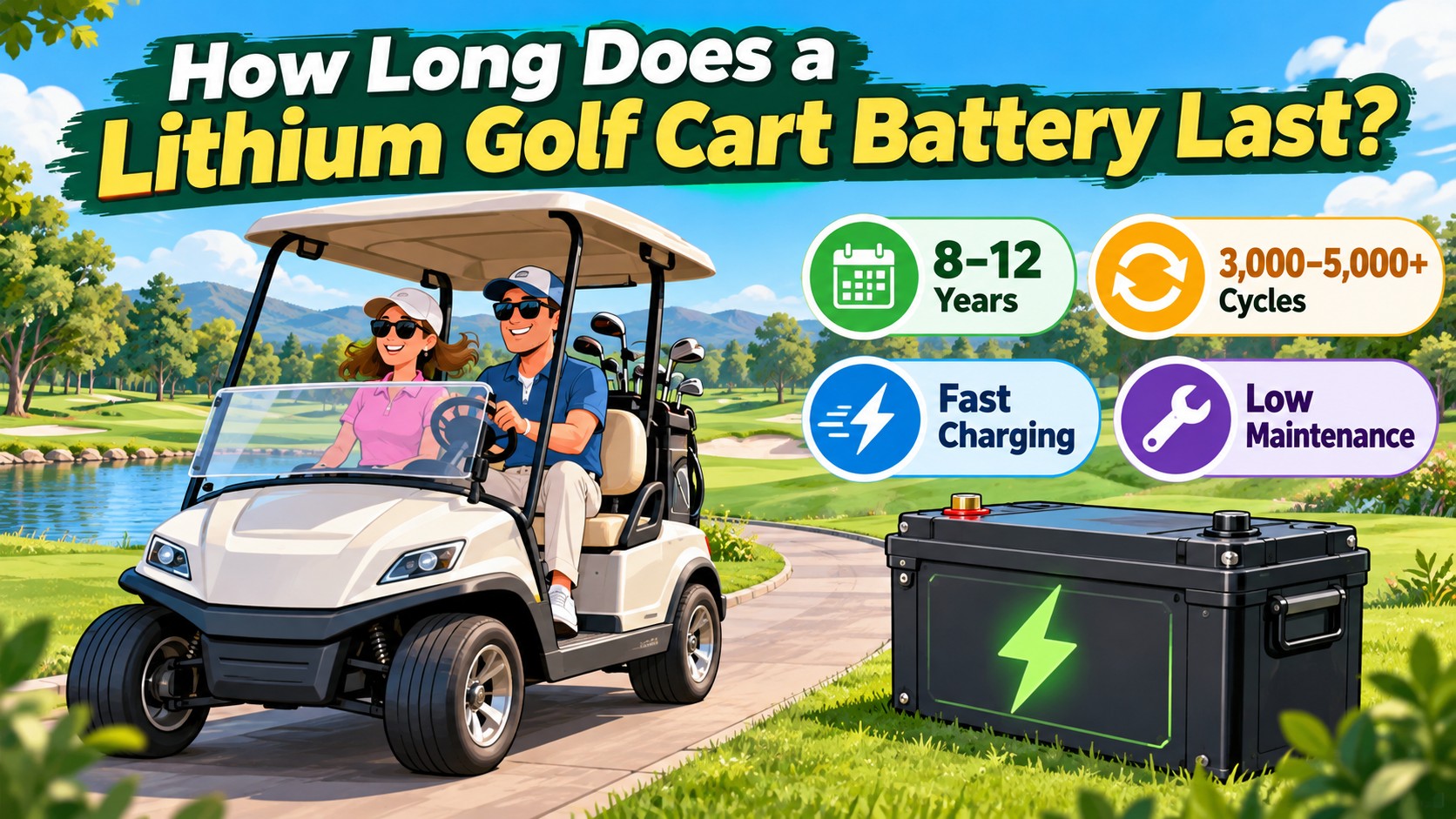
How Long Does a Lithium Golf Cart Battery Last?
Most lithium golf cart batteries last around 8 to 12 years in normal use. Some lightly used and carefully maintained packs may last even longer, while heavily cycled fleet batteries may reach the end of their useful life sooner. Cycle life, temperature, charging habits, depth of discharge, and daily workload all affect the final lifespan.
Lithium batteries have become a popular upgrade for golf carts because they generally last much longer than traditional flooded lead-acid batteries while requiring far less routine maintenance. A quality LiFePO4 golf cart battery can often provide 3,000 to 5,000 or more charge cycles, making it suitable for recreational carts, neighborhood vehicles, resorts, and fleet applications. Products from Hydrocell Battery use LiFePO4 chemistry designed for long cycle life, stable power delivery, and low-maintenance operation.
Lithium Golf Cart Battery Lifespan at a Glance
| Battery Type | Typical Service Life | Typical Cycle Life |
|---|---|---|
| LiFePO4 Lithium Battery | 8–12+ Years | 3,000–5,000+ Cycles |
| Flooded Lead-Acid Battery | 3–5 Years | About 500–1,000 Cycles |
| Heavy Commercial Lithium Fleet Use | Often 4–8 Years | Depends heavily on daily cycling |
| Light Residential Lithium Use | 10+ Years Possible | Lower annual cycle count |
The actual lifespan depends on how often the cart is driven and how deeply the battery is discharged each day.
Why Lithium Batteries Last Longer Than Lead-Acid
Lithium Iron Phosphate batteries use a very different chemistry from traditional lead-acid batteries.
LiFePO4 cells are designed to tolerate repeated charge and discharge cycles while maintaining relatively stable voltage throughout much of the discharge curve.
Key longevity advantages include:
- Much higher cycle life
- Lower routine maintenance
- No electrolyte watering
- No traditional equalization charging
- Better usable depth of discharge
- Integrated Battery Management System protection
These features make modern lithium batteries attractive to golf cart owners who want to reduce battery replacement frequency and maintenance work.
How Many Charge Cycles Does a Lithium Golf Cart Battery Last?
Many quality LiFePO4 golf cart batteries are rated for approximately 3,000 to 5,000 or more charge cycles under specified test conditions.
A cycle is not necessarily the same as plugging the battery into a charger once.
For example, using 50% of the battery one day and another 50% the next day together represents approximately one full equivalent cycle.
If a cart completes 250 full equivalent cycles each year, a 3,500-cycle battery could theoretically support many years of operation, although age, temperature, current demand, and storage conditions also affect real-world life.
Do not estimate battery life using cycle count alone. Calendar age, heat exposure, charging voltage, discharge current, and storage conditions also influence how long a lithium golf cart battery lasts.
How Long Do Lead-Acid Golf Cart Batteries Last?
Flooded lead-acid golf cart batteries commonly last around 3 to 5 years under normal conditions.
Poor maintenance can shorten that lifespan considerably.
Lead-acid batteries require:
- Regular watering
- Terminal cleaning
- Electrolyte inspections
- Proper full charging
- Periodic maintenance checks
They also tend to suffer more from repeated deep discharge than LiFePO4 systems.
Depth of Discharge and Battery Life
Depth of discharge, or DoD, describes how much of the battery’s stored energy is used before recharging.
Lithium batteries can generally use a much greater percentage of their rated capacity than traditional lead-acid systems without suffering the same level of immediate degradation.
For example, many LiFePO4 systems are designed around approximately 80% usable depth of discharge, and some systems may permit deeper discharge depending on BMS settings.
However, repeatedly running any battery to its absolute lower limit can increase stress over time.
Lithium golf cart batteries can usually be discharged more deeply than lead-acid batteries, but avoiding unnecessary 0% state-of-charge operation can still help support long-term battery health.
Charging Habits That Affect Lifespan
Proper charging is one of the most important ways to extend lithium battery life.
Use a charger specifically designed for the battery’s voltage and chemistry.
Helpful charging practices include:
- Use the recommended lithium charger
- Avoid unnecessary overcharging
- Recharge before the battery remains deeply discharged for long periods
- Avoid charging outside the approved temperature range
- Follow manufacturer charging instructions
Does the 20%–80% Rule Help?
Keeping a lithium battery roughly between 20% and 80% state of charge can reduce stress and may extend service life, especially when maximum range is not required every day.
However, golf cart owners do not always need to follow this range rigidly.
Modern LiFePO4 systems use a BMS to control charging and discharging limits, and occasional full charges are normal when required for range or cell balancing.
The better rule is to avoid unnecessary extreme discharge and excessive heat whenever possible.
Temperature Has a Major Effect on Battery Life
Lithium golf cart batteries perform best in moderate temperatures.
Excessive heat is particularly damaging because it accelerates chemical aging inside the cells.
Cold weather usually causes temporary reductions in available power and charging performance rather than immediate permanent capacity loss.
| Temperature Condition | Battery Effect |
|---|---|
| Moderate Temperature | Best balance of performance and long-term lifespan |
| Cold Weather | Temporary reduction in available capacity and charging speed |
| Extreme Cold | Charging may be limited or blocked by the BMS |
| Excessive Heat | Accelerated battery aging and capacity loss |
Maintenance Requirements
One of the biggest advantages of lithium golf cart batteries is low maintenance.
Unlike flooded lead-acid batteries, they do not require:
- Adding distilled water
- Checking electrolyte levels
- Cleaning acid residue
- Traditional equalization charging
Owners should still inspect cables, connectors, mounting hardware, chargers, and battery condition periodically.
How Usage Type Changes Battery Lifespan
Not every golf cart battery experiences the same workload.
Residential and Personal Golf Carts
Personal carts often accumulate relatively few full cycles per year.
A cart driven around a community, resort, or golf course several times per week may reach 10 years or more when the battery is properly charged and protected from excessive heat.
Commercial and Fleet Golf Carts
Fleet vehicles experience much heavier cycling.
Rental carts, golf course fleets, resorts, campuses, and multi-passenger vehicles may operate for many hours each day.
This increased cycle accumulation can shorten calendar service life even when the battery is operating normally.
Heavy commercial use may place some packs closer to approximately 4 to 8 years depending on cycle frequency, load, temperature, and charging strategy.
How Golf Cart Weight Affects Battery Life
Heavier carts require more energy to accelerate and climb hills.
Battery demand increases with:
- Four- or six-passenger configurations
- Lift kits
- Oversized tires
- Heavy accessories
- Frequent hills
- High-speed driving
Higher current draw means the battery accumulates energy throughput faster, which may influence long-term wear.
The Role of the Battery Management System
A quality lithium golf cart battery normally includes an integrated Battery Management System, or BMS.
The BMS monitors conditions such as:
- Cell voltage
- Total battery voltage
- Charging current
- Discharge current
- Temperature
- Cell balance
- State of charge
It can help protect the battery from over-voltage, under-voltage, excessive current, and unsafe temperature conditions.
How Long Do Hydrocell Golf Cart Batteries Last?
Many golf cart batteries from Hydrocell Battery use LiFePO4 chemistry and are designed for long-term deep-cycle use.
Several Hydrocell golf cart battery models are rated for more than 3,500 cycles, making them suitable for both personal and commercial golf cart applications.
Hydrocell also offers extended warranty coverage on select battery lines, with some products carrying warranty terms of up to 10 years.
| Hydrocell Feature | Benefit |
|---|---|
| LiFePO4 Chemistry | Long cycle life and good thermal stability |
| 3,500+ Cycles on Many Models | Supports years of repeated golf cart use |
| Integrated BMS | Monitors voltage, current, temperature, and cell balance |
| No Watering | Reduces routine maintenance |
| Fast Charging | Helps reduce vehicle downtime |
| Up to 10-Year Warranty on Select Lines | Long-term product support |
How Can You Make a Lithium Golf Cart Battery Last Longer?
- Use the correct lithium battery charger.
- Avoid storing the battery completely discharged.
- Keep the battery away from excessive heat when possible.
- Do not charge below the manufacturer’s approved temperature.
- Avoid unnecessary repeated discharge to the minimum BMS cutoff.
- Inspect battery terminals and cables periodically.
- Keep the battery securely mounted.
- Follow manufacturer storage recommendations during long periods of inactivity.
If the golf cart will not be used for several months, follow the battery manufacturer’s recommended storage state of charge and check the battery periodically instead of leaving it completely full or completely empty for an extended period.
How Do You Know When a Lithium Golf Cart Battery Is Wearing Out?
Lithium batteries usually lose capacity gradually rather than suddenly failing at a specific age.
Possible signs include:
- Noticeably reduced driving range
- More frequent charging
- Voltage dropping faster under load
- Unexpected BMS shutdowns
- Reduced hill-climbing performance
- Battery communication or fault warnings
A professional battery diagnostic can help determine whether the issue is cell aging, the charger, wiring, BMS protection, or another vehicle component.
Is a Lithium Golf Cart Battery Worth It?
For many owners, the longer lifespan can offset the higher purchase price.
Lithium batteries may also provide:
- Lower weight
- Faster charging
- More stable voltage
- No routine watering
- Longer cycle life
- Reduced battery maintenance
This can make them especially attractive for carts used frequently or expected to remain in service for many years.
Final Thoughts
So, how long does a lithium golf cart battery last? A quality LiFePO4 battery commonly provides around 8 to 12 years of service and approximately 3,000 to 5,000 or more charge cycles, although light-use applications may last longer and high-cycle commercial fleets may wear batteries faster. Battery temperature, depth of discharge, charging habits, vehicle weight, and daily use all influence the final lifespan. Compared with traditional lead-acid batteries that often last around 3 to 5 years, lithium batteries offer a significant longevity advantage. For owners looking for a long-cycle, low-maintenance option, Hydrocell Battery offers LiFePO4 golf cart battery solutions with integrated BMS protection, thousands of rated cycles, fast charging capability, and long-term warranty coverage on select models.

Add a review
Your email address will not be published. Required fields are marked *