
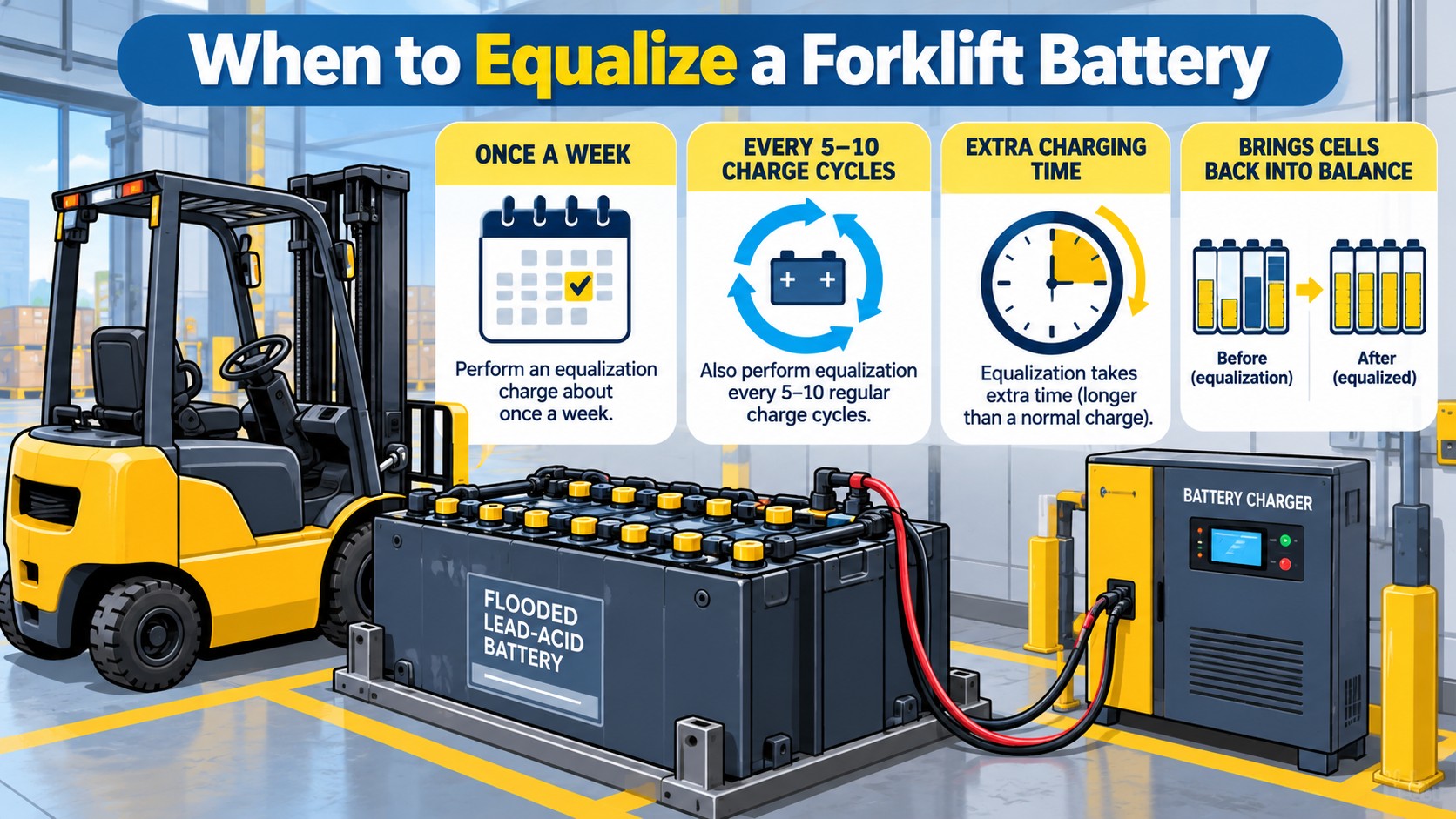
When to Equalize a Forklift Battery
For a flooded lead-acid forklift battery used in normal heavy-duty service, equalization is commonly scheduled once a week or approximately every 5 to 10 charging cycles. Light-use batteries may only need equalization every 2 to 3 weeks. Always follow the battery manufacturer's instructions because equalization frequency can vary by battery design and operating conditions.
Battery equalization is an important maintenance step for traditional flooded lead-acid forklift batteries. Over time, individual cells can develop differences in voltage and specific gravity, which may reduce available runtime and overall battery performance. A controlled equalization charge applies an extended charging cycle to help bring the cells back into balance. However, equalization is not appropriate for every battery chemistry, and lithium-ion batteries such as those offered by Hydrocell do not require this routine maintenance process.
What Is Forklift Battery Equalization?
Equalization is a controlled extended charge used primarily on flooded lead-acid batteries. Its purpose is to bring individual battery cells to a more uniform state of charge.
During normal use, some cells may charge or discharge slightly differently from others. Over multiple cycles, these differences can accumulate and lead to:
- Uneven cell voltage
- Differences in electrolyte specific gravity
- Reduced usable capacity
- Shorter forklift runtime
- Less consistent lifting or travel performance
An equalization cycle gives the weaker cells additional time to reach a fuller state of charge while helping reduce imbalance across the battery pack.
How Often Should You Equalize a Forklift Battery?
For a flooded lead-acid forklift battery used in demanding warehouse or industrial service, a common maintenance schedule is once per week or every 5 to 10 normal charging cycles.
| Operating Pattern | Typical Equalization Schedule |
|---|---|
| Heavy Daily Use | About once per week |
| Regular Cycling | Every 5 to 10 charging cycles |
| Light or Occasional Use | About every 2 to 3 weeks |
The exact interval should still be based on the battery manufacturer's recommendations, charger settings, usage intensity, and battery condition.
When Is the Best Time to Schedule Equalization?
Use Off-Peak Hours
Equalization takes longer than a standard recharge, so it should be scheduled when the forklift is not needed for normal production.
Good times include:
- Overnight
- Weekend downtime
- Planned maintenance periods
- Low-volume shifts
This prevents the equalization cycle from interfering with normal forklift availability.
Allow Extra Charging Time
Equalization can add approximately 3 to 5 hours to the normal charging process, depending on the battery and charger.
After charging, the battery also needs time to cool before returning to heavy service.
Do not schedule equalization immediately before a high-demand shift. Allow enough time for the extended charge and the required cooling period before the forklift goes back into service.
Signs Your Forklift Battery May Need Equalizing
A maintenance schedule is useful, but battery condition can also indicate when equalization is needed.
Voltage Differences Between Cells
If individual cell voltage readings vary by more than approximately 0.10 volts, the battery may be becoming unbalanced.
This difference suggests that some cells are reaching full charge earlier than others.
Specific Gravity Differences
For flooded lead-acid batteries, technicians can measure electrolyte specific gravity with a hydrometer.
If readings differ by more than approximately 0.030 between cells, equalization may help bring the battery back into better balance.
Reduced Forklift Runtime
If a forklift that previously completed a full shift now requires charging much earlier, uneven cell charging may be one possible cause.
However, reduced runtime can also result from:
- Battery aging
- Low electrolyte levels
- Damaged cells
- Loose electrical connections
- High forklift workload
Slower Lifting or Travel Performance
A battery with low or uneven voltage can cause a forklift to feel weaker as the shift progresses.
Operators may notice slower travel speed, weaker acceleration, or reduced hydraulic lifting performance.
How to Equalize a Flooded Lead-Acid Forklift Battery
- Park the forklift in the approved charging area.
- Turn the forklift off and follow normal battery charging procedures.
- Inspect the battery for damage, leaks, or excessively low electrolyte levels.
- Connect the compatible charger.
- Select the equalization function if the charger requires manual activation.
- Allow the normal charging cycle to finish.
- Allow the equalization stage to continue for the required additional time.
- Let the battery cool before inspection or heavy use.
- Check electrolyte levels after charging.
- Add distilled water if required.
Why Should Water Be Added After Equalization?
Water level management is especially important with flooded lead-acid batteries.
During charging and equalization, the electrolyte can expand and generate gas. If the battery is filled too high before charging, electrolyte may overflow.
For this reason, the preferred maintenance sequence is generally:
- Charge and equalize the battery.
- Allow it to cool.
- Check electrolyte levels.
- Add distilled water only as needed.
Do not overfill a flooded battery before equalization. Add distilled water after the battery has completed charging and cooled, unless electrolyte is so low that the plates are exposed before charging.
Which Batteries Should Never Be Equalized?
Equalization is designed mainly for flooded lead-acid batteries. It should not automatically be used with other battery types.
| Battery Type | Equalize? |
|---|---|
| Flooded Lead-Acid | Yes, when recommended |
| LiFePO4 Lithium | No |
| TPPL | Do not use a traditional flooded-battery equalization routine |
| Other Sealed Batteries | Follow manufacturer instructions |
Why Lithium Forklift Batteries Do Not Need Equalization
Lithium-ion batteries use a completely different charging and cell-management system from flooded lead-acid batteries.
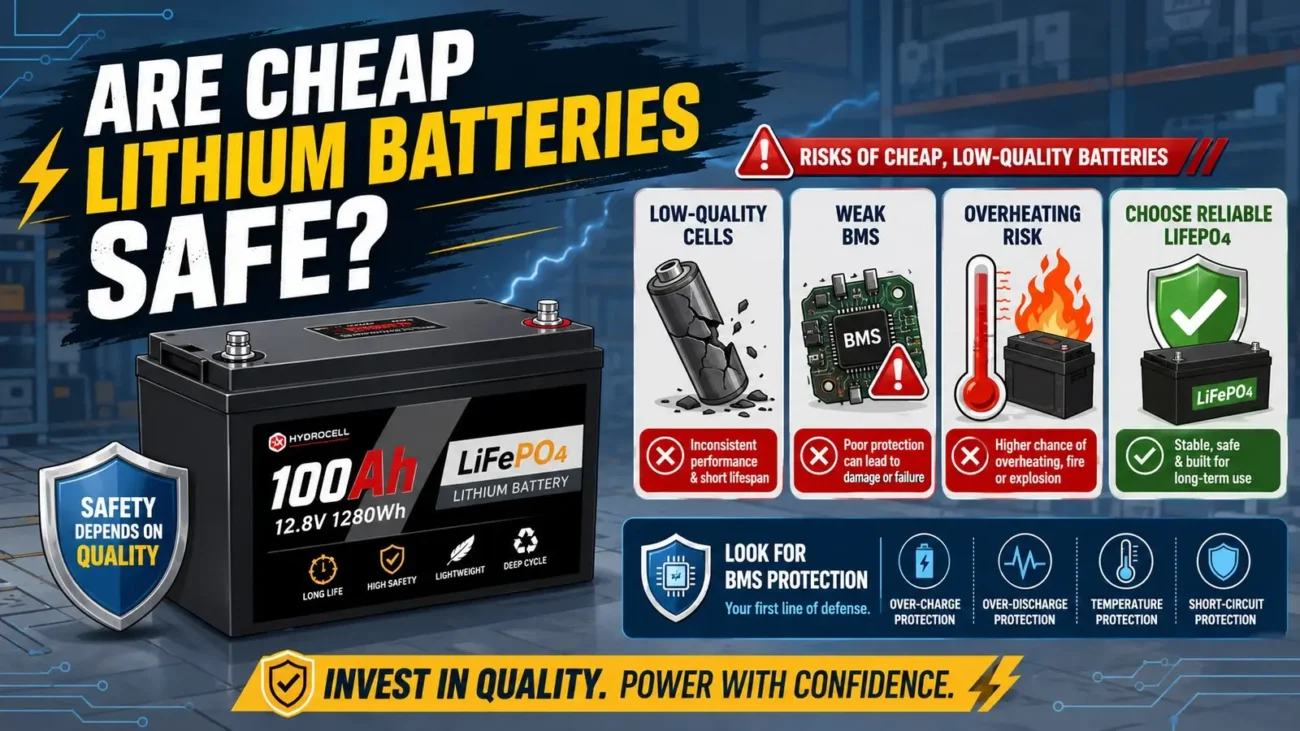
A LiFePO4 battery normally includes an integrated Battery Management System, or BMS, that monitors:
- Individual cell voltage
- Total pack voltage
- Charging current
- Discharge current
- Temperature
- Cell balance
The BMS manages cell balance electronically rather than relying on a traditional lead-acid equalization charge.
Applying a flooded lead-acid equalization profile to a lithium battery can be inappropriate and may trigger battery protection or cause damage.
Can You Avoid Forklift Battery Equalization?
Yes. If a business wants to reduce routine battery maintenance, switching from flooded lead-acid to LiFePO4 technology can eliminate the need for weekly equalization and battery watering.
Hydrocell provides LiFePO4 battery solutions for industrial applications, including electric forklifts.
Compared with flooded lead-acid batteries, lithium batteries can reduce several routine maintenance requirements.
| Maintenance Task | Flooded Lead-Acid | LiFePO4 |
|---|---|---|
| Routine Watering | Required | Not required |
| Equalization Charging | Required periodically | Not required |
| Specific Gravity Checks | Used for maintenance | Not applicable |
| Cell Management | Manual maintenance and charging | Managed electronically by BMS |
Advantages of Hydrocell LiFePO4 Forklift Batteries
For operations that want to reduce maintenance downtime, Hydrocell LiFePO4 batteries provide several practical benefits.
- No routine watering
- No traditional equalization charging
- Integrated BMS protection
- Fast charging capability
- Opportunity charging support
- Stable voltage during discharge
- Reduced routine maintenance
These characteristics can be particularly valuable for warehouses, manufacturing plants, distribution centers, and other operations where forklifts are used across multiple shifts.
If weekly equalization, watering, and specific-gravity checks are creating too much maintenance work, a LiFePO4 system from Hydrocell can eliminate traditional flooded-battery equalization requirements.
Common Equalization Mistakes
Avoid these common battery maintenance errors:
- Equalizing too frequently
- Equalizing a lithium battery
- Using the wrong charger
- Overfilling the battery before charging
- Skipping the cooling period
- Ignoring major voltage differences between cells
- Continuing to use a damaged battery
Equalization is a maintenance procedure, not a repair for severely damaged or failed cells.
Final Thoughts
So, when should you equalize a forklift battery? For a flooded lead-acid battery used in normal heavy-duty operation, a practical schedule is approximately once a week or every 5 to 10 charging cycles, while lightly used batteries may only need equalization every 2 to 3 weeks. Schedule the process during off-peak periods because it can add several hours to the normal charging cycle and requires additional cooling time. Watch for warning signs such as cell-voltage differences above about 0.10V, specific-gravity variation above approximately 0.030, reduced runtime, or weaker forklift performance. Most importantly, only use equalization on battery chemistries designed for it. Lithium-ion and LiFePO4 batteries should not receive traditional lead-acid equalization charges. For operations that want to eliminate watering, equalization, and other routine flooded-battery maintenance, Hydrocell LiFePO4 forklift batteries offer a lower-maintenance alternative with electronic BMS-based cell management.

Add a review
Your email address will not be published. Required fields are marked *