
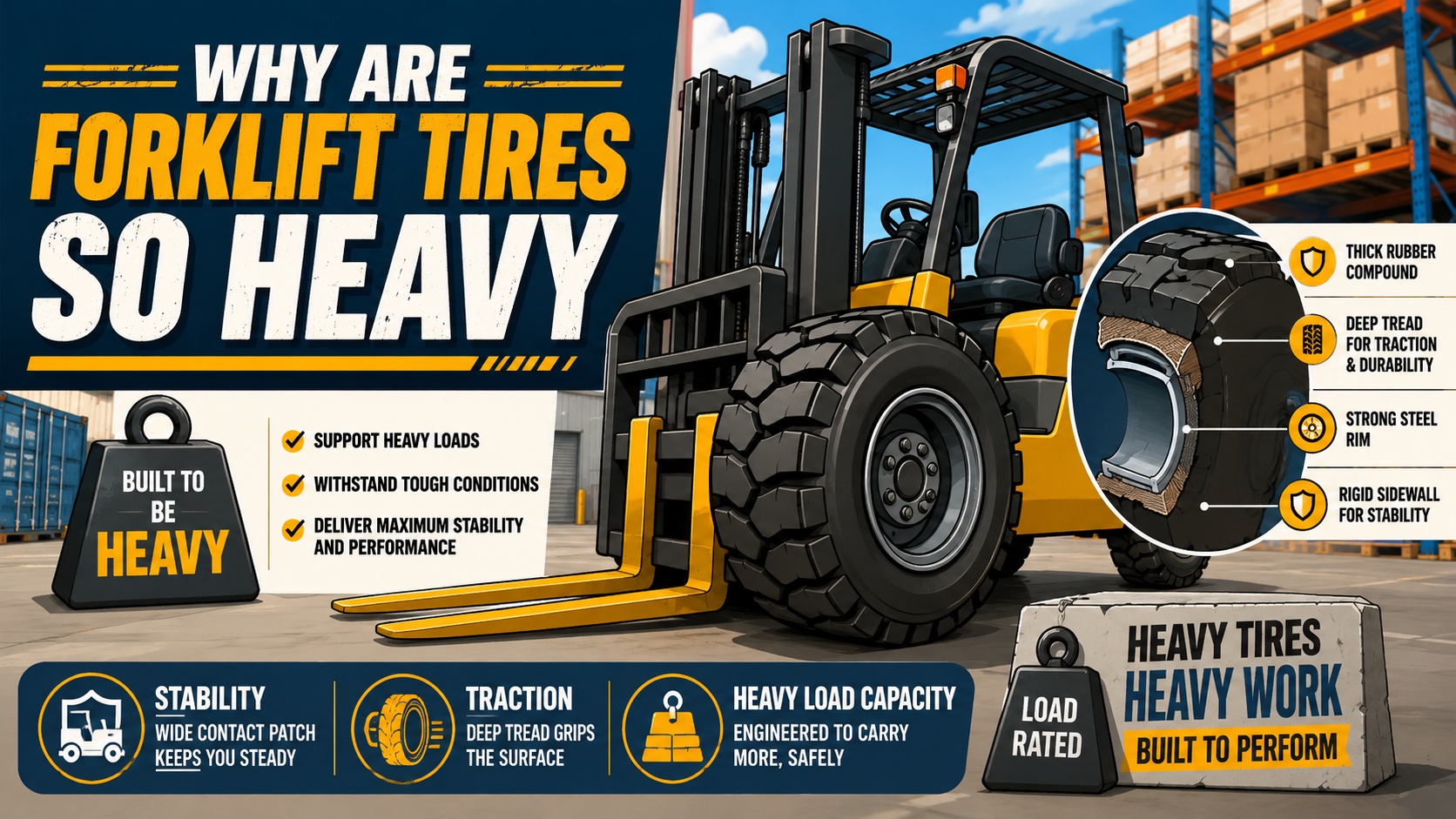
Why Are Forklift Tires So Heavy?
Quick Answer: Forklift tires are extremely heavy because they are designed to support massive loads, improve machine balance, absorb impact, and help prevent tipping. Unlike cars, most forklifts do not use traditional suspension systems, so the tire structure plays a major role in stability, traction, and load control.
Forklift tires are much heavier than most people expect. A single tire and rim assembly can weigh dozens or even hundreds of pounds, depending on the tire type, size, and forklift capacity. This weight is not accidental. Forklift tires are engineered as critical safety components that support the truck, the operator, the load, and the working environment.
Unlike passenger vehicles, forklifts are compact machines designed to lift heavy loads in tight areas. They must stay stable while carrying weight in front of the truck, turning in narrow aisles, braking on ramps, and working on demanding surfaces. Heavy tires help provide the strength, contact, and durability needed for this type of work.
Why Forklift Tires Are Built So Heavy
The main reason forklift tires are so heavy is that they must carry concentrated industrial loads. A forklift may lift thousands of pounds while the load is positioned in front of the machine. This creates stress on the tires, axles, mast, frame, and counterweight. Tires must be strong enough to support this stress without deforming, failing, or reducing stability.
Many forklift tires are made from dense rubber, reinforced compounds, steel bands, or heavy-duty rim systems. Solid tires are especially heavy because they contain thick rubber throughout the entire structure. Pneumatic tires may be lighter, but they are still reinforced to handle industrial load demands.
Important Note: Forklift tires are not just “wheels.” They are part of the forklift’s safety system, helping control balance, traction, shock, and load-bearing performance.
The Three Main Reasons Forklift Tires Are Heavy
1. Load-Bearing Capacity
Forklift tires must support the combined weight of the forklift, operator, battery or engine system, attachments, and load. In many applications, the tires are constantly exposed to heavy pressure during lifting, turning, loading, and stacking. A lightweight tire would not provide enough strength for this kind of work.
Dense rubber and reinforced construction help the tire resist compression, tearing, cracking, chunking, and heat buildup. This allows the forklift to carry heavy pallets, drums, containers, building materials, machinery parts, and industrial products safely.
2. Stability and Balance
Forklifts are designed around a stability triangle and counterweight system. Because the load is carried in front, the machine must remain balanced while moving, turning, and lifting. Heavy tires help keep the forklift planted and support steady contact with the ground.
Forklift tires also act as part of the machine’s shock control system. Since forklifts usually do not have car-style suspension, tire material helps absorb vibration and surface impact. This is especially important on rough warehouse floors, loading docks, outdoor yards, ramps, and uneven surfaces.
3. Traction and Grip
Forklift tires need enough weight and surface contact to grip the floor or ground. Traction affects braking, steering, turning, and load control. Heavy tire construction helps maintain contact with the surface, especially when the forklift is carrying a load or operating in high-traffic conditions.
Different tire designs provide different levels of grip. Cushion tires work well on smooth indoor floors, while pneumatic and solid pneumatic tires are better for outdoor surfaces. To understand those differences in more detail, read What Are the Differences in Tires on Forklifts.
How Tire Type Affects Weight
Not all forklift tires weigh the same. The tire type has a major impact on total weight, maintenance needs, ride comfort, and application suitability.
- Cushion tires: These are made from solid rubber pressed onto a steel band. They are compact and heavy for their size, making them useful for indoor forklifts on smooth concrete.
- Solid pneumatic tires: These are among the heaviest forklift tires because they are made from thick solid rubber and often mounted on heavy steel rims.
- Air-filled pneumatic tires: These are usually lighter than solid tires because they contain air, but they still use reinforced rubber and heavy-duty construction.
- Foam-filled pneumatic tires: These tires are filled with foam to reduce puncture risk, making them heavier than standard air-filled tires but often more durable in rugged environments.
Pro Tip: Heavier does not always mean better. The best forklift tire is the one that matches the forklift design, load rating, surface condition, and daily duty cycle.
How Many Hours Do Forklift Tires Last?
Forklift tire lifespan depends on tire type, surface condition, operating hours, load weight, driving habits, and maintenance quality. A forklift used on smooth indoor floors may get much longer tire life than one used outdoors on debris, gravel, ramps, or rough pavement.
Solid Tires: On average, solid forklift tires can last anywhere from 5,000 to 10,000 hours of operation. Proper maintenance, clean floors, correct load handling, and conservative driving can help extend service life.
Pneumatic Tires: Pneumatic forklift tires typically have a shorter lifespan, often ranging from 2,000 to 5,000 hours of operation. Their life can be reduced by punctures, low air pressure, rough ground, overloading, or aggressive driving.
Maintenance Reminder: Replace forklift tires when they reach the wear line, show chunking, cracking, flat spots, deep cuts, exposed material, or signs of separation from the rim or base.
Why Heavy Tires Matter for Safety
Heavy forklift tires help protect safety in several ways. They support the load, reduce instability, maintain traction, and help absorb shock. If tires are too worn, damaged, mismatched, or incorrectly selected, the forklift may become harder to steer, slower to stop, and less stable during turns or lifting.
Operators should inspect tires before each shift. This includes checking for cuts, missing rubber, embedded debris, uneven wear, flat spots, rim damage, and sidewall problems. Even solid tires that cannot go flat still need regular inspection and replacement.
Step-by-Step: How to Manage Forklift Tire Safety
- Check the tire type: Confirm whether the forklift uses cushion, solid pneumatic, air-filled pneumatic, or foam-filled tires.
- Read the data plate: Make sure tire size and load rating match the forklift manufacturer’s specifications.
- Inspect before each shift: Look for wear, cracks, chunking, flat spots, punctures, and rim damage.
- Match tires to the surface: Use indoor tires for smooth floors and rugged tires for outdoor or uneven surfaces.
- Avoid overloading: Excess weight increases tire stress and can reduce stability.
- Replace tires on time: Do not wait until tire failure. Schedule replacement when wear indicators or damage appear.
What Are the Differences in Tires on Forklifts?
The main differences between forklift tires come down to construction, surface use, puncture resistance, ride comfort, and stability. Cushion tires are compact and ideal for indoor smooth floors. Air-filled pneumatic tires provide cushioning and traction outdoors. Solid pneumatic tires offer durability and puncture resistance for rugged or debris-heavy environments.
For a deeper comparison of tire types, applications, and selection tips, visit What Are the Differences in Tires on Forklifts.
Conclusion
Forklift tires are heavy because they must support massive loads, maintain stability, provide traction, and absorb impact without traditional suspension. Their dense rubber, reinforced construction, and heavy rim systems are essential for safe material handling.
Whether your forklift uses cushion, pneumatic, solid pneumatic, or foam-filled tires, the key is choosing the right tire for the job and maintaining it properly. Heavy tires are not a design flaw; they are one of the reasons forklifts can lift, carry, and move industrial loads safely.
Add a review
Your email address will not be published. Required fields are marked *