
Are Forklift Levers Different on All Forklifts?
Understanding whether forklift levers are different across all machines is important for operator safety, training efficiency, and OSHA compliance. While many operators assume every machine is unique, most modern forklifts share a standardized control layout. This is especially true for widely used industrial equipment such as Liftron forklifts, which follow industry-standard hydraulic control systems.
The Standard Forklift Lever Layout
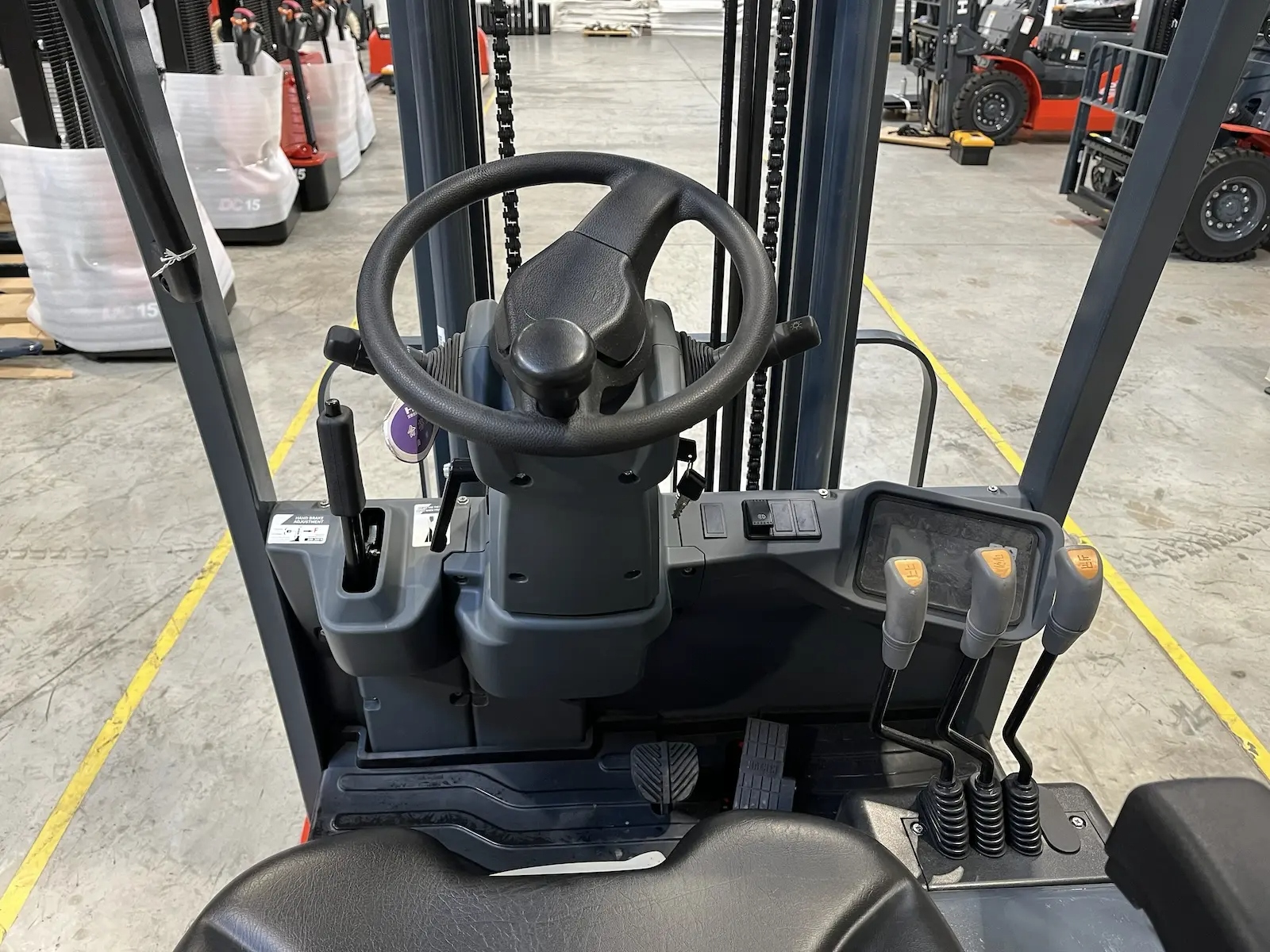
Most sit-down counterbalance forklifts—whether electric or internal combustion—use a standard three-lever hydraulic system located to the right of the operator seat.
1. Lift Control Lever
This lever controls vertical movement. Pulling it back raises the forks, while pushing it forward lowers them.
2. Tilt Control Lever
This lever tilts the mast forward or backward. Tilting back secures loads, while tilting forward prepares for unloading.
3. Auxiliary / Side-Shift Lever
This controls lateral movement of the fork carriage, allowing precise alignment without moving the forklift itself.
Modern Liftron forklifts often use similar layouts, making it easier for operators to switch between models with minimal retraining.
Where Forklift Controls Differ
Special Attachments
Forklifts equipped with clamps, rotators, or fork positioners may include extra levers or buttons for specialized functions.
Stand-Up and Reach Trucks
These machines often replace multiple levers with a single joystick system that controls lifting, lowering, tilting, and sometimes driving functions.
Directional Controls
Some forklifts use a steering-column-mounted directional lever, while others use thumb switches or electronic controls for forward and reverse movement.
Comparison Table: Forklift Control Types
| Forklift Type | Control System | Complexity Level |
|---|---|---|
| Sit-Down Counterbalance | 3 hydraulic levers | Standard |
| Reach Trucks | Joystick control | Advanced |
| Stand-Up Forklifts | Electronic joystick + switches | Advanced |
| Specialty Forklifts | Extra levers/buttons | Variable |
Step-by-Step: How to Understand Forklift Controls
- Identify forklift type before operation
- Locate hydraulic control system
- Test lift, tilt, and side-shift functions
- Confirm directional controls (lever or switch)
- Practice movements in a safe, open area
Why Standardization Matters
Standardized controls reduce training time and improve safety across different workplaces. Operators trained on one machine can quickly adapt to others, especially when using common equipment such as Liftron forklifts.
However, even with standardization, small differences in responsiveness, sensitivity, and layout require careful attention during initial operation.
Key Safety Rules for Using Forklift Levers
- Always sit properly before operating controls
- Never move levers abruptly
- Keep hands steady during lifting operations
- Confirm load stability before tilting
- Follow OSHA-certified training procedures
Conclusion
Forklift levers are mostly standardized across the industry, but variations exist depending on forklift type and application. Understanding these differences is essential for safe and efficient operation.
Whether operating a basic warehouse model or advanced equipment like Liftron forklifts, proper training ensures operators can handle all control systems safely and confidently.


Add a review
Your email address will not be published. Required fields are marked *