
are forklift batteries isolated from chassis
Yes, forklift batteries are isolated from the chassis in virtually all modern electric forklifts, using rubber mounts, insulated trays, and non-conductive barriers to prevent current leakage, corrosion, and electrical shorts. This isolation is critical for operator safety, component longevity, and compliance with ANSI/OSHA standards. Below, we examine why this design exists, how it works, and what fleet managers should check during maintenance.
Why Battery-to-Chassis Isolation Matters
Electric forklifts operate on low-voltage DC systems (typically 24V, 36V, or 48V/80V), but even these voltages can create dangerous stray currents if the battery circuit accidentally completes through the truck frame. Isolation prevents the chassis from becoming a return path for current, which would cause electrolytic corrosion of bearings, hydraulic lines, and structural welds. Moreover, a short to the chassis can ignite hydrogen gas emitted during charging, posing an explosion risk. By isolating the battery, the electrical system remains a closed loop, and the frame stays at a neutral potential.
Primary Isolation Methods in Forklift Design
1. Rubber and Polyurethane Mounting Pads
Battery compartments are fitted with thick, oil-resistant rubber or polyurethane pads at the bottom corners and side rails. These pads absorb vibration and impact while providing a high dielectric barrier. Typical resistance exceeds 1 megohm between the battery terminals and the chassis, which is well above the minimum 500,000 ohms recommended by industry guidelines.
2. Insulated Battery Trays and Liners
Many forklifts use a steel tray coated with epoxy or lined with a non-conductive plastic sheet. This double-layer approach ensures that even if the battery case cracks or a terminal loosens, the tray does not become conductive. Some trays have drainage holes that channel any electrolyte spill into a contained sump, away from the chassis.
3. Non-Conductive Connectors and Cable Boots
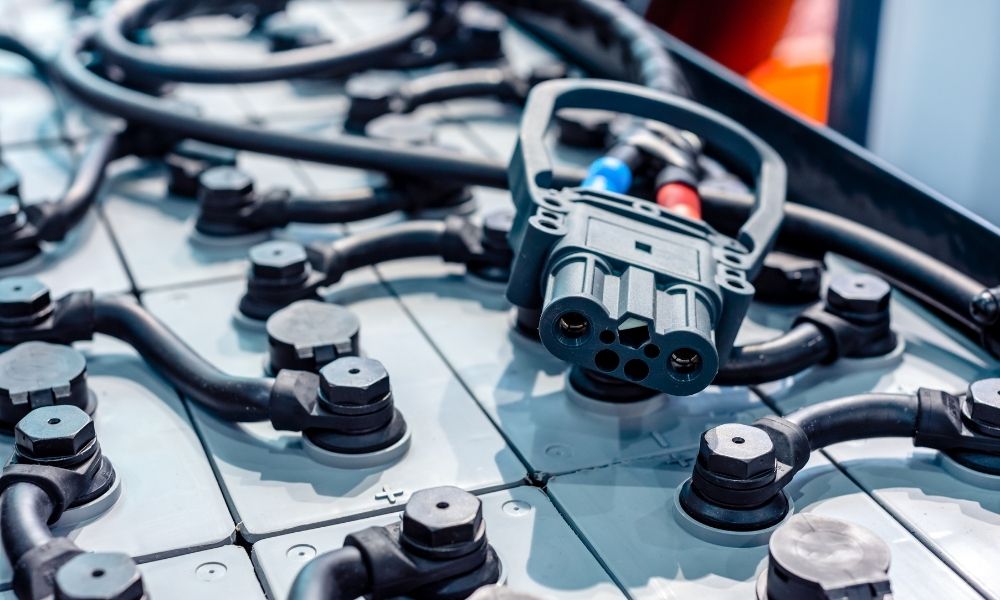
The heavy-gauge cables connecting the battery to the motor controller are routed through insulating grommets and secured with non-metallic clamps. Quick-disconnect plugs feature molded plastic housings with recessed pins. These components prevent accidental contact with metal surfaces and maintain isolation even during plugging and unplugging.
4. Paint and Powder Coating as a Secondary Barrier
Even with mounting pads, the battery compartment itself is often powder-coated or painted with an insulating epoxy. This adds an extra layer of resistance, especially in areas where moisture and salt residue can accumulate, reducing the risk of surface creepage currents.
How Is Isolation Tested and Verified
Per OSHA 1910.178 and ANSI/ITSDF B56.1, forklifts must undergo a continuity test during routine inspections. A megohmmeter applies 500V DC between the battery positive terminal and the chassis, measuring insulation resistance. A reading below 0.5 megohm triggers a lockout for service. Additionally, a ground-fault monitoring system on some AC-drive forklifts continuously measures leakage current while the truck operates, alerting the driver if isolation degrades.
For lithium-ion upgrades, such as those offered by Liftron Material Handling, the isolation design is factory-tested under full load and thermal cycling. Their proprietary battery management systems (BMS) incorporate an extra isolation monitoring feature that detects even slight insulation breakdowns before they become critical.
Consequences of Isolation Failure
- Chassis corrosion: Stray current accelerates galvanic corrosion on steel frames, reducing structural life.
- Bearing damage: Motors, gearboxes, and wheel bearings suffer fluting or pitting when current passes through them.
- Operator shock hazard: While 48V is below lethal thresholds in dry conditions, wet floors or damaged gloves can make contact dangerous.
- Hydraulic fluid contamination: Electrolysis can break down seals and allow metal particles into the hydraulic system.
- Fire or explosion risk: Arcing can ignite hydrogen gas emitted during charging, especially in poorly ventilated areas.
Maintenance Best Practices to Preserve Isolation
Daily Checks
- Inspect rubber mounts for cracks or compression set (flattening).
- Look for electrolyte residue around the battery base – clean any moisture with a baking soda solution.
- Verify that cable boots and grommets are not torn or missing.
Monthly Inspections
- Measure insulation resistance with a megohmmeter using the truck’s specified test procedure.
- Check torque on battery compartment mounting bolts to ensure the battery is not shifting and pinching wires.
- Examine the battery tray for rust or coating degradation – touch up with insulating paint if needed.
After Any Collision or Battery Replacement
- Re-test isolation immediately. Even a minor bump can crack a rubber mount or loosen a ground strap.
- Verify that replacement batteries are the correct size and have the same insulation requirements as the OEM spec.
Lithium-Ion vs. Lead-Acid Isolation Differences
| Parameter | Lead-Acid (Wet Cell) | Lithium-Ion (e.g., Liftron DL SERIES) |
|---|---|---|
| Mounting design | Rubber pads on steel tray | Integrated composite baseplate with vibration-damping feet |
| Electrolyte leakage risk | High – acid spills require neutralization | Low – solid-state cells with sealed enclosures |
| Insulation resistance monitoring | Manual megohmmeter test | Continuous BMS monitoring, automatic disconnection at 0.3 megohm |
| Typical chassis isolation resistance | 0.5–2 megohm | 5+ megohm (factory tested) |
| Maintenance frequency | Weekly visual, monthly electrical test | Monthly visual, quarterly electrical test |
For fleets converting to lithium power, the Liftron DL SERIES offers a pre-isolated battery cassette that drops directly into existing compartments without modifying the truck frame. Its reinforced polymer housing and shielded busbars exceed OEM isolation requirements, reducing downtime for testing.
Common Myths About Forklift Battery Isolation
Myth 1: “The negative terminal is connected to the chassis anyway, so isolation is pointless.” That is false – only the charger’s negative may be bonded in some designs, but the truck’s operating system floats relative to ground. The battery itself is never chassis-grounded during normal operation.
Myth 2: “Rubber mounts only dampen vibration.” While they do absorb shock, their primary electrical function is to break the conductive path. Using metal shims or replacing rubber with hard plastic can negate isolation.
Myth 3: “New forklifts don’t need isolation testing.” Even new units can have manufacturing defects – a loose bolt on the battery top plate can bridge the terminal to the hold-down bracket. Always perform a baseline test on arrival.
Regulatory and Insurance Implications
Failure to maintain battery isolation is a common finding in workplace safety audits. OSHA citations under 1910.178(g) often reference unprotected battery terminals or missing insulating covers. Additionally, insurance underwriters may require documented isolation test records for equipment breakdown coverage. A single electrolyte-induced frame leak can cost thousands in repair and downtime – far more than a simple $20 rubber pad replacement.
Final Takeaway for Fleet Managers
Battery isolation is not an optional feature; it is a fundamental safety and reliability requirement. While all major forklift brands – Toyota, Crown, Hyster, Yale – adhere to isolation standards, the actual degree of protection depends on maintenance quality. Use a calibrated megohmmeter, keep spare rubber mounts on hand, and train operators to report any unusual shocks or corrosion. For older trucks, retrofitting with a modern insulated battery tray and a Liftron Material Handling lithium battery system can significantly improve grounding integrity and reduce long-term maintenance costs. Always consult your truck’s service manual for specific isolation values, and if in doubt, schedule a professional electrical safety inspection.

Add a review
Your email address will not be published. Required fields are marked *