
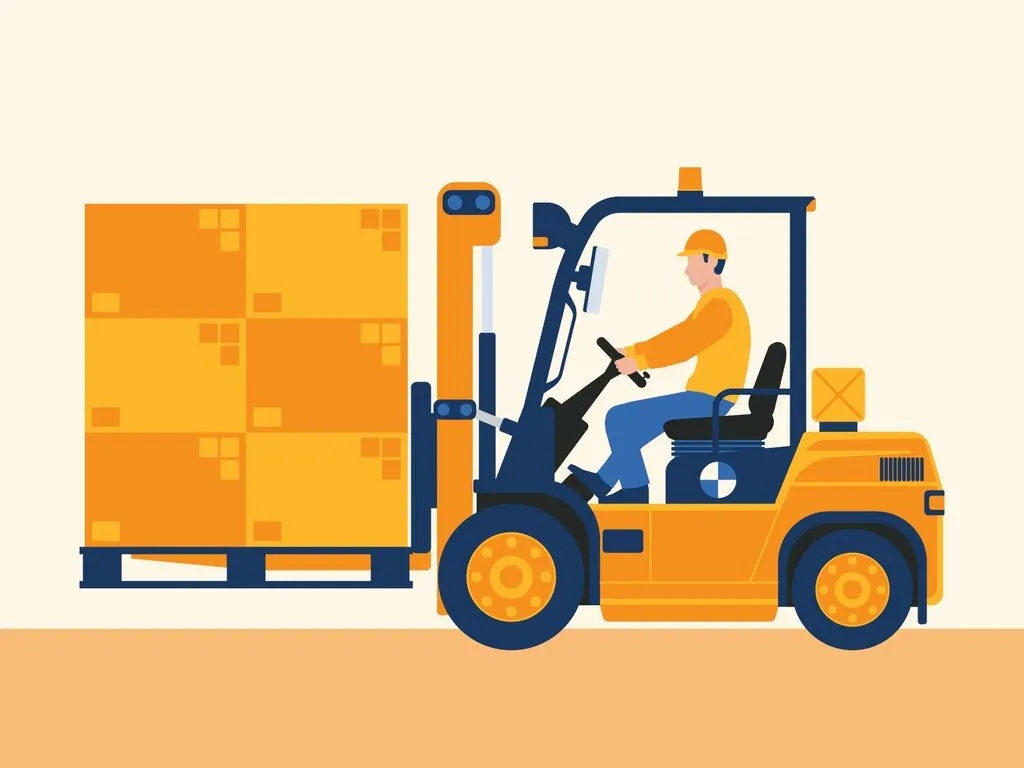
Where Must a Forklift’s Center of Gravity Remain?
Understanding where a forklift’s center of gravity must remain is essential for safe industrial operation, OSHA compliance, and preventing serious workplace accidents. The stability of any forklift depends entirely on whether its combined center of gravity stays within the defined stability triangle during operation.
What Is the Stability Triangle?
The stability triangle is an invisible geometric area that determines forklift balance. All safe forklift operation depends on keeping the center of gravity within this triangle while moving, lifting, or turning.
Modern industrial forklift systems are engineered to maintain stability, but operator behavior plays the most important role in preventing accidents.
Why the Center of Gravity Changes
1. Raising Loads
When a load is lifted, the center of gravity moves upward, reducing stability and increasing the risk of tipping.
2. Turning or Sudden Movement
Sharp turns or sudden braking shift the center of gravity sideways or forward due to inertia.
3. Uneven Surfaces
Slopes, ramps, and rough terrain shift the balance point toward the edges of the stability triangle.
What Happens If the Center of Gravity Moves Outside the Triangle?
If a forklift’s center of gravity moves outside the stability triangle, the machine will tip over. This is one of the most common and dangerous causes of forklift accidents in warehouses and construction sites.
To reduce risk, operators must follow strict safety procedures when using equipment such as modern forklift systems.
Forklift Stability Factors Table
| Factor | Effect on Center of Gravity | Risk Level |
|---|---|---|
| Load Height | Raises center of gravity | High |
| Turning Speed | Shifts balance sideways | High |
| Uneven Ground | Tilts stability triangle | Medium–High |
| Sudden Stops | Moves weight forward | High |
Step-by-Step Safety Guidelines
- Keep loads low when traveling
- Drive slowly and avoid sharp turns
- Inspect surfaces before operation
- Never exceed load capacity
- Maintain proper training and certification
OSHA Safety Principle
OSHA regulations require that forklift operators maintain full control of the machine and ensure that the combined center of gravity remains within the stability triangle at all times.
Proper training on modern forklift equipment helps operators understand how balance shifts during real-world operations.
Why Stability Matters
Forklift stability is not just a design feature—it is a safety system. Even small changes in load position, speed, or terrain can drastically affect balance and increase accident risk.
Conclusion
A forklift’s center of gravity must always remain within the stability triangle to ensure safe operation. Understanding how loads, movement, and terrain affect stability is essential for preventing accidents.
With proper training and safe operation of industrial forklift systems, operators can maintain full control and reduce workplace risks significantly.


Add a review
Your email address will not be published. Required fields are marked *