
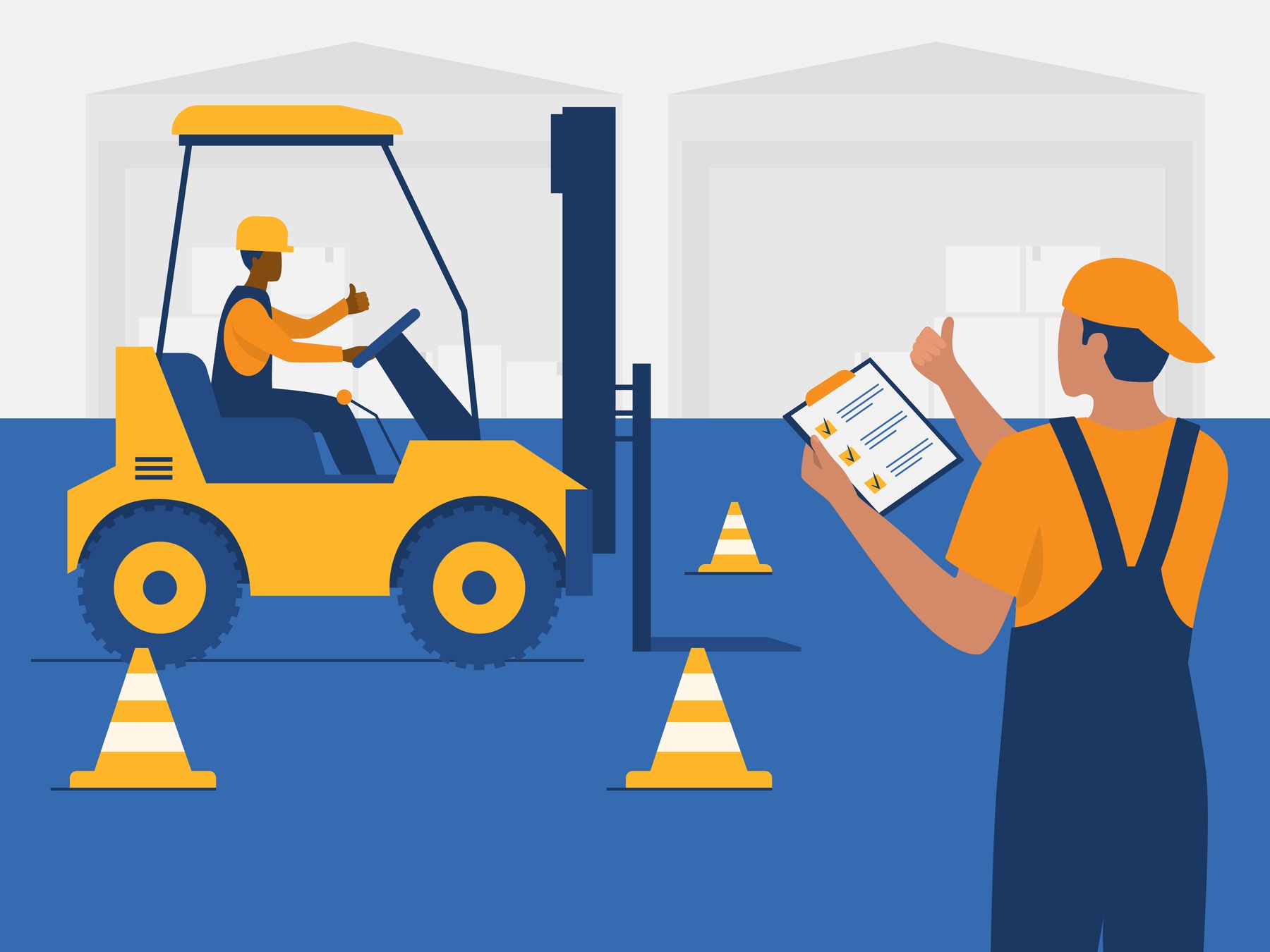
When Should You Drive a Forklift in Reverse?
When Should You Drive a Forklift in Reverse?
A forklift should be driven in reverse whenever reverse travel provides the safest view, better control, or proper load position. The most common reason is blocked forward visibility. If a pallet, crate, container, or bulky material prevents the operator from seeing the direction of travel, the forklift should travel backward with the load trailing.
This does not mean operators should reverse casually or at high speed. Reverse driving still requires full attention, a clear path, controlled speed, horn use where needed, and constant awareness of pedestrians, racks, doors, dock edges, trailers, and other equipment.
Forklifts are different from cars. They steer from the rear, carry heavy loads at the front, and have changing visibility depending on the mast, load height, and workplace layout. Because of this, operators must choose the travel direction that gives the safest view and load stability.
When Should You Drive a Forklift in Reverse OSHA?
Under OSHA forklift travel rules, if the load being carried obstructs the operator’s forward view, the operator must travel with the load trailing. In practical warehouse terms, this means driving in reverse when a tall, wide, or bulky load blocks the path ahead.
OSHA also requires operators to look in the direction of travel and slow down and sound the horn at cross aisles and locations where vision is obstructed. These rules apply whether the forklift is moving forward or backward.
| Situation | Should You Reverse? | Reason |
|---|---|---|
| Forward view blocked by load | Yes | Operator must be able to see the travel path |
| Backing out after placing a pallet | Yes | Forklift must clear the rack or stack safely |
| Driving down a ramp with a load | Usually yes | The load should face uphill to reduce sliding or spilling risk |
| Driving up a ramp without a load | Often yes | Forks should usually point downgrade when empty |
| Clear forward view on level ground | Usually no | Forward travel may provide better control and awareness |
1. Drive in Reverse When the Load Blocks Your View
The most important time to reverse a forklift is when the forward view is blocked. A load that is too high, too wide, or too bulky can prevent the operator from seeing pedestrians, racks, pallets, floor hazards, dock edges, or other vehicles.
In that situation, the safe choice is to travel backward with the load trailing. The operator should turn their head and upper body to look in the direction of travel, check mirrors when available, use the horn when approaching intersections, and move at a controlled speed.
Examples of Loads That May Require Reverse Travel
- Tall pallet stacks
- Large appliance crates
- Oversized cartons
- Wrapped loads blocking mast visibility
- Wide containers
- Bulky warehouse inventory
- Loads that block the operator’s direct line of sight
2. Drive in Reverse When Traveling Down a Ramp With a Load
When operating on ramps or inclines, load position is critical. The general rule is to keep the load upgrade. This helps prevent the load from sliding, spilling, or pulling the forklift forward.
When a forklift is carrying a load down a ramp, keeping the load upgrade usually means driving in reverse. The forks and load should face uphill, while the forklift backs down the incline slowly and under control.
3. Drive in Reverse When Backing Out of Racks or Stacks
After picking up, placing, or removing a load from a rack, trailer, or stack, the operator often needs to reverse to clear the structure. This must be done carefully because racks, pallets, and nearby workers may be close to the forklift.
Before backing out, lower the forks or load to a safe travel height, tilt back slightly if carrying a load, check both sides, and look in the direction of travel. Do not rely only on mirrors or backup alarms.
4. Drive in Reverse in Tight Spaces When Forward Maneuvering Is Restricted
Some warehouse layouts require reverse maneuvering because forward movement is too restricted. Examples include narrow aisles, tight dock staging areas, trailer interiors, production cells, and crowded storage zones.
Reverse travel may allow the operator to reposition safely, but it should be done slowly. Operators must avoid sudden steering, sharp turns, and quick acceleration because forklifts can swing wide at the rear.
In What Circumstances Should You Drive a Forklift in Reverse on an Incline?
On an incline, the main principle is load stability. The load should face uphill. This reduces the chance of the load sliding off the forks and helps maintain better stability.
| Incline Situation | Correct Travel Direction | Why |
|---|---|---|
| Driving up a ramp with a load | Forward, load uphill | Keeps load against the backrest and reduces sliding risk |
| Driving down a ramp with a load | Reverse, load uphill | Prevents load from moving away from the carriage |
| Driving up a ramp without a load | Often reverse, forks downgrade | Maintains stable travel position for empty forks |
| Driving down a ramp without a load | Often forward, forks downgrade | Keeps empty forks pointed downhill |
| Turning on a ramp | Do not turn on the ramp | Turning on inclines increases tip-over risk |
Safe Reverse Driving Checklist
Driving in reverse requires more than shifting into reverse gear. The operator must confirm the path is clear and remain fully aware of the direction of travel.
- Lower the load close to the floor before traveling.
- Tilt the mast back slightly to stabilize the load.
- Look over your shoulder in the direction of travel.
- Check mirrors, but do not rely on mirrors alone.
- Sound the horn before backing near intersections, doors, or blind spots.
- Make sure pedestrians are clear of the travel path.
- Drive slowly and avoid sudden steering.
- Keep the load stable and centered.
- Stop if visibility becomes unclear.
- Use a spotter if the work area is crowded or visibility is limited.
How Low Should the Load Be When Reversing?
Before reversing, the load should be lowered as close to the floor as practical while still maintaining safe ground clearance. A common safe travel position is low enough to improve stability but high enough to avoid floor contact, ramp edges, or surface obstacles.
Traveling with the load raised is dangerous because it raises the center of gravity and increases tip-over risk. This is especially important when reversing, turning, or moving on uneven surfaces.
Common Reverse Driving Mistakes
- Backing up without looking in the direction of travel
- Relying only on a backup alarm
- Driving too fast in reverse
- Reversing with a raised load
- Turning sharply while backing
- Backing down ramps with the load facing downhill
- Forgetting to sound the horn at blind intersections
- Assuming pedestrians can hear or see the forklift
Forward vs Reverse Forklift Travel
| Travel Direction | Best Used When | Key Safety Rule |
|---|---|---|
| Forward | Path is visible and load is stable | Keep speed controlled and watch for pedestrians |
| Reverse | Load blocks forward view | Look in the direction of travel |
| Forward up ramp with load | Carrying a load uphill | Keep load uphill |
| Reverse down ramp with load | Carrying a load downhill | Keep load uphill |
| Reverse from rack | Clearing a pallet position | Check both sides before backing out |
Do Backup Alarms Replace Looking Behind You?
No. Backup alarms, lights, cameras, and mirrors are helpful warning tools, but they do not replace looking in the direction of travel. The operator remains responsible for confirming that the travel path is clear.
In noisy warehouses, pedestrians may not hear a backup alarm. In busy dock areas, workers may not notice a flashing light. That is why operators must slow down, look, sound the horn, and stop if the path is uncertain.
Training Tips for Reverse Forklift Operation
Operators should practice reverse driving in a controlled area before working in busy warehouse zones. Training should include reversing with and without a load, backing out of simulated racks, using mirrors correctly, checking blind spots, and operating near intersections.
Employers should also train operators on site-specific hazards such as dock doors, pedestrian walkways, rack layouts, ramp grades, trailer interiors, and one-way traffic routes.
Conclusion
You should drive a forklift in reverse when the load blocks forward visibility, when backing out of racks or trailers, when tight spaces require it, and when ramp travel requires the load to remain uphill.
For OSHA-compliant operation, forklift operators must look in the direction of travel, travel with the load trailing when forward visibility is obstructed, and handle ramps with the load facing uphill. Safe reverse operation on forklifts depends on low travel height, slow speed, clear visibility, horn use, and proper operator training.


Add a review
Your email address will not be published. Required fields are marked *