
What Type of Suspension Do Forklifts Have?
When people ask, “What type of suspension do forklifts have?” they often expect the answer to be similar to a car, truck, or SUV. However, forklifts are built for a very different purpose. A passenger vehicle is designed for ride comfort, speed, and road handling. A forklift is designed to lift, carry, stack, and move heavy loads in a controlled work environment. Because of this, most forklifts do not use traditional automotive suspension systems with coil springs, leaf springs, and shock absorbers.
Instead, forklifts typically rely on a three-point suspension system, solid axles, rigid frame construction, and tire-based cushioning to maintain stability. This design helps keep the forklift’s center of gravity predictable while lifting and transporting heavy materials. In material handling, stability is usually more important than ride softness. A forklift that feels too “springy” could become less stable when carrying a raised or heavy load.
Understanding forklift suspension is important for warehouse managers, forklift operators, fleet buyers, maintenance teams, and safety trainers. The type of suspension or stability system a forklift uses can affect load handling, operator comfort, tire selection, maintenance needs, and the type of work environment where the truck performs best.
Do Forklifts Have Suspension?
Yes, forklifts have a form of suspension, but it is not usually the same type found in cars. Most forklifts use a three-point suspension or stability system. This means the truck is supported in a triangular pattern, usually with two front load wheels and a pivot point at the rear axle. The rear axle can often pivot slightly, allowing the forklift to travel over small floor irregularities while maintaining contact with the ground.
This three-point design creates what is commonly known as the forklift stability triangle. As long as the combined center of gravity of the forklift and its load stays inside this triangle, the forklift remains stable. If the center of gravity moves outside the triangle because of overloading, sharp turns, high travel speed, uneven ground, or a raised load, the forklift may tip over.
Because forklifts regularly handle loads weighing thousands of pounds, their suspension system must support controlled movement rather than soft comfort. A car-style suspension would allow too much body roll and weight transfer, which could reduce the forklift’s ability to safely carry loads.
Unlike Cars, Forklifts Prioritize Load Stability
Unlike cars, most forklifts do not use traditional springs or shock absorbers. Instead, they rely on a three-point suspension system and solid axles designed specifically to maximize load stability. The front axle is usually rigid because it carries most of the load weight. The mast, forks, carriage, and load all place significant stress on the front of the forklift.
The rear axle, which is used for steering on many forklifts, is often mounted in a way that allows limited pivoting. This gives the forklift enough movement to stay in contact with the floor while still maintaining a stable structure. The result is a machine that may feel firmer than a road vehicle but is better suited for lifting pallets, containers, equipment, and warehouse inventory.
This is also why forklift operators are trained to slow down during turns, keep loads low while traveling, avoid uneven surfaces when possible, and never exceed the rated capacity shown on the data plate. Suspension design and safe operation work together. Even a well-designed forklift can become unstable if it is overloaded or operated carelessly.
Main Types of Forklift Suspension and Stability Systems
Forklift suspensions vary depending on the environment in which the truck is used. Indoor warehouse forklifts, outdoor yard forklifts, rough-terrain forklifts, electric forklifts, and heavy-duty industrial forklifts may use different combinations of rigid frames, tire types, axle designs, and operator comfort systems.
1. Solid or Rigid Suspension
A solid or rigid suspension setup is common on many standard forklifts. In this type of design, the frame and axle structure are built to reduce movement and increase stability. The forklift does not bounce like a car because excessive suspension travel could make load handling unsafe.
Rigid suspension is especially useful in warehouses, manufacturing plants, storage facilities, and distribution centers with smooth concrete floors. These environments do not require a soft ride over rough terrain. Instead, they require precise control, tight turning, predictable braking, and stable lifting.
Many cushion tire forklifts use this type of rigid design. The tire itself provides some shock absorption, but the truck’s structure remains firm. This helps operators place pallets accurately on racks, load trailers efficiently, and work safely in narrow aisles.
2. Cushion and Pneumatic Tire Support
Forklift tires play a major role in how the truck feels during operation. While tires are not suspension in the traditional automotive sense, they help absorb vibration and impact from the floor or ground surface.
Cushion tires are typically made from solid rubber and are best suited for indoor use on smooth floors. They provide a compact turning radius and are common on warehouse forklifts. Cushion tires offer limited shock absorption but provide excellent stability on flat surfaces.
Pneumatic tires are larger and may be air-filled or solid pneumatic. They are commonly used for outdoor applications, rougher surfaces, gravel yards, construction areas, lumber yards, and loading zones. Pneumatic tires provide more ground clearance and better impact absorption than cushion tires. This makes them better for uneven surfaces, although operators still need to be careful because forklifts are not designed for high-speed rough-terrain driving unless specifically built for that purpose.
Solid pneumatic tires combine puncture resistance with a larger profile. They are often used where durability is important but where the worksite still requires better surface handling than a standard cushion tire can provide.
3. Operator Compartment Suspension
Although most forklifts do not use full vehicle suspension like cars, many modern forklifts improve comfort through the operator compartment. This may include a suspension seat, rubber floor mat, vibration-dampening mounts, ergonomic controls, adjustable steering column, and improved cabin layout.
A suspension seat is one of the most common comfort features. It helps reduce the impact of vibration on the operator during long shifts. This is especially helpful in facilities where the forklift travels across dock plates, expansion joints, uneven concrete, or outdoor pavement.
Operator comfort matters because fatigue can affect safety and productivity. A forklift with a firm chassis can still be comfortable to operate if the seat, controls, visibility, and ergonomics are well designed. This is why many buyers evaluate not only lift capacity and battery type, but also operator comfort features.
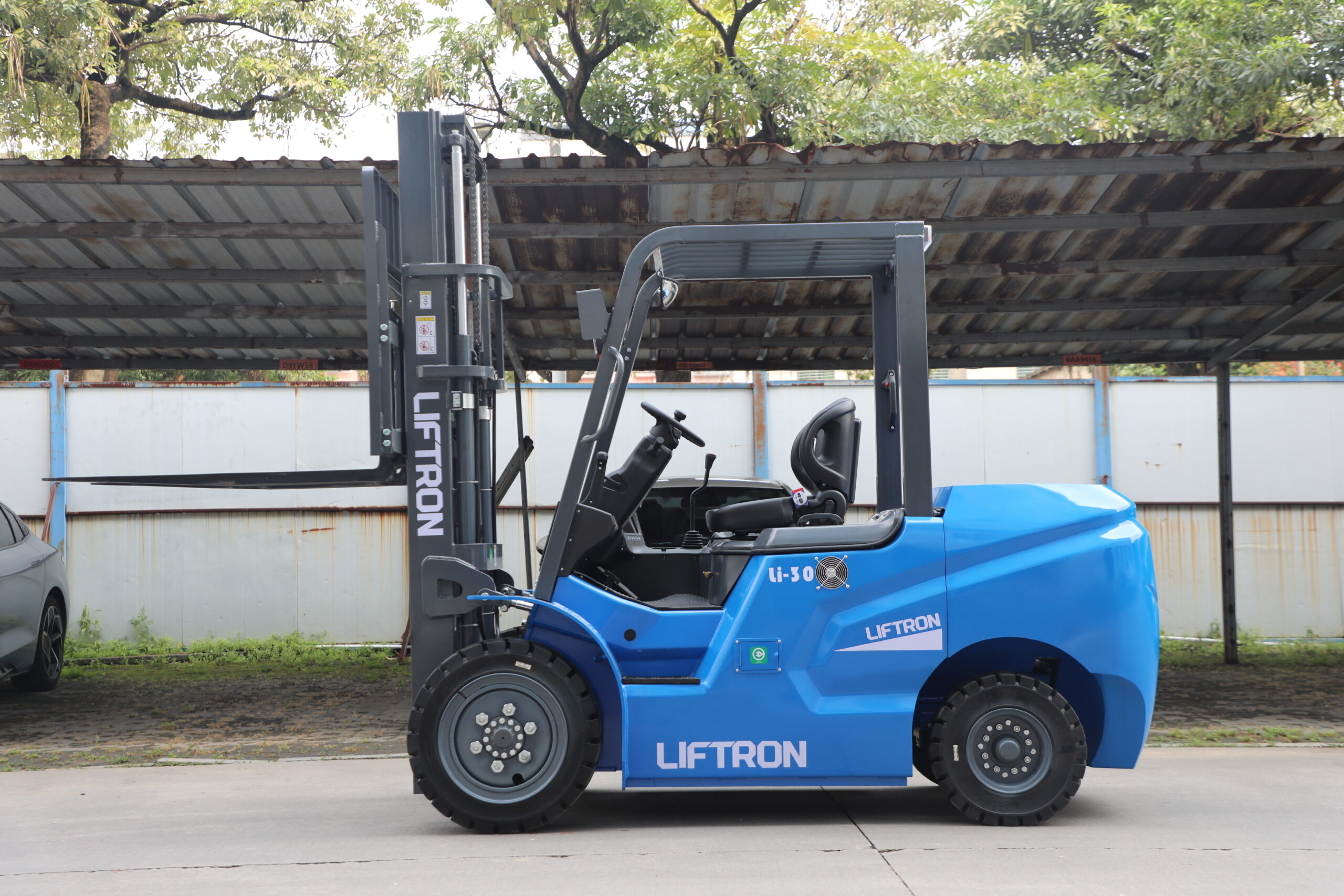
What Type of Suspension System Does the Liftron Forklift Use?
A Liftron forklift is designed for practical material handling applications where stability, control, and operator efficiency are important. Like most modern forklifts, Liftron forklift designs generally focus on a stable chassis, solid axle support, and a forklift-style three-point stability concept rather than a car-like suspension system.
For common warehouse and industrial applications, this type of design helps the forklift remain controlled while lifting and transporting loads. The forklift’s frame, axle layout, tire selection, and operator position all work together to support safe handling. Depending on the specific Liftron forklift model and application, the truck may use cushion tires, pneumatic-style tires, or other tire configurations suited to indoor or outdoor environments.
Because forklift specifications can vary by model, buyers should always review the product manual, data plate, and manufacturer specifications before selecting equipment. The correct forklift depends on load capacity, lift height, travel surface, aisle width, power type, and work environment. However, the general principle remains the same: Liftron forklifts, like most industrial lift trucks, are engineered for load stability rather than soft automotive-style suspension.
Why Forklift Suspension Design Matters
Forklift suspension design affects safety in several ways. First, it helps determine how the truck responds when carrying a load. A stable, rigid structure reduces unwanted movement and helps keep the load controlled. Second, it affects how the forklift handles turns. Since forklifts steer differently than cars, operators must be aware of rear-end swing and stability limits.
Third, the suspension and tire setup influence where the forklift can be used. A cushion tire forklift may be excellent on smooth warehouse floors but unsuitable for rough outdoor yards. A pneumatic tire forklift may perform better outside but may require more space to maneuver indoors. Choosing the wrong setup can reduce efficiency and increase safety risks.
Finally, suspension-related comfort features affect operator performance. A forklift used for long shifts should support the operator with good visibility, a comfortable seat, easy-to-reach controls, and reduced vibration. These features do not replace safe driving practices, but they can make daily operation more productive and less tiring.
How to Choose the Right Forklift Suspension and Tire Setup
To choose the right forklift, start with the work environment. For smooth indoor warehouses, a rigid chassis with cushion tires is often effective. For outdoor yards, uneven pavement, or mixed surfaces, pneumatic or solid pneumatic tires may be more suitable. For rough-terrain applications, a specialized rough-terrain forklift may be required.
Next, consider the load. Heavy loads, high stacking, long travel distances, and frequent dock work may require a forklift with stronger stability features and better operator comfort. Also consider maintenance conditions. Tire wear, axle inspection, seat condition, and steering components should all be part of regular forklift maintenance.
Operators should be trained to understand how the forklift reacts to turns, ramps, braking, lifting, and uneven surfaces. Even the best equipment cannot compensate for unsafe driving. Loads should be carried low, turns should be made slowly, and operators should avoid sudden stops or sharp movements.
Conclusion
So, what type of suspension do forklifts have? Most forklifts use a three-point stability system, rigid or solid axle construction, and tire-based shock absorption rather than traditional automotive suspension. Cushion tires, pneumatic tires, and operator compartment features can influence comfort and performance, but the main goal is always load stability.
Forklifts are not designed to ride like cars. They are designed to lift and move heavy materials safely. Understanding this difference helps businesses choose the right forklift, train operators correctly, reduce equipment misuse, and create a safer workplace. Whether using a warehouse forklift, outdoor forklift, or Liftron forklift, the key is to match the truck’s design to the job and operate it with stability in mind.
Add a review
Your email address will not be published. Required fields are marked *