
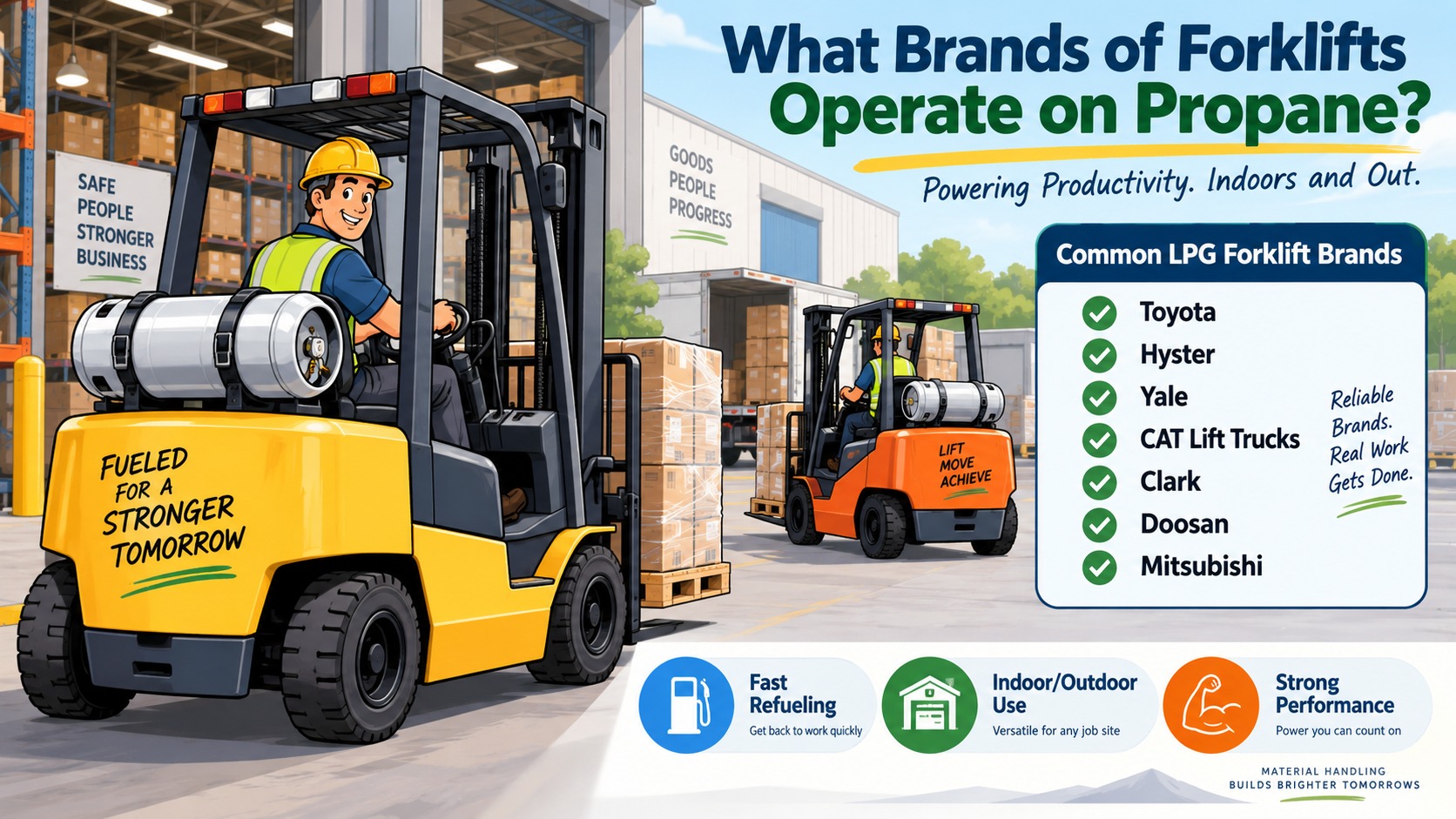
What Brands of Forklifts Operate on Propane?
Well-known brands offering propane-powered forklifts include Toyota, Hyster, Yale, CAT Lift Trucks, Clark, Doosan, and Mitsubishi. Propane models are commonly available with cushion or pneumatic-style tires and are often used for mixed indoor and outdoor work.
Propane forklifts, also called LPG forklifts, remain common in warehouses, distribution centers, manufacturing plants, lumber yards, and outdoor material-handling sites. Major manufacturers including Toyota, Hyster, Yale, CAT Lift Trucks, Clark, Doosan, and Mitsubishi have offered internal-combustion forklift models configured to run on propane. While LPG remains popular for fast refueling and consistent performance, modern Electric forklifts are increasingly preferred in operations focused on indoor cleanliness, lower routine maintenance, and reduced operating noise.
What Is a Propane Forklift?
A propane forklift is an internal-combustion lift truck powered by liquefied petroleum gas, or LPG. Fuel is stored in a removable cylinder mounted on the rear of the truck.
Unlike an electric forklift, an LPG truck uses a combustion engine. The propane vapor is mixed with air, burned inside the engine, and converted into mechanical power for travel and hydraulic operation.
One major advantage is rapid refueling. Instead of waiting for a battery to recharge, an operator can replace an empty propane cylinder with a full one and return the truck to service quickly.
Top Brands Offering Propane Forklifts
| Brand | Typical Propane Forklift Offering | Common Applications |
|---|---|---|
| Toyota | Internal-combustion cushion and pneumatic models | Warehouses, docks, manufacturing, outdoor yards |
| Hyster | Standard and heavy-duty LPG forklifts | Industrial facilities, distribution, heavy handling |
| Yale | Internal-combustion cushion and pneumatic trucks | Warehouses, manufacturing, mixed-use sites |
| CAT Lift Trucks | Gas and LPG GP-series configurations | Industrial and outdoor material handling |
| Clark | Traditional internal-combustion forklift lines | Warehousing, logistics, manufacturing |
| Doosan | LPG-powered industrial forklift models | Multi-shift indoor and outdoor operations |
| Mitsubishi | Internal-combustion cushion and pneumatic forklifts | Warehouses, yards, distribution centers |
Toyota Propane Forklifts
Toyota offers a broad range of internal-combustion forklifts with LPG configurations, including both cushion-tire and pneumatic-style models.
Cushion-tire trucks are typically used indoors on smooth floors where compact turning is important, while pneumatic-style forklifts are better suited to rougher outdoor or mixed surfaces.
Toyota LPG forklifts are commonly used in:
- Warehouses
- Manufacturing plants
- Loading docks
- Distribution centers
- Outdoor storage areas
Hyster Propane Forklifts
Hyster is well known for rugged industrial forklifts and offers internal-combustion models that can use LPG.
The brand serves both standard warehouse operations and heavier industrial applications where durability and consistent power are priorities.
Hyster propane forklifts can be attractive where trucks need to operate for long shifts and refuel quickly between work periods.
Yale Propane Forklifts
Yale provides a variety of internal-combustion forklift configurations suitable for propane operation.
These trucks can be found in applications ranging from warehousing and shipping to manufacturing and general industrial material handling.
Like other LPG-powered equipment, Yale propane models can provide relatively consistent engine performance until the fuel cylinder is depleted.
CAT Lift Trucks
CAT Lift Trucks has long offered gas-powered forklift lines, including LPG-capable models in its internal-combustion product families.
The GP-series designation is commonly associated with gas and LPG-powered forklift applications, depending on model and regional configuration.
These trucks are commonly used where:
- Fast refueling is important
- Outdoor work is frequent
- Loads are relatively heavy
- Multi-shift operation is required
Clark Propane Forklifts
Clark has a long history in forklift manufacturing and offers internal-combustion models that can be configured for LPG fuel.
Propane-powered Clark forklifts are commonly used in warehousing, logistics, and manufacturing where operators value quick fuel replacement and familiar internal-combustion performance.
Doosan Propane Forklifts
Doosan has offered LPG-powered forklift models designed for demanding industrial applications.
These trucks may be used in mixed environments where the forklift moves between indoor production areas and outdoor loading zones.
Propane can be convenient for multi-shift use because the fuel cylinder can be replaced quickly instead of waiting for a conventional battery recharge cycle.
Mitsubishi Propane Forklifts
Mitsubishi offers internal-combustion forklifts with both cushion and pneumatic-style configurations capable of using LPG in suitable models.
These trucks are often used in warehouses, distribution facilities, yards, and general industrial environments.
Fuel options can vary by model, capacity, market, and year. Always confirm that the exact forklift model is factory-configured or manufacturer-approved for LPG operation before purchasing or converting equipment.
Why Companies Choose Propane Forklifts
Propane forklifts remain popular because they combine internal-combustion power with relatively simple refueling.
Typical benefits include:
- Quick cylinder replacement
- Consistent power output
- Suitable performance for long shifts
- Strong acceleration
- Indoor and outdoor versatility when appropriately configured
They can be particularly useful for facilities that do not want to maintain a large battery-charging infrastructure.
What Are the Downsides of Propane Forklifts?
Propane forklifts also have disadvantages.
Because they use combustion engines, they produce exhaust gases and require more engine-related maintenance than battery-electric trucks.
Maintenance may include:
- Engine oil changes
- Filters
- Spark plugs
- Fuel-system service
- LPG regulator maintenance
- Cooling-system maintenance
Indoor facilities must also manage ventilation and carbon monoxide risks associated with internal-combustion equipment.
Propane burns relatively cleanly compared with some other combustion fuels, but LPG forklifts can still produce carbon monoxide and other exhaust gases. Good ventilation and proper engine maintenance remain essential.
Are Propane Forklifts Better Than Electric?
Propane forklifts are not universally better than electric forklifts. The best choice depends on the workload and environment.
| Feature | Propane Forklift | Electric Forklift |
|---|---|---|
| Refueling / Charging | Very fast cylinder replacement | Requires charging, though lithium supports fast opportunity charging |
| Indoor Emissions | Produces exhaust | No tailpipe emissions during operation |
| Noise | Higher | Lower |
| Engine Maintenance | Higher | Lower |
| Outdoor Use | Very good with suitable tires | Good when appropriately configured and protected |
| Multi-Shift Operation | Strong due to rapid refueling | Strong with lithium opportunity charging |
Where Propane Forklifts Have an Advantage
Propane can be attractive for demanding operations where the forklift needs to stay in service for long periods and fuel replacement must take only a few minutes.
It may be especially useful in:
- Lumber yards
- Building-material facilities
- Outdoor storage areas
- Heavy manufacturing
- Mixed indoor/outdoor operations
Where Electric Forklifts Have an Advantage
Electric forklifts are often a stronger choice for clean indoor warehouses and distribution centers.
Because they do not use a combustion engine, they produce no tailpipe exhaust during normal operation and generally generate less noise.
Other advantages include:
- Lower routine engine maintenance
- No engine oil changes
- Quiet operation
- Good low-speed torque
- Suitable performance in narrow indoor environments
- Opportunity charging with compatible lithium batteries
Propane vs. Lithium Forklifts for Multi-Shift Work
Historically, propane had a strong advantage in multi-shift operations because an empty fuel cylinder could be replaced almost immediately.
Modern lithium battery technology has reduced that difference significantly.
Lithium-powered Electric forklifts can often recharge during lunch breaks, scheduled downtime, and shift changes, reducing the need for long charging periods or battery swaps.
Propane offers rapid fuel replacement, while lithium electric forklifts offer opportunity charging, lower noise, and no tailpipe exhaust. The better choice depends on shift length, charging access, workload, and environment.
Which Has Lower Operating Cost?
Electric forklifts often have the potential for lower total operating costs because electric drive systems have fewer moving engine components.
Propane forklifts require recurring fuel purchases and engine maintenance, while electric trucks primarily require electricity, battery management, tires, hydraulics, brakes, steering, and other normal forklift maintenance.
Actual cost depends on:
- Local propane price
- Electricity price
- Annual operating hours
- Maintenance schedule
- Battery technology
- Fleet size
Which Is Better for Indoor Warehouses?
Electric forklifts generally offer advantages for indoor environments because they are quieter and produce no tailpipe emissions.
Propane forklifts can still operate indoors where allowed and properly ventilated, but employers need to manage exhaust exposure and engine condition carefully.
Which Is Better for Outdoor Work?
Propane forklifts are often well suited to outdoor work, particularly when fitted with suitable pneumatic or solid pneumatic-style tires.
They can operate for long periods without charging infrastructure and can refuel quickly.
However, electric forklifts can also work outdoors when the model, tires, weather protection, electrical sealing, and surface conditions are suitable.
How Long Does a Propane Tank Last on a Forklift?
Runtime depends on tank size, engine efficiency, truck capacity, load weight, operating intensity, and idle time.
A common industrial forklift propane cylinder can often support several hours of normal operation, potentially approaching a typical work shift under favorable conditions.
Heavy lifting, frequent acceleration, and long travel distances increase fuel consumption.
Can Any Forklift Be Converted to Propane?
No. A forklift should not be casually converted from gasoline, diesel, or electric power to propane.
Fuel-system changes can affect:
- Engine calibration
- Emissions
- Fuel controls
- Safety systems
- Equipment certification
Any conversion should use manufacturer-approved equipment and procedures appropriate for the exact forklift model.
What Should You Check Before Buying a Propane Forklift?
- Confirm the required load capacity.
- Determine whether operation is indoor, outdoor, or mixed.
- Choose the correct tire type.
- Check LPG fuel availability.
- Evaluate ventilation requirements.
- Compare fuel and electricity costs.
- Review maintenance requirements.
- Compare propane with modern electric alternatives.
When Should You Choose Electric Instead?
Electric equipment may be a better fit when the operation prioritizes indoor air quality, quiet operation, reduced routine maintenance, and predictable battery charging.
Lithium-powered trucks are particularly attractive where operators can recharge during natural breaks throughout the day.
For many warehouses and logistics facilities, modern Electric forklifts can now handle intensive multi-shift work that was traditionally dominated by propane equipment.
Conclusion
Toyota, Hyster, Yale, CAT Lift Trucks, Clark, Doosan, and Mitsubishi are among the well-known brands that offer or have offered propane-powered forklift models. LPG forklifts remain popular for fast refueling, strong performance, and mixed indoor/outdoor use, while electric forklifts generally offer lower noise, no tailpipe exhaust, and reduced engine maintenance. The best choice depends on your operating environment, shift schedule, fuel and electricity costs, load requirements, and available charging or refueling infrastructure.
Add a review
Your email address will not be published. Required fields are marked *