
how to determine the correct load rating for forklift tires
Choosing the correct load rating for forklift tires is critical for operational safety, load stability, and equipment longevity—yet it’s often overlooked in daily maintenance. A mismatched tire rating can lead to premature wear, reduced lift capacity, or even catastrophic failure, especially when handling heavy or uneven loads. This guide explains how to determine the proper load rating by combining forklift data, tire markings, and application factors, ensuring your fleet performs efficiently under real-world conditions.
Why Load Ratings Matter for Forklift Tires
Every forklift tire is designed to support a maximum weight at a specific inflation pressure (for pneumatic tires) or a defined deformation (for solid and cushion tires). Exceeding this rating stresses the tire, sidewalls, and wheel assembly, increasing the risk of blowouts, tread separation, and loss of vehicle control. Additionally, an underrated tire can void manufacturer warranties and compromise OSHA compliance standards. The correct load rating also preserves the forklift’s rated lifting capacity because the tire is part of the vehicle’s overall stability triangle.
Step 1: Read the Forklift’s Nameplate Data
Start with the forklift’s data plate, typically located on the dashboard or inside the overhead guard. Look for the following values:
- Maximum lift capacity – the weight at a specified load center (e.g., 5,000 lbs at 24 inches).
- Maximum travel speed – affects dynamic load on tires.
- Loaded vehicle weight – the total weight including the forklift and a rated load.
- Front and rear axle weights – these are the actual loads each tire must carry when the forklift is loaded and unloaded.
Use the axle weight data, not just the lift capacity, because the front axle bears most of the load when lifting. For example, a 5,000 lb capacity forklift may place 7,500 lbs on the front axle with a full load and only 1,500 lbs on the rear axle.
Step 2: Calculate Load Per Tire
Divide the axle weight by the number of tires on that axle. Most forklifts have two front and two rear tires, so each front tire carries half the front axle load. However, if the forklift has a single wide front tire (common in some specialty models), the calculation is direct. Always use the worst-case scenario: maximum load, maximum lift height, and any added attachments (e.g., sideshifters, clamps) that may shift weight forward.
For example, if the loaded front axle weight is 8,000 lbs, each front tire must handle at least 4,000 lbs. Add a 15–20% safety margin for dynamic forces (pivoting, braking, uneven floors), giving a required tire rating of about 4,800 lbs per tire. Consult the tire manufacturer’s load/inflation tables to match this figure.
Step 3: Decode Tire Markings
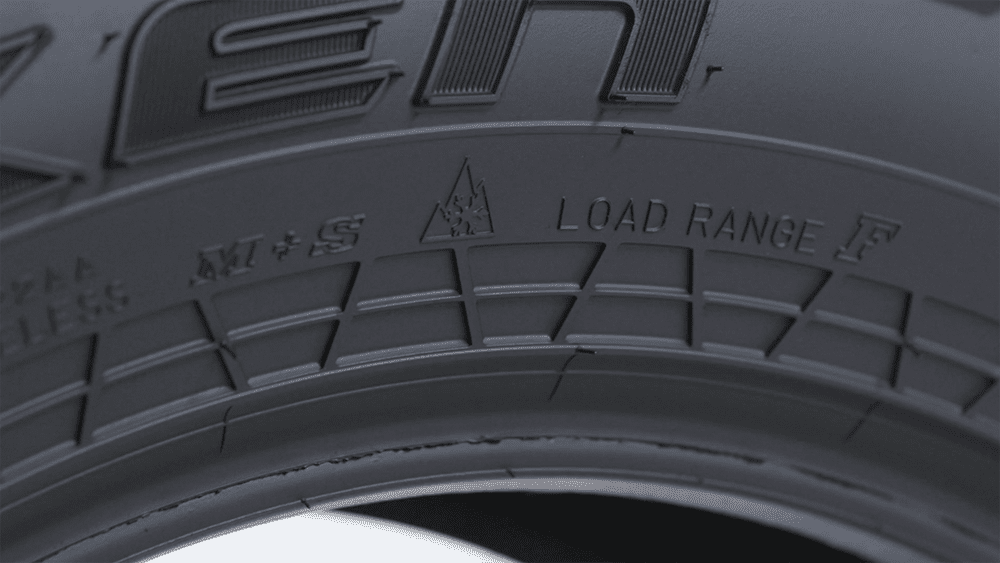
Forklift tires have printed codes on the sidewall. For pneumatic tires, you might see something like “6.00-9” followed by “14PR” and a load index like “120/116” – the first number (120) is the single-load index, the second (116) is the dual-load index. For example, load index 120 corresponds to 3,086 lbs at a specified pressure. For solid or cushion tires, the code may be “18x7x8” with a ply rating or a load capacity stated directly (e.g., “MAX LOAD 4,500 LBS @ 100 PSI”).
Always cross-reference the tire’s load index with the manufacturer’s official load table—do not rely on the ply rating alone, as modern radial tires have higher capacities at lower plies. Also check the speed rating: forklift tires with a “G” rating are suitable for 15 mph max, while higher speeds require different compounds.
Step 4: Consider Application Specifics
The same forklift model may require different tire ratings depending on the environment:
- Indoor smooth floors – lower dynamic load, but softer cushion tires may be used.
- Outdoor rough terrain – pneumatic tires with higher sidewall flexibility are essential; the load rating must account for impacts and punctures.
- Refrigerated warehouses – cold temperatures stiffen rubber, so a higher load rating compensates for reduced flexibility.
- Continuous duty cycles – frequent full lifts and fast maneuvers generate heat; an 8–10% de-rating may be required.
> Always test the actual tire pressure after several hours of operation—underinflation by 20% can reduce load capacity by 15% or more.
Step 5: Match Tire Type to Load Rating
Forklift tires are available in three main constructions:
- Cushion (solid) tires – ideal for indoor use, with ratings often printed directly on the tire. Ensure the rating covers the loaded axle weight plus a safety factor.
- Solid pneumatic tires – a hybrid with airless construction, offering high puncture resistance and stable load ratings. They typically have a higher load capacity than bias-ply pneumatics of the same size.
- Pneumatic (air-filled) tires – require correct inflation pressure to achieve the rated load. A 10 PSI drop can lower capacity by 10–12%.
When switching tire types, never assume the same size means the same rating. For instance, a “18x7x8” solid tire may support 5,200 lbs, while the pneumatic version of the same size only supports 4,200 lbs at max pressure. Verify the replacement tire’s data sheet.
Step 6: Use a Load Rating Calculation Example
| Forklift Model | Max Lift Capacity | Loaded Front Axle (lbs) | Loaded Rear Axle (lbs) | Required Front Tire Rating (per tire) |
|---|---|---|---|---|
| 3,000 lb capacity | 3,000 @ 24 in | 4,500 | 1,200 | 2,250 + 20% = 2,700 |
| 5,000 lb capacity | 5,000 @ 24 in | 7,500 | 1,800 | 3,750 + 20% = 4,500 |
| 8,000 lb capacity | 8,000 @ 24 in | 12,000 | 2,400 | 6,000 + 20% = 7,200 |
These figures are illustrative only—always refer to the forklift’s specific data plate. If your numbers fall between two tire ratings, choose the higher rating. Also factor in the moment of inertia: heavy attachments like a paper roll clamp increase the load moment and may require a higher tire rating even if the total weight is unchanged.
Step 7: Verify with the Tire Manufacturer
& Supplier
Once you have calculated the required rating, cross-reference with tire catalogs from reputable suppliers. For seamless fleet management, consider using Liftron Material Handling for comprehensive guidance on tire specifications and compatibility. Their team can help match your axle loads with the ideal tire compound and tread pattern, ensuring maximum uptime. For electric forklifts, the Liftron DL SERIES offers intelligent load monitoring that can display real-time axle weight, simplifying the process of selecting and verifying correct tire ratings for both new and existing units.
Common Mistakes to Avoid
- Ignoring wheel rim size – a tire with the right load rating but a wrong rim can fail at the bead area.
- Using car or pickup truck tires – they lack the sidewall reinforcement for forklift side loads.
- Assuming higher ply rating equals higher capacity – ply rating is a construction feature, not a direct load rating.
- Forgetting to adjust for load center shifts – a 48-inch load center instead of 24-inch increases the moment by 100%, which may overload the front tires.
- Not rechecking after tire replacement – new tires have different profiles and inflation requirements.
Final Verification Checklist
- Record the forklift’s loaded axle weights from the data plate or OEM documentation.
- Divide by the number of tires on each axle and add a minimum 15% safety margin.
- Compare against the tire’s printed load index or stated capacity at the recommended inflation pressure.
- Adjust for application factors (speed, terrain, temperature, duty cycle).
- Confirm that the wheel rim and tire size are compatible.
- Consult the tire manufacturer’s load table, not just the sidewall abbreviation.
- Perform a test drive with a full load, then inspect tires for heat, bulges, or cracking.
Incorrect load ratings are one of the top five causes of forklift tire failures. By following this systematic approach, you not only protect your operators and equipment but also reduce downtime and replacement costs. When in doubt, always err on the side of a higher rating—the extra cost is negligible compared to a single accident or a prematurely destroyed tire. For specific model inquiries, Liftron Material Handling provides detailed technical datasheets, and the Liftron DL SERIES includes factory-calibrated load sensors that can alert you to potential tire overloads in real time—an advanced feature that simplifies compliance and safety management.
Add a review
Your email address will not be published. Required fields are marked *