
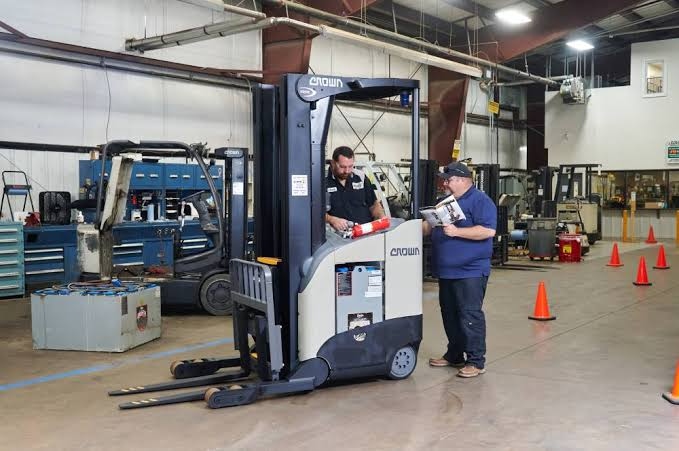
What Is Plugging on a Forklift?
What Is Plugging on a Forklift?
Plugging, sometimes called regenerative braking or directional braking, is a method used on electric forklifts to slow down without applying the service brake pedal. The operator changes the direction selector from forward to reverse or reverse to forward while the forklift is still moving.
When this happens, the motor controller changes the electrical operation of the drive motor. Instead of continuing to push the forklift in the original direction, the motor creates resistance that reduces speed and helps bring the truck to a stop.
Plugging is commonly used by experienced electric forklift operators because it allows smooth speed control during frequent warehouse operations. In environments where operators constantly travel, stop, reverse, and reposition, plugging can improve efficiency.
How Does Forklift Plugging Work?
Electric forklifts use electric motors to control movement. During normal operation, the motor provides power to move the forklift forward or backward. During plugging, the operator commands the motor to operate in the opposite direction while the truck is still moving.
The motor then creates electromagnetic resistance. This resistance works against the current movement of the forklift, slowing it down.
| Operation | Motor Action | Result |
|---|---|---|
| Normal Forward Travel | Motor rotates forward | Forklift moves forward |
| Plugging Forward to Reverse | Motor reverses rotation | Forklift slows down smoothly |
| Regenerative Braking | Motor converts movement energy | Energy may return to the battery |
| Brake Pedal Use | Mechanical braking system activates | Forklift stops through friction braking |
Why Do Operators Use Plugging?
Plugging is popular in warehouses because electric forklifts often perform repetitive movements. Operators may travel a short distance, stop at a rack, reverse, pick up a pallet, and move again hundreds of times per shift.
Using plugging correctly can provide smoother operation and reduce unnecessary brake pedal use.
Benefits of Plugging on a Forklift
1. Reduces Brake Wear
One major advantage of plugging is reduced dependence on mechanical brakes. Since the electric motor helps slow the forklift, the brake system may experience less wear during normal travel.
This can reduce maintenance frequency and extend brake component life when plugging is used properly.
2. Regenerative Braking
Many modern electric forklifts use regenerative braking technology. During deceleration, some energy from the moving forklift may be converted back into electrical energy and returned to the battery system.
This improves energy efficiency and can help extend operating time between charges.
3. Prevents Roll-Backs
Plugging can help operators maintain control when changing directions, especially during frequent forward and reverse movements. In some applications, it can provide smoother control compared with sudden braking.
| Benefit | How Plugging Helps |
|---|---|
| Less Brake Usage | Reduces reliance on mechanical braking components |
| Smoother Stops | Allows controlled deceleration |
| Energy Recovery | Supports regenerative braking systems |
| Better Productivity | Helps operators quickly change directions |
| Improved Control | Provides smoother warehouse movement |
Plugging vs Traditional Braking
| Feature | Plugging | Brake Pedal |
|---|---|---|
| Primary System | Electric motor control | Mechanical braking system |
| Energy Use | May recover some energy | Energy converted to heat |
| Component Wear | Less brake wear | More brake usage |
| Best Application | Frequent direction changes | Emergency stops and final stopping |
| Operator Skill | Requires practice | Simple operation |
Best Practices and Safety Tips for Plugging
Although plugging can improve productivity, improper use can create problems. Operators should learn the correct technique and understand the limits of the forklift.
1. Feather the Controls
Avoid moving the direction control aggressively. Smooth control inputs create smoother deceleration and reduce stress on the motor, controller, and drivetrain.
A skilled operator gradually changes direction instead of abruptly switching from full forward speed to reverse.
2. Control the Agility
Different forklifts respond differently to plugging. Factors such as truck size, motor design, controller programming, load weight, and surface conditions affect how quickly the forklift slows.
Operators should practice with the specific forklift model they use instead of assuming all electric forklifts behave the same.
3. Use Plugging for Routine Stopping
Plugging is best used for normal travel adjustments and controlled stops. It should not replace the brake pedal in emergency situations.
Step-by-Step Guide to Plugging a Forklift
- Check that the travel path is clear.
- Confirm the forklift is operating normally.
- Travel at a controlled speed.
- Release the accelerator smoothly.
- Move the directional control toward the opposite direction.
- Allow the motor resistance to slow the forklift.
- Apply the brake if a complete stop is required.
- Return the direction selector to the correct position before moving again.
- Practice the technique in a safe training area.
- Follow manufacturer recommendations for the specific forklift model.
Common Mistakes When Plugging
- Changing direction too aggressively
- Using plugging at excessive speed
- Relying only on plugging during emergencies
- Ignoring load stability
- Operating without proper training
- Using plugging techniques on equipment not designed for it
- Failing to understand forklift controls
Which Forklifts Use Plugging?
Plugging is mainly associated with electric forklifts because they use electric motors and controllers that can manage directional braking.
Modern lithium-ion electric forklifts often include advanced motor control systems that support smooth acceleration, braking, and energy management.
Companies looking for electric material handling solutions can explore models from Liftron Material Handling, including the DE SERIES, DL SERIES, and DD SERIES electric forklift models.
| Liftron Model | Application |
|---|---|
| DE SERIES | Indoor warehouse material handling and electric forklift operations |
| DL SERIES | Indoor warehouse, heavier loads, and frequent handling tasks |
| DD SERIES | Demanding applications requiring stronger electric performance |
Is Plugging Safe?
Yes, plugging can be safe when performed correctly. It is a common operating technique for electric forklifts and can improve efficiency when used by trained operators.
However, it should never replace basic forklift safety practices. Operators must still follow speed limits, maintain visibility, carry loads correctly, and understand the truck’s braking system.
Conclusion
Plugging on a forklift is an electric braking technique where the operator reverses the directional control while the truck is still moving. The motor creates resistance that slows the forklift without relying only on mechanical brakes.
When used correctly, plugging can reduce brake wear, improve productivity, support regenerative braking, and provide smoother operation. However, operators should always use controlled movements and follow manufacturer recommendations when operating forklifts.




Add a review
Your email address will not be published. Required fields are marked *