

What Is a Counterweight Forklift?
What Is a Counterweight Forklift?
A counterweight forklift is a type of lift truck designed to carry loads on forks at the front while using a heavy mass at the rear to balance the load. This design is why it is often called a counterbalance forklift.
The basic idea is simple: when a forklift lifts a heavy pallet, the front of the machine wants to tip downward. The counterweight at the back helps offset that force. It works like a seesaw. The load is on one side, the counterweight is on the other side, and the front axle acts as the balance point.
Counterweight forklifts are among the most common forklifts in the world because they are easy to understand, versatile, and useful in many industries. They can load trucks, unload pallets, move materials across a warehouse, stack goods, and support manufacturing or distribution operations.
How Does a Counterweight Forklift Work?
A counterweight forklift uses physics to balance the load. The forks are mounted at the front of the machine. The operator drives up to a pallet, slides the forks underneath, lifts the load, and transports it.
Because the load is in front of the front wheels, it creates forward tipping force. The counterweight built into the rear of the forklift resists this force. As long as the combined center of gravity stays within the forklift’s stability triangle, the truck remains stable.
If the load is too heavy, too far forward, raised too high, or carried on a slope incorrectly, the forklift can become unstable. That is why capacity charts and operator training are critical.
| Part | Function |
|---|---|
| Forks | Slide under pallets and support the load |
| Mast | Raises and lowers the forks |
| Counterweight | Balances the front load and helps prevent forward tipping |
| Front Axle | Acts as the pivot point in the balance system |
| Operator Compartment | Provides controls, steering, and safety protection |
| Battery or Engine | Powers travel, lifting, steering, and hydraulic functions |
Why the Rear Counterweight Matters
The rear counterweight is the defining feature of this forklift type. It is usually made from cast iron, steel, or another heavy material. In internal combustion forklifts, the counterweight is often a large metal block built into the rear body.
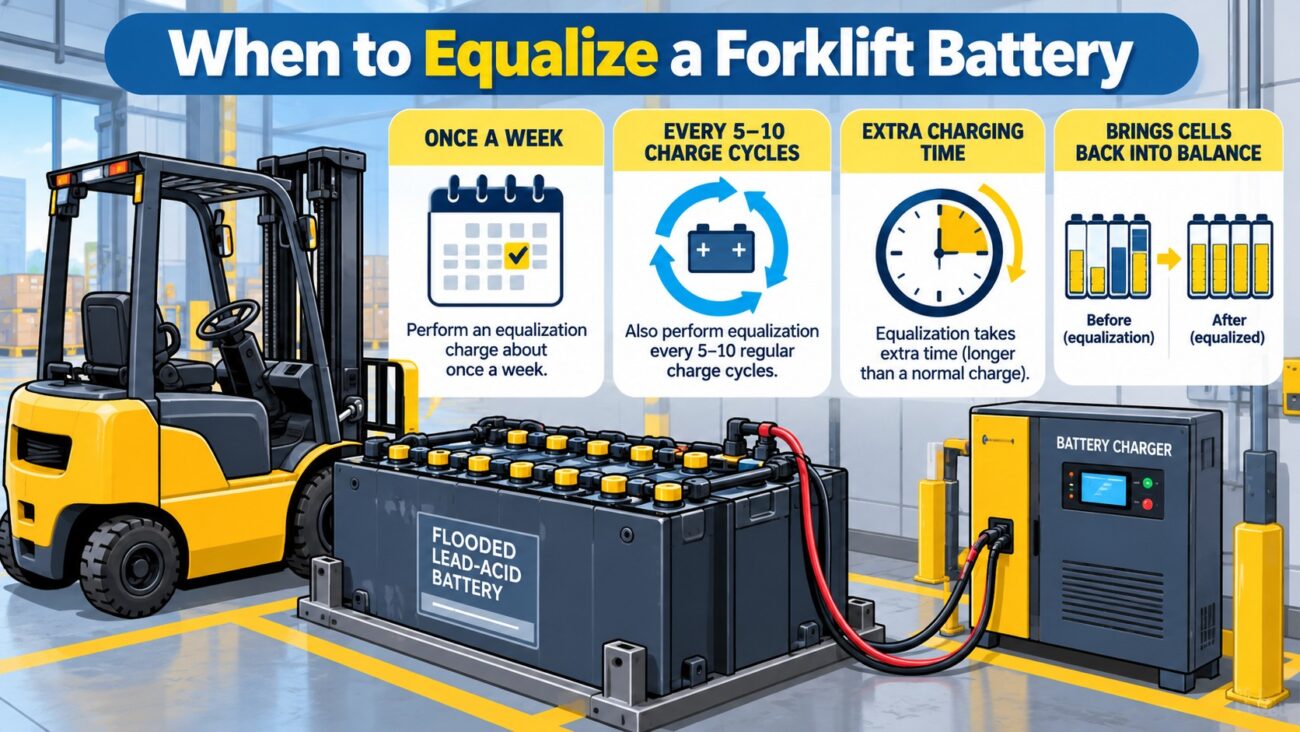
In electric counterweight forklifts, the battery can also play a major role in balancing the machine. Traditional lead-acid batteries are very heavy and may act as part of the counterbalance system. Modern lithium-ion forklifts may use battery weight and chassis design together to maintain proper balance.
Without enough counterweight, the forklift could tip forward when lifting a heavy load. However, the counterweight only works within the design limits of the truck.
What Makes Counterweight Forklifts Unique?
1. No Front Outriggers Needed
Unlike some reach trucks or specialized lifting equipment, counterweight forklifts do not require front support legs or outriggers. This allows the operator to drive straight up to a pallet, rack, loading dock, or trailer.
2. Simple Direct Loading
The forks are positioned directly in front of the truck. This makes loading and unloading straightforward. Operators can approach pallets from the front, lift them, and reverse away.
3. Versatile Work Environments
Counterweight forklifts are used indoors and outdoors depending on tire type, power source, and truck design. Electric models are common indoors, while diesel or propane models are often used outdoors.
4. Strong Lifting Ability
Because of their balanced design, counterweight forklifts can handle many standard warehouse and industrial loads. Larger models can lift heavier materials in manufacturing, construction, and yard applications.
Power Options for Counterweight Forklifts
Counterweight forklifts can use different power systems. The best choice depends on the environment, ventilation, workload, and operating cost.
| Power Type | Common Use | Advantages |
|---|---|---|
| Electric Battery | Indoor warehouses and clean operations | Quiet operation, low emissions, lower maintenance |
| Lithium-Ion Electric | Modern warehouse and multi-shift operations | Fast charging, high efficiency, maintenance-free battery |
| Propane / LPG | Indoor and outdoor work with ventilation | Fast refueling and consistent power |
| Diesel | Outdoor yards and heavy-duty work | High torque and rugged performance |
| Gasoline | Some outdoor or mixed-use applications | Simple fuel availability in certain regions |
Where Are Counterweight Forklifts Used?
Counterweight forklifts are used in many industries because they are flexible and easy to apply to different material handling tasks.
- Warehouses and distribution centers
- Loading docks
- Manufacturing plants
- Construction supply yards
- Retail storage facilities
- Food and beverage distribution
- Recycling centers
- Ports and freight terminals
In warehouses, electric counterweight forklifts are often preferred because they can operate indoors without direct exhaust emissions. In outdoor yards, larger pneumatic tire models may be used to handle rougher surfaces and heavier loads.
Counterweight Forklift vs Reach Truck
Counterweight forklifts and reach trucks are both used in warehouses, but they are designed for different environments.
| Feature | Counterweight Forklift | Reach Truck |
|---|---|---|
| Main Design | Rear counterweight balances front load | Reach mechanism extends forks into racking |
| Aisle Width | Needs more turning space | Better for narrow aisles |
| Outdoor Use | Possible with suitable tires and design | Usually indoor-only |
| Best For | Loading docks, pallets, general handling | High racks and narrow warehouse aisles |
| Load Access | Drives directly to the load | Reaches into the rack position |
Versatility and Limits
Counterweight forklifts are highly versatile, but they are not perfect for every application. Their turning radius is usually larger than a reach truck or three-wheel electric forklift. They may not be ideal for extremely narrow aisles.
They also require careful load handling. Because they depend on balance, load weight and load center are very important. A load that is too long or too far forward can reduce safe lifting capacity.
How to Operate a Counterweight Forklift Safely
- Inspect the forklift before operation.
- Check the data plate for rated capacity.
- Confirm the load weight and load center.
- Approach the pallet slowly and squarely.
- Insert the forks fully under the load.
- Lift only high enough for safe travel.
- Tilt the mast back slightly when carrying a load.
- Travel with the load low to the ground.
- Slow down before turning.
- Never exceed the rated capacity.
- Keep pedestrians clear of the operating area.
- Park safely with forks lowered after use.
Common Safety Mistakes
- Lifting loads heavier than the rated capacity
- Carrying loads too high while traveling
- Turning sharply with a raised load
- Ignoring load center distance
- Driving on slopes incorrectly
- Using attachments without updated capacity information
- Operating on unsuitable ground
- Parking with forks raised
What Counterweight Forklift Models Does Liftron Material Handling Offer?
Liftron Material Handling offers electric counterweight forklift solutions designed for modern warehouses and industrial applications. Its main counterweight forklift models include the DE SERIES, DL SERIES, and DD SERIES.
The DE SERIES and DL SERIES are suitable for indoor warehouse applications, pallet handling, and general material movement. The DD SERIES is designed for more demanding applications where stronger load handling and outdoor-capable performance may be required.
| Liftron Series | Power Type | Typical Application |
|---|---|---|
| DE SERIES | Electric lithium-ion counterweight forklift | Indoor warehouse handling and flexible material movement |
| DL SERIES | Electric lithium-ion counterweight forklift | Indoor warehouse, heavier pallet handling, and industrial storage |
| DD SERIES | Electric lithium-ion counterweight forklift | Demanding material handling and outdoor-capable operation |
How to Choose the Right Counterweight Forklift
Choosing the right counterweight forklift requires more than selecting a lifting capacity. Businesses should evaluate their full working environment.
- Identify the maximum load weight.
- Measure the load center and pallet size.
- Check required lift height.
- Measure aisle width and turning space.
- Determine whether the truck will operate indoors, outdoors, or both.
- Choose the right tire type for the surface.
- Compare electric, lithium-ion, propane, diesel, or gasoline power.
- Consider charging or refueling requirements.
- Review maintenance and service support.
- Train operators on the specific forklift model.
Conclusion
A counterweight forklift, or counterbalance forklift, is one of the most common and useful forklift types. It uses a heavy rear counterweight to balance the load carried on the front forks, allowing operators to lift and move materials without front outriggers.
These forklifts are widely used in warehouses, loading docks, manufacturing plants, and industrial yards. However, they depend on proper balance, so operators must follow capacity charts, load center rules, and safe travel practices.
For businesses looking for modern electric counterweight forklift options, Liftron Material Handling offers the DE SERIES, DL SERIES, and DD SERIES for different warehouse and industrial applications.

Add a review
Your email address will not be published. Required fields are marked *