
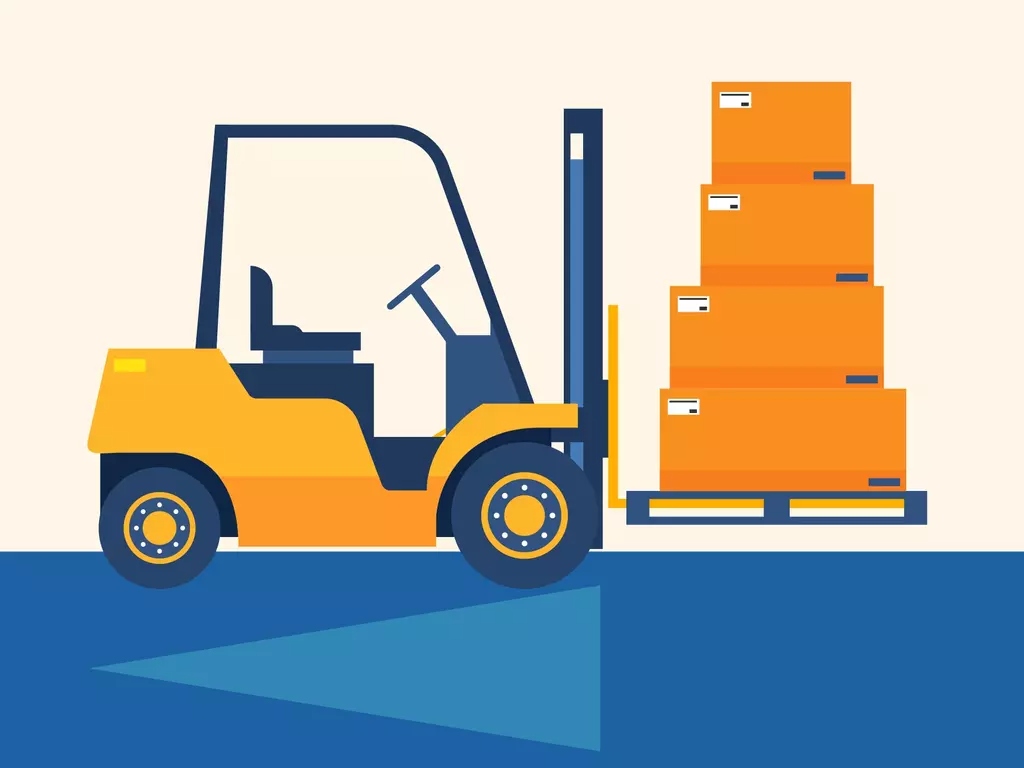
What Is the Mechanical Advantage of a Forklift?
What Does Mechanical Advantage Mean?
Mechanical advantage describes how a machine multiplies an input force or changes the relationship between force, speed and distance. A simple lever, pulley or hydraulic cylinder can allow a relatively small input to move a much heavier load.
In a forklift, the operator does not directly produce the force that raises the pallet. The engine or electric motor powers a hydraulic pump, and the pump moves oil under pressure. That pressure acts on one or more lift cylinders to create the force needed to raise the mast and carriage.
The forklift also uses chains, rollers and sheaves to transfer the lift-cylinder movement to the forks. The complete lifting ability therefore depends on several systems working together rather than one fixed pulley ratio.
What Are the Basic Mechanics of a Forklift?
A counterbalance forklift combines five important mechanical systems:
- Power source: An electric motor or internal-combustion engine supplies energy.
- Hydraulic pump: Converts mechanical energy into pressurized fluid flow.
- Lift cylinders: Convert hydraulic pressure into linear upward force.
- Mast and chain system: Guides and transfers movement to the carriage and forks.
- Counterweight and chassis: Balance the load around the front axle.
The forks support the pallet, but the front axle acts as the truck’s main pivot point. The load creates a forward-turning moment, while the truck’s counterweight produces an opposing moment behind the axle.
For safe operation, the combined center of gravity of the forklift and load must remain within the truck’s stability area.
How the Hydraulic System Creates Mechanical Advantage
Hydraulic Pressure
The hydraulic pump draws oil from a reservoir and sends it through control valves to the lift cylinder. When the operator moves the lift control, pressurized fluid enters the cylinder and pushes against the piston.
The basic relationship is:
Output Force = Hydraulic Pressure × Piston Area
For example, if the hydraulic system supplies 2,500 psi to a piston with an effective area of 10 square inches, the theoretical force is:
2,500 psi × 10 in² = 25,000 pounds of force
This simplified figure does not include friction, pressure losses, mast weight or system efficiency, but it shows why a compact hydraulic cylinder can create a very large lifting force.
Piston Area Matters
A larger piston area produces more force at the same hydraulic pressure. However, a larger cylinder also requires more fluid to move the same distance, which can reduce lifting speed unless the pump supplies greater flow.
This illustrates an important rule of mechanical advantage: gaining force usually requires giving up speed or distance.
| Hydraulic Factor | Effect on Forklift Performance |
|---|---|
| Higher system pressure | Can produce greater cylinder force within the approved design limit |
| Larger piston area | Creates more lifting force but requires more oil volume |
| Higher pump flow | Increases lifting speed but does not directly increase maximum force |
| Internal leakage | Reduces efficiency and may cause slow lifting or mast drift |
| Restricted hydraulic filter | Can reduce flow, create heat and damage the pump |
How the Pulley and Chain System Works
The mast chains connect the carriage to the mast and run over chain wheels, also called sheaves. As the lift cylinder extends, the chain arrangement transfers motion to the carriage and raises the forks.
In many forklift mast designs, the chain arrangement allows the carriage to travel farther than the lift cylinder itself moves. In that case, the chain system acts mainly as a distance or speed multiplier rather than a force multiplier.
This means the hydraulic cylinder must provide enough force to overcome the corresponding chain tension, carriage weight, mast friction and load weight.
The exact relationship varies among:
- Two-stage masts
- Three-stage masts
- Full-free-lift masts
- Simplex, duplex and triplex designs
- Single-cylinder and multiple-cylinder arrangements
For this reason, it is inaccurate to claim that every forklift has a 4:1 mechanical advantage. The manufacturer determines the actual cylinder and chain geometry for each model.
Hydraulics vs. Chains: What Does Each System Do?
| System | Main Function | Mechanical Role |
|---|---|---|
| Hydraulic pump | Creates oil flow and pressure | Supplies energy to the lifting system |
| Lift cylinder | Pushes the mast or carriage upward | Converts hydraulic pressure into linear force |
| Mast chains | Support and move the carriage | Transfer force and coordinate carriage travel |
| Chain sheaves | Guide the chains | Change force direction and movement relationship |
| Mast rollers | Guide mast stages | Reduce friction and control alignment |
| Counterweight | Balances the load | Provides stability rather than lifting force |
Does the Counterweight Provide Mechanical Advantage?
The counterweight does not multiply hydraulic lifting force, but it is essential to the forklift’s ability to carry a load safely.
The front axle acts as a pivot. The load creates a forward moment calculated approximately as:
Load Moment = Load Weight × Load-Center Distance
A 4,000-pound load centered 24 inches from the fork face creates a load moment of 96,000 pound-inches. If the load center moves to 30 inches, the moment rises to 120,000 pound-inches even though the load weight has not changed.
This is why long, off-center or improperly positioned loads can reduce practical capacity. The hydraulic system may have enough force to lift the pallet, but the truck may not have enough stability to carry it safely.
Why Does Forklift Capacity Change?
The rated capacity shown on the data plate applies only under stated conditions. Capacity may change because of:
- Increased load-center distance
- Higher lift height
- Longer forks
- Side shifters, clamps or rotators
- Attachment weight
- Tall or irregular loads
- Forward mast tilt
- Uneven or sloped surfaces
A stronger hydraulic system does not override the forklift’s rated capacity. The forks, chains, mast, carriage, axles, tires and stability limits all contribute to the safe rating.
How a Forklift Lifts a Load Step by Step
- The operator activates the lift control. The hydraulic valve directs oil toward the lift cylinder.
- The pump supplies pressurized oil. The engine or electric motor drives the hydraulic pump.
- Pressure acts on the piston. The piston rod begins extending upward.
- The mast stage or carriage moves. Cylinder movement begins raising the lifting structure.
- Chains travel over the sheaves. The chain system transfers movement to the carriage.
- The forks rise with the carriage. The pallet is supported from below.
- The counterweight balances the load. The truck remains stable when operated within its rating.
- The control valve stops the flow. The mast holds at the selected height.
- The lowering valve releases oil. Controlled fluid return allows the carriage to descend.
What Reduces a Forklift’s Mechanical Efficiency?
Theoretical force is always greater than the usable force because real systems experience losses. Common sources include:
- Friction in mast rollers and chain sheaves
- Hydraulic leakage inside cylinders or valves
- Worn pump components
- Contaminated or incorrect hydraulic oil
- Clogged hydraulic filters
- Damaged or poorly lubricated lift chains
- Bent mast channels
- Misaligned rollers
- Low hydraulic fluid level
- Air entering the hydraulic system
These conditions can cause slow lifting, jerky movement, mast drift, overheating, whining noises or reduced load-control accuracy.
Common Forklift Mechanical Problems
| Mechanical Problem | Possible Symptom | Safety Concern |
|---|---|---|
| Hydraulic leak | Slow lifting or oil beneath the truck | Loss of load control or slipping hazard |
| Worn lift chain | Uneven carriage or abnormal chain noise | Reduced lifting reliability |
| Damaged mast roller | Binding, vibration or jerky lifting | Poor load alignment |
| Weak brakes | Long stopping distance | Collision or rack damage |
| Steering problem | Excessive play or difficult turning | Loss of directional control |
| Damaged fork | Bending, cracks or unequal tips | Dropped or unstable load |
| Overheating pump | Hot oil, noise or slow hydraulics | Hydraulic failure |
When a Forklift Develops Mechanical Problems, What Should You Do?
Stop operating the truck as soon as it can be parked safely. Do not continue working to finish one more pallet or shift.
- Keep the forklift under control. Avoid sudden steering or hydraulic movement.
- Move to a safe location if possible. Stay away from docks, pedestrians and active traffic.
- Lower the load and forks. Place the load securely and lower the carriage fully.
- Place the controls in neutral. Apply the parking brake.
- Shut off the power. Remove the key or disable operator access.
- Tag the forklift out of service. Prevent another employee from operating it.
- Report the symptoms. Describe noises, warning lights, leaks or control problems.
- Request qualified inspection. Repairs should be performed by authorized personnel.
- Test before returning to service. Confirm that the defect has been corrected safely.
Can an Operator Repair a Mechanical Problem?
An operator may perform only tasks permitted by the employer and manufacturer, such as routine inspections or basic fluid checks. Safety-critical repairs should be completed by trained maintenance personnel.
Operators should not:
- Adjust hydraulic relief pressure
- Weld or straighten forks
- Repair mast chains
- Bypass safety switches
- Install unapproved attachments
- Continue operating with hydraulic leaks
- Use temporary wiring or improvised parts
A defective forklift should remain out of service until it has been repaired and verified safe.
How to Maintain the Forklift’s Lifting Advantage
- Complete a pre-shift inspection
- Maintain the correct hydraulic fluid level
- Replace hydraulic filters on schedule
- Inspect lift chains and anchors
- Lubricate mast components correctly
- Repair hydraulic leaks promptly
- Keep forks matched and properly positioned
- Stay within the data-plate capacity
- Use manufacturer-approved attachments
- Schedule preventive maintenance by operating hours
Well-maintained forklift systems provide smoother lifting, more accurate load placement and longer component life.
Final Answer
The mechanical advantage of a forklift is created primarily by hydraulic pressure acting on the lift-cylinder piston. The cylinder produces a large output force, while chains and sheaves transfer motion to the carriage and forks.
There is no standard 4:1 mechanical advantage for all forklifts. Chain reeving, cylinder size, pump pressure and mast design vary among models. Some chain systems increase carriage travel rather than multiplying force.
The counterweight does not increase hydraulic force, but it balances the load around the front axle and allows the truck to remain stable within its rated capacity.
When a forklift develops a mechanical problem, lower the load, park safely, shut it down, tag it out of service and request assistance from qualified maintenance personnel.
Add a review
Your email address will not be published. Required fields are marked *