
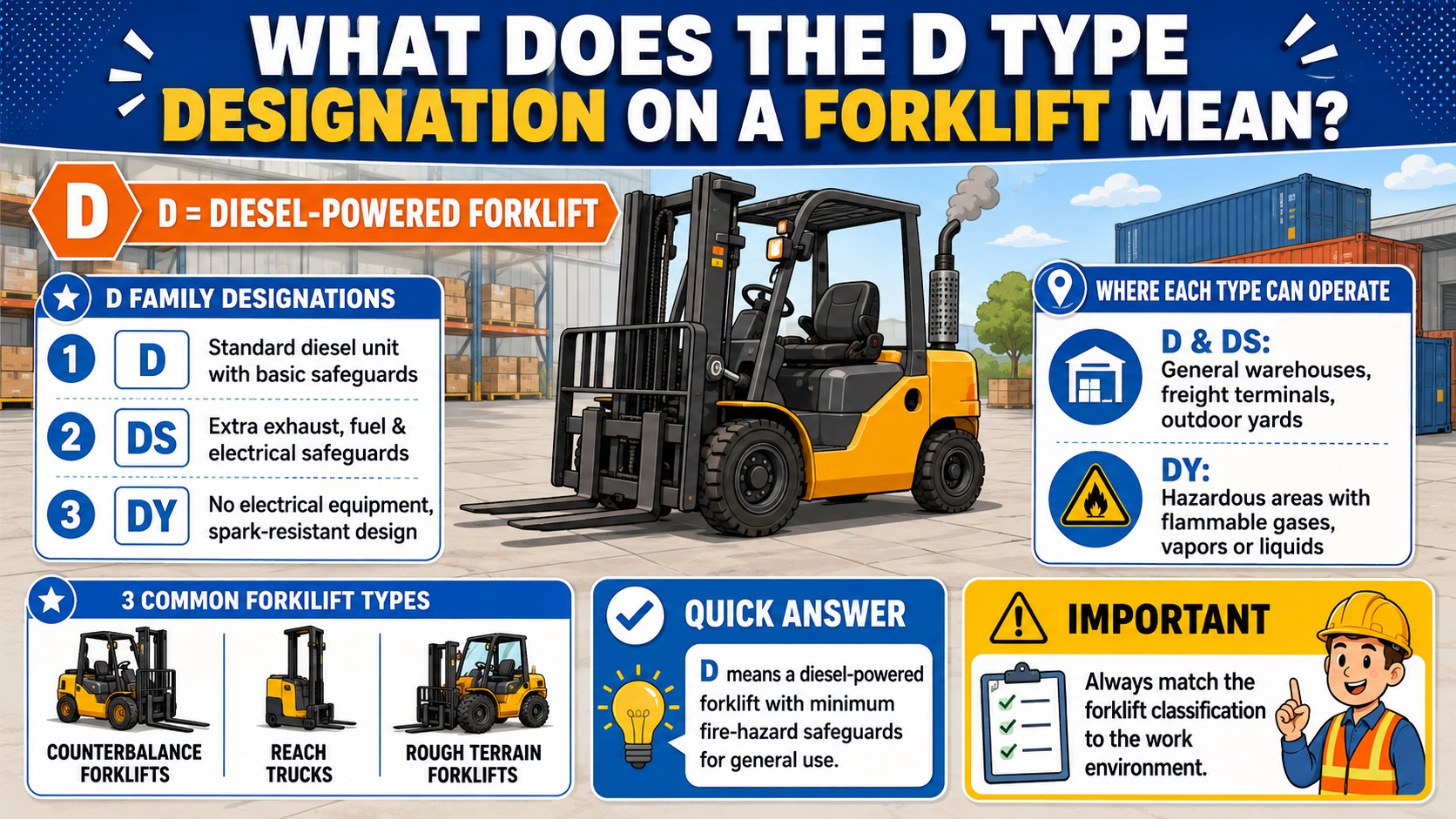
What Does the “D” Type Designation on a Forklift Mean?
Understanding Forklift Safety Designations
Forklift safety classifications are established by OSHA and Underwriters Laboratories (UL) to ensure machines are safely matched with operating environments. These classifications help prevent fires, explosions, and electrical hazards in industrial workplaces.
Among these classifications, the “D” type is one of the most common for diesel-powered machines used in logistics, construction, and warehouse environments.
Modern material handling systems, including Liftron Material Handling, often integrate advanced safety and energy-efficient technologies that complement traditional forklift classifications.
The D Family of Forklift Designations
The “D” category includes several sub-classifications that indicate increasing levels of safety protection depending on operating conditions.
| Designation | Meaning | Application |
|---|---|---|
| D | Standard diesel-powered forklift with basic safeguards | General warehouse and outdoor use |
| DS | Enhanced diesel safety with improved fuel, exhaust, and electrical protection | Moderate-risk industrial environments |
| DY | Diesel unit with no electrical components and spark-resistant design | Highly hazardous environments with flammable materials |
Where D-Type Forklifts Can Be Used
The operating environment is a critical factor in selecting the correct forklift classification. The “D” designation defines where diesel forklifts can safely operate without risk of ignition or fire hazards.
- D & DS forklifts: Suitable for general warehouses, freight terminals, and outdoor yards
- DY forklifts: Designed for high-risk chemical or vapor environments
These classifications ensure that forklifts are matched with environments where flammable gases, vapors, or liquids are either absent or properly contained.
Counterbalance Forklifts and Their Role
Most diesel “D” type forklifts are also classified as counterbalance forklifts, which are the most common type used in industrial operations. These machines use a rear counterweight to balance heavy loads at the front.
Counterbalance forklifts are widely used because they are versatile, easy to operate, and suitable for both indoor and outdoor applications depending on fuel type and safety rating.
In modern material handling environments, companies such as Liftron counterbalance forklifts combine efficiency and advanced engineering to support high-demand logistics operations.
Why the D Classification Matters
The “D” classification is not just a label—it directly impacts workplace safety, insurance compliance, and regulatory approval. Using the wrong forklift in a hazardous environment can lead to severe accidents or regulatory violations.
How OSHA and UL Standards Apply
OSHA and UL standards define how industrial trucks are classified based on ignition risk, fuel type, and electrical safety. These classifications help employers choose the correct equipment for specific jobsite conditions.
- OSHA regulates workplace safety and operator requirements
- UL defines equipment testing and fire safety classifications
- Manufacturers must label forklifts with correct designations
Step-by-Step: Choosing the Right Forklift Type
- Identify environment: Determine if the area contains flammable materials or vapors.
- Check load requirements: Match forklift capacity with typical load weight.
- Select fuel type: Diesel, electric, or LPG depending on safety classification.
- Verify designation: Ensure D, DS, or DY rating matches jobsite risk level.
- Confirm compliance: Review OSHA and UL requirements before operation.
Comparison with Other Forklift Types
Forklifts are generally grouped into three main categories based on application and design:
- Counterbalance forklifts – Most common, versatile lifting design
- Reach trucks – Designed for narrow aisle warehouse storage
- Rough terrain forklifts – Built for outdoor construction environments
Among these, counterbalance forklifts remain the most widely used due to their simplicity and adaptability across industries.
Conclusion
A “D” type designation on a forklift indicates a diesel-powered machine with basic fire safety protections designed for general industrial use. Subcategories such as DS and DY provide enhanced safety levels for more hazardous environments. Understanding these classifications is essential for ensuring compliance, safety, and proper equipment selection in material handling operations.
Modern solutions from Liftron Material Handling continue to improve efficiency and safety across forklift applications, especially in counterbalance forklift operations used in logistics and manufacturing industries.
Add a review
Your email address will not be published. Required fields are marked *