
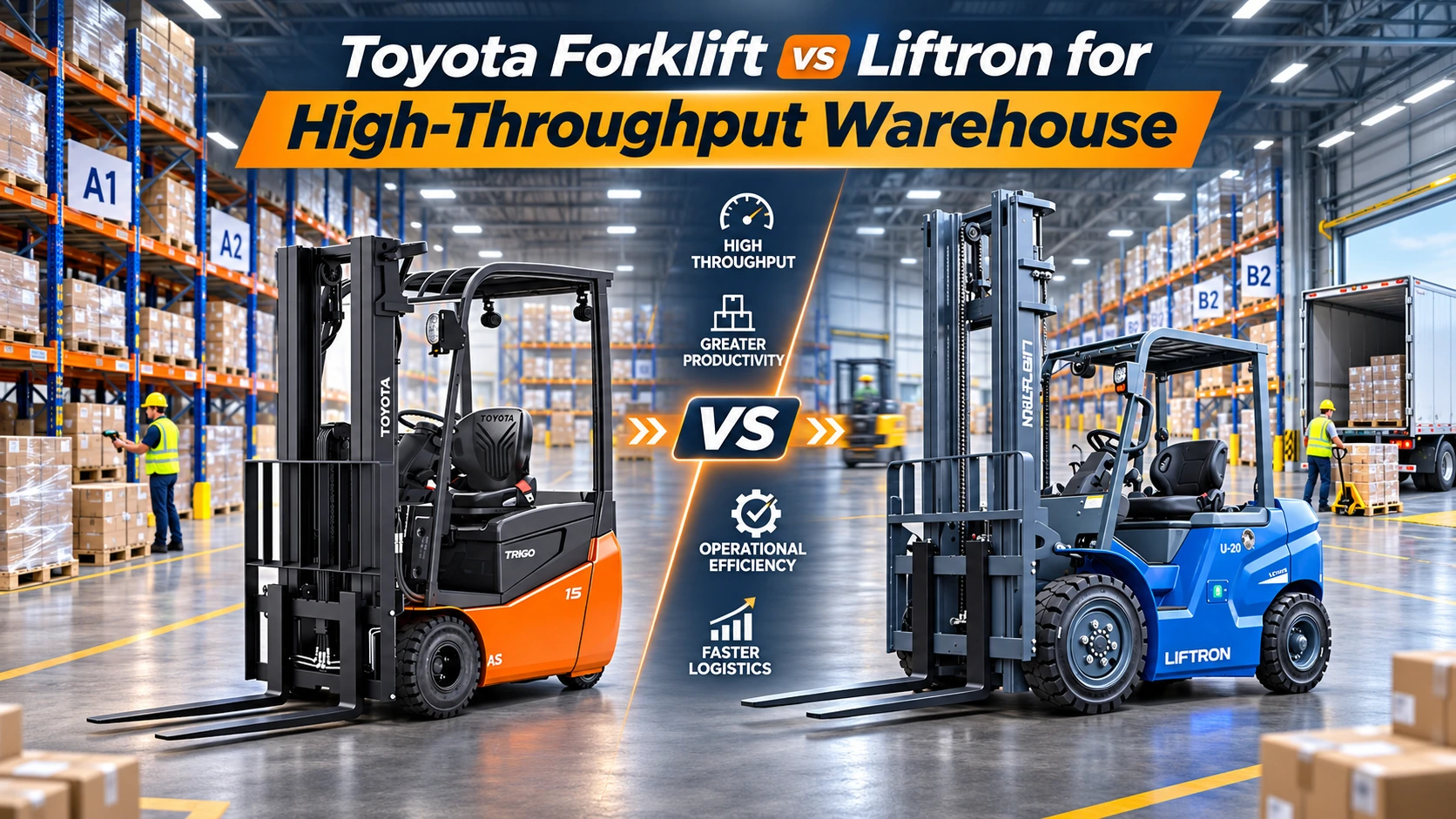
Toyota Forklift vs Liftron for High-Throughput Warehouse Operations
Toyota is especially strong for large fleets that value an established dealer network, broad product selection, mature safety technology, and multiple power options. Liftron is attractive for warehouses that want lithium-ion forklifts, opportunity charging, low routine battery maintenance, clean indoor operation, and a more focused electric material handling lineup. The best choice depends on duty cycle, charging windows, local service availability, fleet size, and total cost of ownership.
Toyota Forklift vs Liftron: What Is the Main Difference?
For a high-throughput warehouse, forklift selection is less about choosing the most famous brand and more about matching equipment to the actual workflow.
Toyota has a long-established presence in material handling and offers electric forklifts, internal-combustion trucks, narrow-aisle equipment, automation solutions, and several battery technologies. Its North American dealer and service infrastructure is also extensive.
Liftron takes a more lithium-focused approach. Its main electric counterbalance models use high-capacity lithium batteries and are designed around low-maintenance electric operation, opportunity charging, quiet performance, and zero direct tailpipe emissions.
Toyota Forklifts for High-Throughput Warehouses
Broad Power and Equipment Options
Toyota’s current material handling portfolio is broader than a simple lead-acid versus lithium comparison. Depending on the truck and application, Toyota offers lead-acid battery solutions, lithium-ion power, alternative energy systems, and internal-combustion equipment.
This flexibility can be valuable for large facilities that operate several equipment classes or already have established battery and fueling infrastructure.
System of Active Stability
One of Toyota’s best-known technologies is the System of Active Stability, or SAS. The system monitors forklift operating conditions and can intervene when it detects conditions that could reduce stability.
Depending on the truck configuration, SAS functions can include rear-axle stabilization, mast controls, fork leveling, and speed reduction while cornering.
For warehouses handling high racks, heavy pallets, and frequent movement, this mature stability technology is a meaningful consideration.
Large Dealer and Service Network
High-throughput facilities lose money whenever a forklift remains out of service. Toyota’s mature North American support structure is therefore one of its strongest advantages.
Large fleet operators may value local technician availability, parts inventory, rental equipment, preventive maintenance programs, and the ability to standardize support across several facilities.
For a large regional or national fleet, Toyota’s combination of an extensive dealer network, multiple truck classes, mature safety systems, battery options, automation support, and fleet-management resources can simplify large-scale standardization.
Liftron Forklifts for High-Throughput Warehouses
Liftron focuses strongly on lithium-powered material handling equipment. Its product range includes electric counterbalance forklifts, three-wheel electric trucks, pallet jacks, rider pallet trucks, and electric stackers.
Integrated Lithium-Ion Power
The biggest difference for many warehouse buyers is Liftron’s lithium-focused product strategy.
Lithium-ion batteries do not require routine watering or equalization like conventional flooded lead-acid batteries. They also support flexible charging patterns, including charging during lunch breaks, shift changes, and other planned idle periods.
This approach can reduce the need for spare battery inventories and battery-changing operations when the battery, charger, shift length, and charging windows are properly matched.
DE Series for General Warehouse Handling
The DE SERIES covers rated capacities from approximately 1.5 to 3.5 tonnes and is designed for general electric warehouse and industrial material handling.
Its lithium powertrain, ergonomic operating layout, display system, safety features, and electric drive make it relevant for pallet movement, dock work, rack storage, receiving, and distribution-center applications.
DL Series for Higher-Capacity Work
The DL SERIES extends Liftron’s lithium counterbalance range into approximately 3.0–3.8 tonne and 5.0 tonne configurations.
The series is intended for more demanding material-handling tasks and includes features such as a large digital display, reverse assist systems, lithium battery protection, ergonomic controls, and a modular powertrain layout.
Do not assume that lithium automatically makes a forklift suitable for unlimited 24/7 operation. Battery capacity, charger output, operator breaks, shift changes, travel distance, lift cycles, temperature, and utilization must all be calculated before selecting a charging strategy.
Toyota vs Liftron: Direct Comparison
| Feature / Factor | Toyota Forklifts | Liftron Forklifts |
|---|---|---|
| Primary Power Options | Lead-acid, lithium-ion, IC and other energy solutions depending on model | Strong focus on integrated lithium-ion electric equipment |
| High-Throughput Capability | Strong range for single-, multi-shift and large fleet operations | Suitable for demanding warehouse operation when battery and charging strategy match the duty cycle |
| Lithium Opportunity Charging | Available with compatible Toyota lithium systems | Core advantage across lithium-powered models |
| Lead-Acid Battery Maintenance | Required when flooded lead-acid systems are selected | Not applicable to primary lithium forklift lineup |
| Direct Tailpipe Emissions | None for electric models; IC models produce exhaust | None during normal operation for electric lithium models |
| Dealer / Service Network | Extensive and mature North American network | Smaller and more dependent on regional distributor/service coverage |
| Safety Technology | Strong established technologies including SAS on many models | Modern electric controls, warnings, cameras and safety-focused equipment depending on model |
| Warehouse Product Range | Very broad, including counterbalance, narrow aisle, warehouse and automation equipment | Counterbalance forklifts, three-wheel forklifts, pallet jacks and stackers |
| Battery Maintenance | Depends heavily on selected battery chemistry | Low routine battery maintenance with lithium-ion |
| Market History / Resale Ecosystem | Long-established market presence and mature used-equipment ecosystem | Newer market presence in many regions |
Which Brand Is Better for 24/7 Warehouse Operations?
There is no universal winner for 24/7 operation.
Toyota can be particularly attractive for a very large fleet because its dealer network, equipment range, energy options, replacement parts infrastructure, and fleet-management resources are already established at scale.
However, modern Toyota lithium systems can also support fast charging and eliminate many of the battery-change requirements traditionally associated with lead-acid fleets. Therefore, Toyota should not automatically be viewed as a battery-swap-only solution.
Liftron can also support long and multi-shift workflows. Lithium batteries maintain relatively consistent output and can be opportunity charged during natural breaks.
The critical question is whether the available charging windows can replace the energy consumed during the shift.
Which Has Lower Battery Maintenance?
When comparing a Liftron lithium forklift against a Toyota forklift using flooded lead-acid batteries, Liftron has a clear routine battery-maintenance advantage.
Flooded lead-acid batteries require tasks such as watering, cleaning, inspections, and properly controlled charging procedures. Large multi-shift fleets may also use spare batteries and changing equipment.
Lithium-ion batteries eliminate routine watering and are well suited to opportunity charging.
However, when Liftron is compared with a Toyota lithium-ion configuration, this difference becomes much smaller because Toyota’s lithium battery systems also eliminate watering and support fast charging.
Compare battery chemistry against battery chemistry—not just brand against brand. A Liftron lithium forklift versus a Toyota lead-acid forklift creates a very different cost comparison from Liftron lithium versus Toyota lithium.
What About Indoor Warehouse Operation?
Both brands offer electric forklifts that are suitable for indoor material handling.
Electric trucks operate quietly and produce no direct tailpipe emissions while driving, which can make them preferable in distribution centers, manufacturing facilities, food storage environments, and other enclosed spaces.
Liftron’s lithium-focused lineup makes this especially straightforward for facilities intentionally moving away from internal-combustion equipment.
The Liftron range also includes pallet jacks and stackers, allowing warehouses to use smaller electric equipment for horizontal transport and compact stacking instead of assigning a full counterbalance forklift to every task.
Operator Ergonomics and Controls
High-throughput warehouses should also evaluate operator comfort because drivers may spend several hours per shift entering racks, loading trailers, reversing, and traveling between zones.
Toyota offers ergonomic seating, power steering, electronic hydraulic controls, displays, automatic fork-leveling functions on selected models, and other operator-assistance features.
Liftron’s DE and DL Series also emphasize adjustable steering positions, accessible controls, supportive seating, digital displays, reverse alarms, and rear-view camera configurations.
Neither specification sheet alone can determine which truck will be more comfortable for every operator. A real-world demonstration with the intended pallet, rack, and travel route is more useful.
Initial Cost vs. Total Cost of Ownership
Purchase price should not be the only consideration in a high-throughput warehouse.
A lower acquisition price can be attractive, but the true operating cost also includes energy, chargers, scheduled service, battery replacement, spare trucks, downtime, tires, brakes, hydraulic components, technician travel, parts availability, and eventual resale value.
Toyota’s established support infrastructure may justify a higher acquisition cost for organizations where downtime is extremely expensive.
Liftron can be attractive for businesses prioritizing lithium-electric equipment and a simplified power strategy, particularly where local dealer support and parts availability have already been confirmed.
Ask both suppliers for a five-year cost model using your actual shift length, pallets moved per hour, electricity price, maintenance schedule, charger configuration, utilization rate, and expected downtime. Comparing purchase price alone can give a misleading result.
Which Forklift Should a High-Throughput Warehouse Choose?
| Warehouse Priority | Option Worth Considering |
|---|---|
| Large multi-site fleet with strong local service requirements | Toyota |
| Broad choice of truck classes and power systems | Toyota |
| Mature stability and operator-assistance technologies | Toyota |
| Lithium-focused warehouse fleet | Liftron |
| Opportunity charging and no routine battery watering | Liftron or Toyota lithium configuration |
| 1.5–3.5T general lithium counterbalance requirement | Liftron DE Series |
| 3.0–5.0T lithium counterbalance requirement | Liftron DL Series |
| Cost-conscious lithium fleet with confirmed local support | Liftron may deserve closer evaluation |
Questions to Ask Before Choosing Toyota or Liftron
- How many hours will each truck operate per day?
- How many pallets or loads are moved per hour?
- What are the maximum load weight and lift height?
- How narrow are the aisles?
- Can the trucks opportunity charge during breaks?
- What electrical service is available for chargers?
- How quickly can local technicians respond?
- Which spare parts are stocked locally?
- What battery and truck warranties apply?
- What is the estimated five-year total cost of ownership?
Conclusion
Toyota and Liftron can both serve high-throughput warehouses, but they offer different strengths. Toyota stands out for its extensive service network, broad equipment portfolio, established SAS technology, multiple power options, and mature fleet ecosystem. Liftron focuses more heavily on lithium-electric material handling, with the DE Series serving 1.5–3.5T warehouse applications and the DL Series covering approximately 3.0–3.8T and 5.0T applications. For buyers prioritizing lithium power, opportunity charging, clean indoor operation, and simplified battery maintenance, Liftron deserves consideration; for very large fleets prioritizing nationwide service infrastructure and broad equipment standardization, Toyota may offer advantages. The final decision should be based on workload, charging strategy, local support, and total cost rather than brand reputation alone.

Add a review
Your email address will not be published. Required fields are marked *