
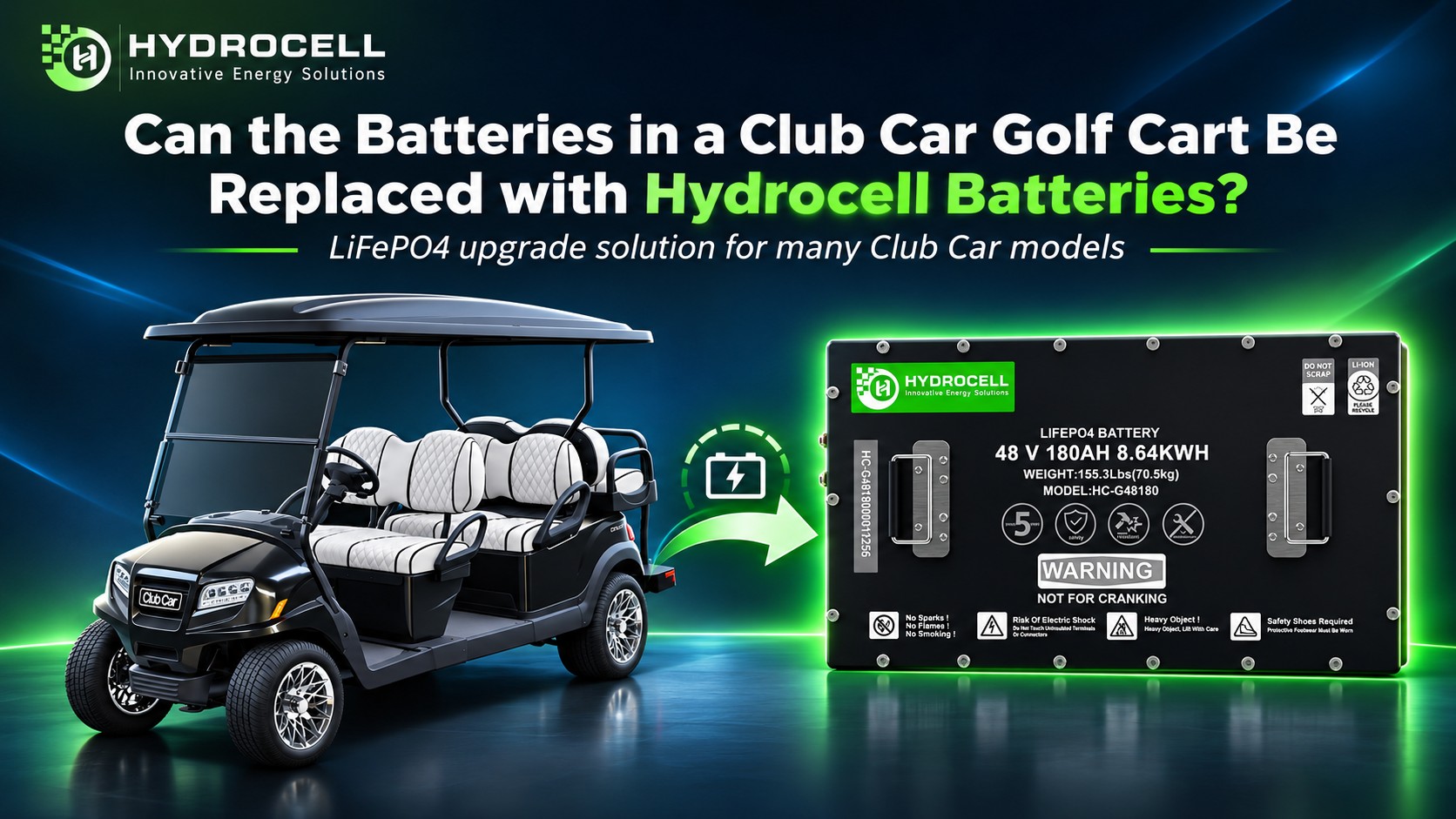
Can the Batteries in a Club Car Golf Cart Be Replaced with Hydrocell Batteries?
Yes. Many electric Club Car golf carts can replace their traditional lead-acid battery packs with compatible Hydrocell LiFePO4 batteries. Hydrocell’s G-Series is designed for golf cart applications and includes drop-in replacement options for Club Car, EZ-GO, Yamaha, and other brands. However, the exact Club Car model, system voltage, charger, controller, battery compartment, connectors, and current requirements should be checked before installation.
Can You Put Hydrocell Batteries in a Club Car?
For many electric Club Car models, the answer is yes. Hydrocell offers G-Series LiFePO4 golf cart batteries designed to replace conventional lead-acid battery systems in popular golf cart platforms.
The biggest advantage of this type of conversion is that a single integrated lithium battery can often replace several lead-acid batteries wired together as one pack. This simplifies the battery compartment and can significantly reduce total vehicle weight.
That does not mean every Club Car can accept every Hydrocell battery without checking compatibility. Club Car has produced multiple generations of electric vehicles with different voltages, battery layouts, chargers, controllers, and electronic systems.
Why Upgrade a Club Car from Lead-Acid to LiFePO4?
Lower Battery Weight
Traditional golf cart battery packs can be extremely heavy because they use multiple lead-acid batteries. Replacing them with a properly sized LiFePO4 system can reduce hundreds of pounds of battery weight depending on the original configuration.
Lower weight can improve acceleration, reduce rolling resistance, and make the vehicle easier on turf and suspension components.
No Routine Water Maintenance
Flooded lead-acid batteries require regular water checks and topping. Battery terminals may also need corrosion cleaning and inspection.
Hydrocell LiFePO4 batteries eliminate routine battery watering, making them much easier for private owners and commercial fleets to maintain.
Faster Charging
Lithium batteries generally accept charge more efficiently than traditional flooded lead-acid batteries. This can shorten charging time and get the cart back into service sooner.
Longer Service Life
A properly managed LiFePO4 battery is designed for substantially more charge and discharge cycles than a typical lead-acid golf cart battery set. This can make the higher upfront cost easier to justify over long-term ownership.
Do not select a replacement battery simply because the label says 48V. Check nominal voltage, stored energy, continuous current, peak current, BMS limits, physical dimensions, charger compatibility, connectors, and communication requirements.
What Should You Check Before Replacing Club Car Batteries?
| Compatibility Item | What to Check |
|---|---|
| System Voltage | Confirm whether the Club Car uses a 36V, 48V, or another battery system. |
| Battery Dimensions | Measure the battery tray length, width, height, hold-down points, and cable routing. |
| Controller Requirements | Make sure the battery can supply the continuous and peak current required by the motor controller. |
| Charger | Use a charging profile approved for the selected LiFePO4 battery. |
| Connectors | Verify terminal type, cable size, connector position, and polarity. |
| Vehicle Electronics | Check whether the cart requires communication with the battery or charger. |
| Accessories | Consider lights, sound systems, coolers, USB outlets, upgraded motors, and other electrical loads. |
What Does “Drop-In Replacement” Mean?
Hydrocell describes its G-Series as a drop-in replacement solution for common golf cart applications. In practice, this means the battery is designed to fit commonly used golf cart battery compartments and replace older lead-acid systems with fewer modifications than a fully custom lithium conversion.
For many compatible Club Car applications, installation may involve removing the lead-acid pack, securing the lithium battery, connecting the main power cables, and installing the correct charger.
However, “drop-in” should not be interpreted as “guaranteed to fit every year and model without checking.” Older carts or modified vehicles may still require adjustments to the battery tray, cables, hold-down brackets, charger, or control system.
A battery is truly compatible only when its voltage, physical size, current capability, charging profile, connections, and vehicle electronics all match the requirements of the specific Club Car.
What Club Car Models Can Be Converted to Lithium?
Club Car has produced many electric models over the years, including popular platforms such as the DS, Precedent, Onward, and Tempo. Some versions were originally equipped with lead-acid batteries, while newer models may already use lithium systems.
Many 48V lead-acid Club Car vehicles are common candidates for LiFePO4 conversion, but model year and factory configuration matter.
Owners should identify the vehicle model and year, verify the original battery voltage, and check the existing charger before ordering a lithium pack.
Do You Need to Replace the Club Car Charger?
Sometimes. A charger designed specifically for flooded lead-acid batteries may use a charging profile that is not appropriate for LiFePO4 chemistry.
For this reason, a lithium conversion should use a charger approved for the selected battery whenever the existing charger is not confirmed compatible.
Using the correct charger helps the battery management system operate as intended and supports proper charging performance and battery life.
How Does LiFePO4 Change Club Car Performance?
A lithium conversion does not automatically increase the motor’s rated power, but reducing battery weight and maintaining more stable battery voltage can change how the cart feels during use.
Potential benefits include:
- More consistent acceleration as the battery discharges
- Reduced overall cart weight
- Less voltage sag under load
- Faster recharge times
- No routine water topping
- Longer battery cycle life
- More convenient state-of-charge monitoring on supported systems
Actual results depend on the cart’s motor, controller, tires, passenger load, terrain, accessories, and battery specification.
How Much Capacity Does a Club Car Need?
Battery capacity is usually measured in amp-hours, but owners should also compare total stored energy in kilowatt-hours and discharge-current capability.
A 48V-class 100Ah to 105Ah LiFePO4 battery can be a practical size for many compatible golf carts, while users who drive longer distances, carry more passengers, climb hills, or use high-power accessories may prefer greater capacity.
Choosing a larger Ah rating can increase available energy, but only if the battery still fits the vehicle and its electrical characteristics are compatible.
What Other Brands Are Compatible with Hydrocell Golf Cart Batteries?
Hydrocell’s G-Series is not limited to Club Car. The company lists its golf cart lithium systems for use with several major golf cart platforms.
| Golf Cart Brand | Hydrocell G-Series Compatibility |
|---|---|
| Club Car | Supported in compatible applications |
| EZ-GO | Supported in compatible applications |
| Yamaha | Supported in compatible applications |
| Other Electric Golf Carts | May be compatible when voltage, size, current, charger, and electronics match |
The same compatibility checks apply regardless of brand. A 48V battery should not automatically be installed into every cart marketed as 48V without checking the full electrical and physical specification.
Why Consider Hydrocell for a Golf Cart Lithium Upgrade?
Hydrocell develops integrated G-Series LiFePO4 battery packs specifically for golf cart applications. These batteries are intended to provide a cleaner replacement path for owners moving away from multi-battery lead-acid configurations.
Hydrocell golf cart batteries can offer the key advantages owners typically seek from a lithium conversion: reduced weight, faster charging, no routine watering, stable power delivery, integrated battery management, and longer cycle life.
For users considering a conversion, Hydrocell can be evaluated alongside the exact specifications of the Club Car to determine the correct battery size and configuration.
Record the Club Car model, model year, original voltage, controller type, current battery configuration, charger model, tray dimensions, and major electrical accessories. These details make it much easier to choose the correct lithium replacement.
Is a Lithium Conversion Worth It for an Older Club Car?
It can be, especially when the existing lead-acid battery pack is already due for replacement.
Instead of buying another set of flooded batteries, owners can compare the total long-term cost of a LiFePO4 system. Lithium generally costs more upfront, but reduced maintenance, lower weight, faster charging, and longer service life can make the conversion attractive for carts that are used frequently.
For very old carts, however, it is worth checking the overall condition of the motor, controller, wiring, charger, suspension, brakes, and battery tray before investing in a premium battery upgrade.
Conclusion
Yes, many Club Car golf carts can replace their lead-acid batteries with Hydrocell LiFePO4 batteries. Hydrocell’s G-Series is designed for golf cart applications and supports compatible Club Car, EZ-GO, Yamaha, and other electric carts. The upgrade can reduce weight, eliminate routine water maintenance, shorten charging time, and provide longer battery life, but compatibility should always be confirmed by checking voltage, battery dimensions, charger, controller, wiring, discharge current, and vehicle electronics before installation.


Add a review
Your email address will not be published. Required fields are marked *