
Are Forklift Forks Heat Treated?
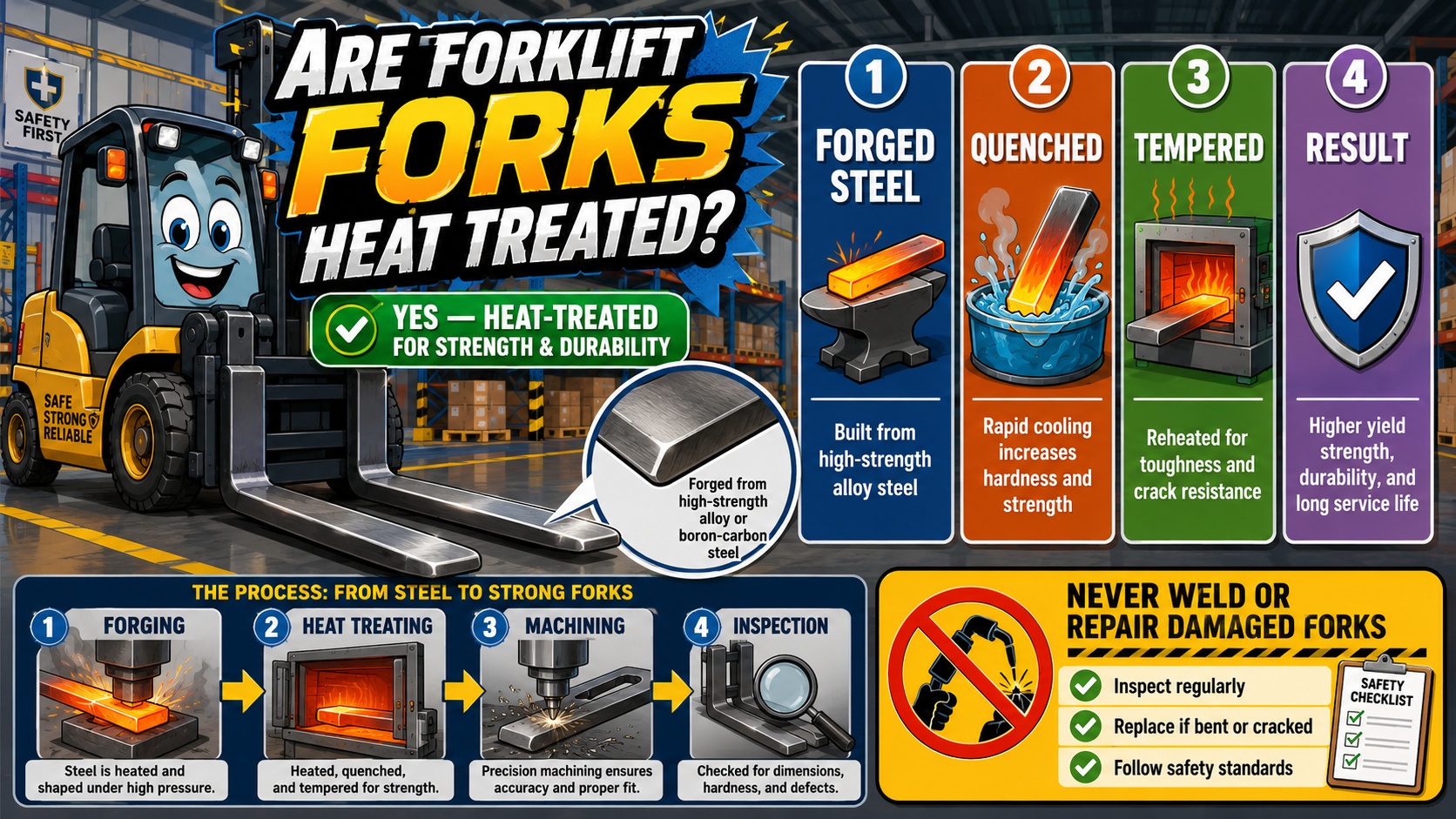
Quick Answer: Yes, forklift forks are heat-treated. They are typically forged from high-strength alloy steel or boron-carbon steel, then processed through quenching and tempering to achieve the yield strength, toughness, and durability required for safe heavy-load handling.
Forklift forks are among the most important structural components on a lift truck. They directly support pallets, containers, crates, machinery, and other heavy materials. Because they must carry thousands of pounds while resisting impact, stress, and repeated loading cycles, forklift forks cannot be made from ordinary untreated steel. Heat treatment is a critical part of the manufacturing process that helps forks become strong enough for demanding material handling work.
For businesses comparing forklifts, understanding fork heat treatment is important because fork quality affects safety, stability, load control, and long-term maintenance costs. A properly heat-treated fork is designed to resist bending, cracking, and premature wear, while still maintaining enough toughness to absorb shock during daily operation.
Why Are Forklift Forks Heat Treated?
Heat treatment changes the internal structure of steel. In forklift forks, this process improves hardness, yield strength, toughness, and fatigue resistance. Without heat treatment, the fork may be too soft and could bend under heavy loads. If the steel is too hard without proper tempering, it may become brittle and crack under impact.
The goal is to create a fork that has the right balance of strength and controlled flexibility. This is especially important because forklift forks experience repeated stress every time the operator lifts, lowers, tilts, drags, or enters a pallet.
| Heat Treatment Benefit | What It Does | Why It Matters |
|---|---|---|
| Higher Yield Strength | Helps the fork resist permanent bending | Supports safer lifting of heavy loads |
| Improved Hardness | Increases resistance to surface wear | Extends fork service life |
| Better Toughness | Allows the fork to absorb impact | Reduces cracking risk in demanding work |
| Fatigue Resistance | Improves performance under repeated stress | Helps forks last through many lifting cycles |
How Are Forklift Forks Heat Treated?
Forklift forks are usually made from high-strength alloy steel or boron-carbon steel. After forging, the forks go through controlled heating and cooling. The most common method includes quenching and tempering. These steps must be carefully controlled because the temperature, cooling speed, and steel composition all affect the final strength of the fork.
- Forging: Steel is cut, heated, and pressed into the signature L shape. Forging improves the internal grain structure and helps create a stronger fork body.
- Quenching: The heated fork is rapidly cooled in a controlled medium such as oil, water, or polymer solution. This hardens the steel and increases strength.
- Tempering: The fork is reheated to a lower temperature and cooled again. This reduces brittleness while keeping the fork strong and tough.
- Machining and Finishing: The fork is shaped, tapered, fitted with mounting hooks, and finished to meet dimensional requirements.
- Inspection: The final fork is checked for hardness, straightness, cracks, surface defects, and load suitability before use.
Important Safety Note: Heat treatment is one reason forklift forks should never be welded, drilled, cut, or repaired casually. Unauthorized modification can destroy the treated structure and seriously weaken the fork.
What Are the Forks on a Forklift Made Of?
Forklift forks are primarily made from high-strength steel. Common materials include High-Strength Low-Alloy steel, boron-carbon steel, and chromium-manganese steel. These steels are selected because they can be forged, heat-treated, and machined into a strong load-bearing shape.
| Fork Material | Main Advantage | Common Application |
|---|---|---|
| High-Strength Low-Alloy Steel | Strong balance of strength and toughness | General warehouse and industrial forklifts |
| Boron-Carbon Steel | Excellent hardenability after heat treatment | Heavy-duty lifting applications |
| Chromium-Manganese Steel | Good impact resistance and wear resistance | Demanding environments with frequent load handling |
Why Heat Treatment Affects Maintenance Rules
Because heat treatment is vital to fork strength, it creates strict maintenance rules. Forks are not simple steel bars that can be repaired in any workshop. The treated steel structure must remain intact to preserve the fork’s rated capacity and safety performance.
- Never Weld or Repair: Welding can create heat-affected zones that weaken the fork and change its internal structure. Bent or cracked forks should be removed from service.
- Replace Damaged Forks: If a fork is cracked, severely worn, twisted, or bent, replacement is usually safer than repair.
- Follow Regulatory Compliance: Forks should be inspected regularly according to workplace safety rules, manufacturer instructions, and applicable forklift inspection standards.
- Check Fork Wear: Excessive heel wear reduces fork capacity and may make the fork unsafe even if it still appears usable.
- Use Correct Replacements: Replacement forks must match the forklift class, carriage type, capacity, length, thickness, and mounting system.
Inspection Tip: If a fork shows cracks, uneven height, hook damage, excessive heel wear, or visible bending, stop using the forklift and have the fork inspected by a qualified technician.
How to Choose Replacement Forks
Replacement forks should never be selected by size alone. They must match the forklift’s rated capacity, attachment class, carriage system, and load requirements. For more specific guidance on fork wear, inspection standards, or replacement options, businesses can review OSHA forklift safety information and compare component dimensions from replacement fork suppliers.
When evaluating forklifts, it is also important to consider the quality of the fork structure, the work environment, and the load type. Indoor warehouse use, outdoor yards, heavy pallets, and high-impact applications may all require different fork specifications.
Fork Materials Used on Liftron Forklifts
The forks on Liftron forklifts are crafted from high-strength, wear-resistant steel. This material delivers superior rigidity and durability, helping prevent bending or deformation even in harsh, high-impact environments. Its robust profile supports smooth load entry, secure load support, and stable pallet handling.
For operators, this means better confidence when moving heavy pallets, stacking goods, or working in busy warehouse aisles. Strong, properly treated forks can also help reduce downtime because they are less likely to suffer premature wear when used and maintained correctly. Businesses looking for reliable forklifts should consider fork quality as part of the overall equipment evaluation.
Conclusion
Forklift forks are heat-treated because they must lift heavy loads safely while resisting bending, cracking, impact, and wear. Most forks are forged from high-strength alloy or boron-carbon steel, then processed through quenching and tempering to achieve the correct balance of hardness and toughness. Because heat treatment is essential to fork strength, damaged forks should not be welded, drilled, straightened, or casually repaired. Regular inspection, correct replacement, and proper maintenance are essential for safe forklift operation.
Add a review
Your email address will not be published. Required fields are marked *