
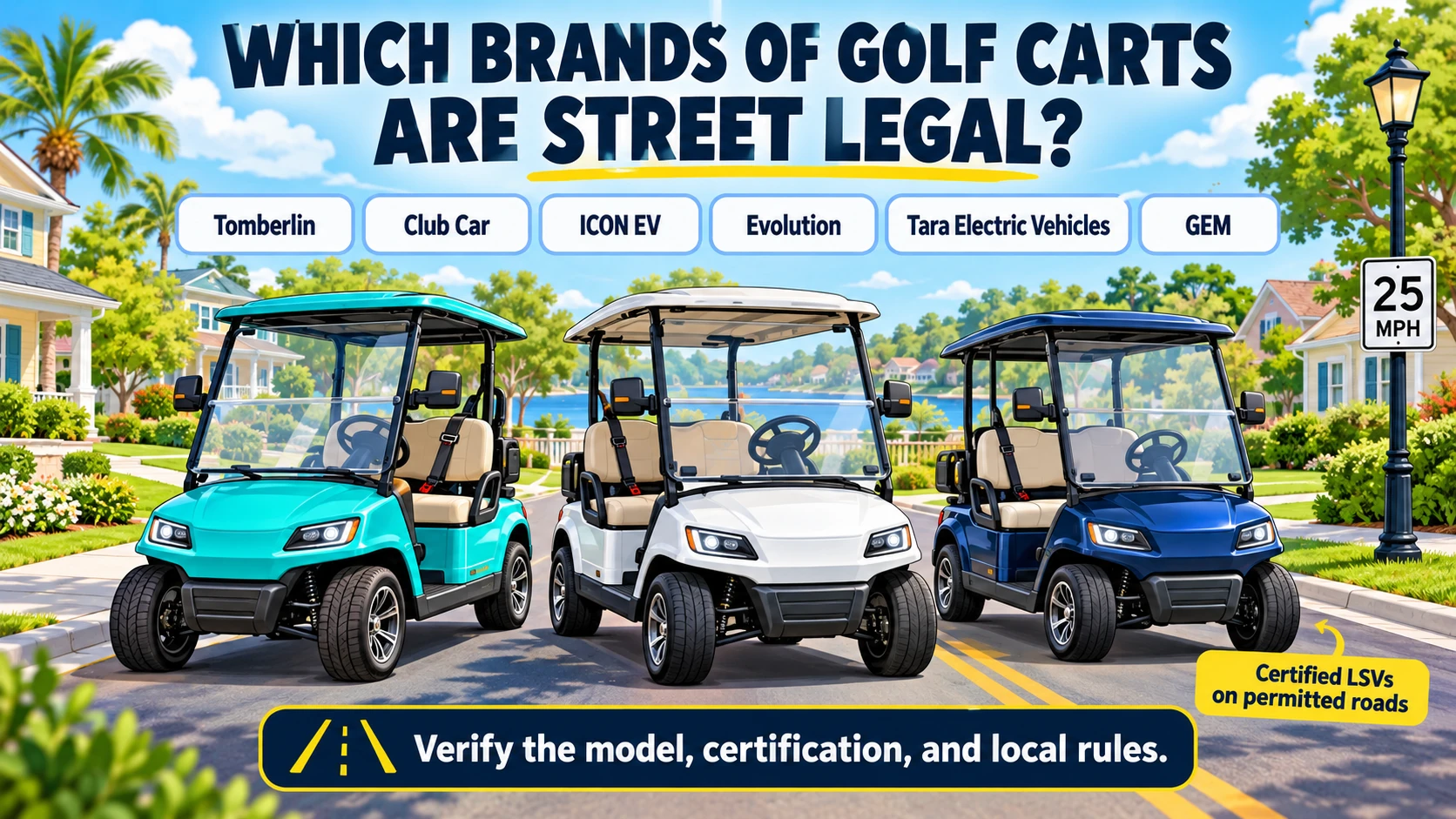
Which Brands of Golf Carts Are Street Legal?
Quick Answer: Look for a factory-certified low-speed vehicle, not simply a familiar golf cart brand. Verify the specific vehicle’s certification label, VIN, title paperwork, required equipment, and eligibility for registration before buying.
Street-Legal Golf Cart and LSV Brands to Consider
Several manufacturers serve the neighborhood transportation market. However, golf carts, personal transportation vehicles, and road-certified models may appear in the same product range. The following comparison is a starting point, not a guarantee that every vehicle from each brand is street legal.
| Brand | Road-Use Options | What to Check |
|---|---|---|
| Tomberlin | LSV configurations in its neighborhood vehicle range | Specific configuration, certification, and registration documents |
| Club Car | CRU and designated Onward LSV models | Market availability and the LSV designation |
| ICON EV | Street-legal LSV configurations | Ordered configuration and title eligibility |
| Evolution Electric Vehicles | LSVs alongside off-road vehicles | Vehicle classification and certification label |
| Tara Electric Vehicles | Roadster and Explorer configurations to discuss with a dealer | LSV certification and local registration eligibility |
| GEM | Purpose-built passenger and utility LSVs | Seating, equipment, and permitted routes |
Tomberlin
Tomberlin markets electric low-speed vehicles for neighborhood transportation. Its lineup includes Engage and E-Merge vehicles, with equipment and configurations varying by model. Ask the dealer to identify the certified LSV version rather than relying on appearance or advertised speed.
Club Car
Club Car offers designated street-use vehicles, including CRU and Onward LSV options in applicable markets. A regular course cart or another Onward configuration should not automatically be treated as equivalent. Confirm the exact model designation on the purchase documents.
ICON EV
ICON EV offers vehicles that can be configured for street-legal use. Buyers should distinguish a golf cart configuration from a certified LSV. Lights, mirrors, and a touchscreen are useful features, but they do not independently prove registration eligibility.
Evolution Electric Vehicles
Evolution’s manufacturer information lists both low-speed and off-road vehicle categories. This makes vehicle-specific verification particularly important. Request certification and ownership paperwork for the actual unit being purchased, rather than assuming every model carries the same road-use status.
Tara Electric Vehicles
Tara Electric Vehicles offers golf-focused and personal transportation models. Buyers considering Roadster 2, Roadster 2+2, or Explorer 2+2 for public roads should confirm the supplied configuration’s LSV certification with an authorized dealer. Spirit Air and Spirit Plus are golf-focused options and should not automatically be described as road-certified vehicles.
GEM
GEM specializes in electric low-speed passenger and utility vehicles. Although often associated with Polaris historically, GEM is now owned by Waev. Its purpose-built LSV approach makes it relevant for neighborhood, campus, and commercial transportation, subject to local operating rules.
What Makes a Golf Cart Street Legal?
Federal LSV Classification
Under the federal definition, an LSV has four wheels, a gross vehicle weight rating below 3,000 pounds, and an attainable speed greater than 20 mph but no more than 25 mph under specified testing. Manufacturers self-certify compliance with applicable federal standards; NHTSA does not individually approve each model.
Required Safety Equipment
FMVSS 500 requires lighting, reflectors, specified mirrors, a parking brake, a compliant windshield, a VIN, and compliant seat belts at designated seating positions. It also addresses rear visibility and applicable pedestrian alert sounds. A decorative windshield or basic light kit is insufficient.
Check state requirements for additional items such as windshield wipers and horns. Wipers are not explicitly listed in FMVSS 500’s equipment list, so avoid treating every local requirement as a universal federal rule.
State and Local Operating Rules
Federal vehicle compliance does not authorize travel on every street. Many jurisdictions permit LSVs on roads posted at 35 mph or less, but route restrictions and crossing rules vary. Confirm title, registration, insurance, licensing, and local operating requirements with the relevant authorities.
Buying Tip: Ask for the VIN, certification-label details, and manufacturer’s certificate of origin before paying a deposit. Have your motor vehicle agency confirm that the documents support registration for your intended use.
What Is the Difference Between an LSV and a Golf Cart?
A golf cart is generally designed for golf courses and similar environments. An LSV is a federally defined motor vehicle category. Adding accessories or increasing speed does not, by itself, complete a lawful conversion.
| Feature | Standard Golf Cart | Certified LSV |
|---|---|---|
| Primary purpose | Golf and private-property transportation | Low-speed transportation on permitted public roads |
| Speed | Typically below LSV speeds; definitions vary | Greater than 20 mph, up to 25 mph under federal testing |
| Federal status | Not automatically certified under FMVSS 500 | Subject to applicable LSV standards |
| Identification | May have a manufacturer serial number | Requires a compliant VIN |
| Public-road access | Possible only where specific rules allow | Subject to registration and road restrictions |
How to Choose a Street-Legal Golf Cart
- Check your routes: Verify that your planned streets allow the vehicle category.
- Verify certification: Match the VIN and compliance information to the actual vehicle.
- Confirm registration: Review documents, insurance, and driver requirements before purchase.
- Compare practical needs: Consider seating, payload, hills, charging access, and service support.
- Test-drive the configuration: Check braking, visibility, passenger comfort, and turning space.
When comparing options from Tara Electric Vehicles, explain your intended routes and passenger needs to the dealer so the proposed configuration matches your application.
Conclusion
Tomberlin, Club Car, ICON EV, Evolution Electric Vehicles, Tara Electric Vehicles, and GEM are brands to consider when shopping for a street-legal golf cart or LSV. However, road eligibility depends on the specific vehicle and configuration, not the brand name alone. Before purchasing, verify its certification label, VIN, safety equipment, and registration documents.
The key difference between a golf cart and an LSV is the vehicle’s classification and applicable safety requirements. Choose a model that meets your passenger, range, and charging needs, then confirm insurance, licensing, and permitted routes with your state and local authorities. Checking these details helps you select a vehicle suited to both your daily transportation needs and the roads you intend to use.

Add a review
Your email address will not be published. Required fields are marked *