
What Is a Straddle Stacker?
What Is a Straddle Stacker?
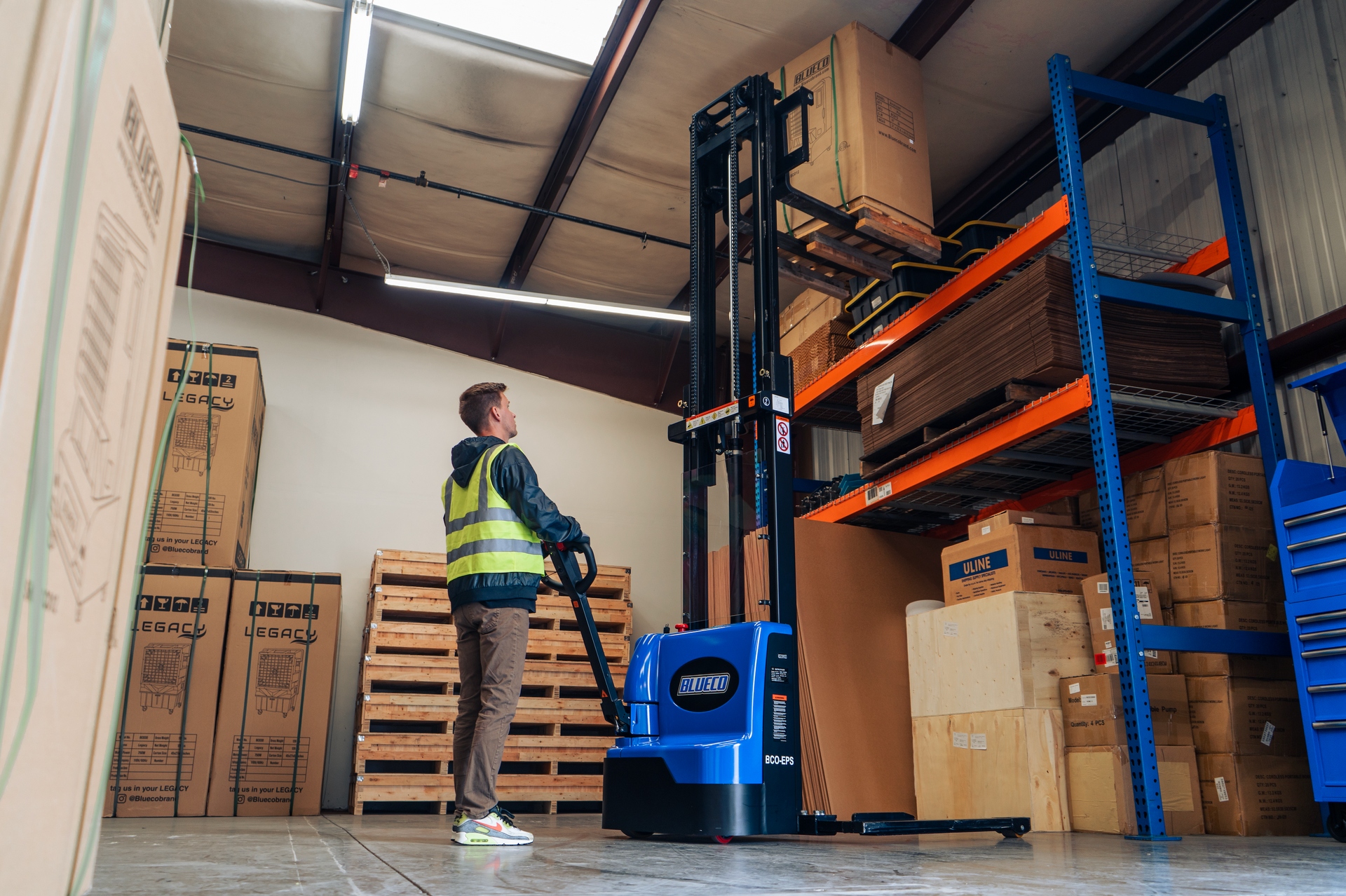
A straddle stacker is a warehouse lifting machine designed to raise, move, and stack pallets. It looks smaller than a traditional forklift but still includes forks, a mast, wheels, and an operator control handle. Its most important feature is the pair of forward support legs, also called outriggers or straddle legs.
These legs extend forward on both sides of the pallet. Instead of placing the entire load in front of the machine like a counterbalance forklift, the stacker supports the load within or between its straddle legs. This gives the machine better stability in compact spaces.
Straddle stackers are commonly used in warehouses, retail storage rooms, manufacturing plants, distribution centers, small workshops, and facilities where a full-sized forklift may be too large or too expensive.
Businesses looking for compact warehouse handling solutions can compare stacker options from Liftron Material Handling, including fork-over and straddle stacker models for different pallet handling needs.
How Straddle Stackers Work
The “Straddle” Design
The name “straddle stacker” comes from the way the machine’s support legs straddle the load. The legs move along the outside of the pallet while the forks slide under the pallet. This design helps stabilize the stacker while lifting.
Because the load is supported closer to the machine’s base, the stacker can lift pallets without needing a large rear counterweight. This makes it smaller and easier to operate in tight areas.
Lifting and Stacking
A straddle stacker uses a mast and hydraulic lifting system to raise and lower the forks. The operator positions the forks under the pallet, lifts the load, moves it to the correct location, and places it onto a rack, shelf, truck area, or storage position.
The load should always be carried low while traveling and raised only when stacking or placing the pallet.
Power Types
Straddle stackers may be manual, semi-electric, or fully electric. Manual models require more operator effort. Semi-electric models usually offer powered lifting but manual travel. Fully electric models provide powered travel and powered lifting for higher productivity.
| Stacker Type | How It Works | Best Use |
|---|---|---|
| Manual Straddle Stacker | Operator manually moves and pumps the stacker | Light-duty and occasional use |
| Semi-Electric Straddle Stacker | Electric lifting with manual pushing or pulling | Small warehouses and moderate use |
| Fully Electric Stacker | Powered travel and powered lifting | Frequent warehouse operation |
Advantages of a Straddle Stacker
1. Narrow Aisle Maneuverability
One of the biggest advantages of a straddle stacker is its compact turning ability. It requires less operating space than many traditional forklifts, making it useful in narrow aisles, small stockrooms, and high-density storage areas.
When a warehouse does not have enough aisle width for a large forklift, a straddle stacker may be a practical alternative.
2. Versatility
Straddle stackers are versatile because their support legs and forks may accommodate different pallet sizes and load styles, depending on the model. They can be used for stacking pallets, moving inventory, loading workstations, and organizing storage areas.
3. Cost-Effective Operation
A straddle stacker is usually much cheaper to purchase and maintain than a full-sized forklift. It also uses less space, requires less fuel or battery power, and may be easier to fit into small warehouse operations.
For small businesses, retail storage areas, and light industrial users, this can make a straddle stacker a smart investment.
Common Uses for Straddle Stackers
- Stacking pallets in warehouse racks
- Moving pallets through narrow aisles
- Loading and unloading light goods
- Replenishing inventory in storage areas
- Supporting production lines
- Handling pallets in retail stockrooms
- Working in small warehouses with limited space
- Moving loads on smooth indoor floors
What Is the Difference Between a Fork Over Stacker and a Straddle Stacker?
A fork over stacker and a straddle stacker look similar, but they handle pallets differently.
A fork over stacker has forks that sit directly over the support legs. It is typically best for open-bottom pallets or skids where the legs can fit under the pallet. A straddle stacker has wider support legs that go around the pallet, allowing it to handle more pallet styles, including closed-bottom pallets in many applications.
| Feature | Fork Over Stacker | Straddle Stacker |
|---|---|---|
| Support Leg Position | Legs sit under the forks | Legs straddle the pallet from the sides |
| Pallet Compatibility | Best for open-bottom pallets | More flexible for different pallet styles |
| Stability | Stable for suitable pallet types | Strong stability due to outer support legs |
| Space Requirement | Compact and simple | May need slightly more width because of straddle legs |
| Common Use | General pallet stacking | Mixed pallet handling and narrow aisle storage |
What Types of Stackers Does Liftron Material Handling Offer?
Liftron Material Handling offers stacker solutions designed for compact warehouse handling. Two important options include the CDD15 Fork Over Stacker and the CTD15 Straddle Stacker.
| Liftron Model | Stacker Type | Typical Application |
|---|---|---|
| CDD15 Fork Over Stacker | Fork over stacker | Efficient stacking for open-bottom pallets and indoor warehouse use |
| CTD15 Straddle Stacker | Straddle stacker | Stable pallet handling with straddle-leg support for tighter spaces |
When Should You Choose a Straddle Stacker?
A straddle stacker is a good choice when your facility needs to lift pallets but does not have enough room or budget for a traditional forklift. It is especially useful when operations involve narrow aisles, moderate lift heights, and indoor pallet storage.
Choose a straddle stacker when:
- You need to stack pallets in tight spaces.
- Your warehouse floor is smooth and level.
- Your loads are within the stacker’s rated capacity.
- You handle different pallet styles.
- You want a lower-cost alternative to a forklift.
- Your operation does not require outdoor rough-terrain travel.
How to Operate a Straddle Stacker Safely
- Inspect the stacker before use.
- Check the battery, wheels, forks, mast, and controls.
- Confirm the load weight is within the rated capacity.
- Adjust the forks or support legs if the model allows it.
- Approach the pallet slowly and squarely.
- Insert the forks fully under the pallet.
- Lift the load only high enough for travel.
- Move slowly through aisles and corners.
- Raise the load only when stacking or placing it.
- Keep pedestrians away from the operating area.
- Lower the forks fully before parking.
- Charge or maintain the stacker according to manufacturer instructions.
Straddle Stacker vs Forklift
| Comparison | Straddle Stacker | Traditional Forklift |
|---|---|---|
| Size | Compact | Larger |
| Cost | Lower purchase and maintenance cost | Higher cost |
| Aisle Use | Good for tighter spaces | Needs more turning room |
| Lift Capacity | Light to medium loads | Medium to heavy loads |
| Best Environment | Indoor smooth floors | Indoor and outdoor depending on type |
| Operator Position | Walk-behind or walkie style | Sit-down, stand-up, or rider style |
Common Mistakes to Avoid
- Using a straddle stacker on rough or uneven floors
- Overloading the stacker beyond rated capacity
- Traveling with the load raised too high
- Turning sharply with an elevated load
- Ignoring pallet compatibility
- Operating too fast in narrow aisles
- Failing to inspect wheels and brakes
- Using the wrong stacker type for the pallet style
- Allowing untrained operators to use the equipment
Conclusion
A straddle stacker is compact material handling equipment used to lift, move, and stack pallets in warehouses and storage areas. Its straddle-leg design provides stability and allows it to handle various pallet styles while working in tighter spaces than many traditional forklifts.
The main difference between a fork over stacker and a straddle stacker is how the support legs interact with the pallet. Fork over stackers are best for open-bottom pallets, while straddle stackers offer more flexibility for different pallet styles.
For businesses comparing stacker options, Liftron Material Handling offers the CDD15 Fork Over Stacker and CTD15 Straddle Stacker for efficient indoor pallet handling.

Add a review
Your email address will not be published. Required fields are marked *