
How Does a Straddle Stacker Lift Work?
How Does a Straddle Stacker Lift Work?
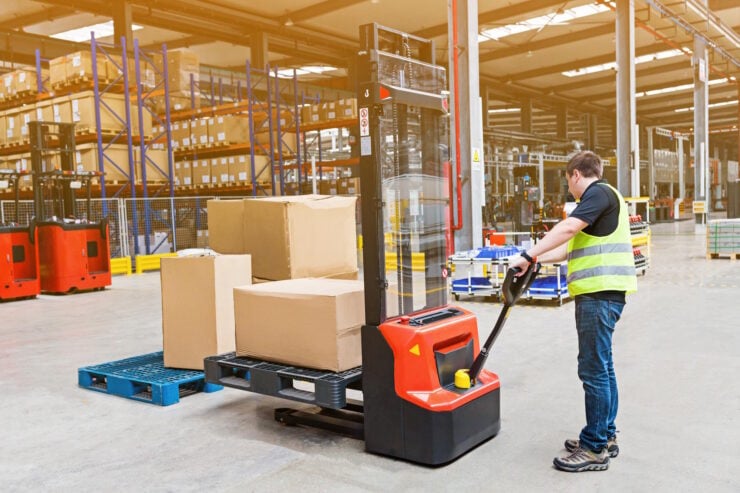
A straddle stacker works by combining a hydraulic lifting system with a stable straddle-leg base. The operator positions the stacker so that the two forward support legs sit on the outside of the pallet or load. The forks slide under the pallet, and the mast raises the load vertically.
Unlike a standard counterbalance forklift, a straddle stacker does not depend on a heavy rear counterweight to balance the load. Instead, its two base legs extend forward and support the machine close to the load area. This design keeps the center of gravity low and helps improve stability during lifting.
Straddle stackers are commonly used in warehouses, stockrooms, small distribution centers, manufacturing areas, and facilities where aisle space is limited. They are especially useful when the operation needs pallet lifting but does not require a full-size riding forklift.
Main Parts Involved in the Lifting Process
| Part | Function |
|---|---|
| Straddle Legs | Extend around the pallet and provide load stability |
| Forks | Slide under the pallet and support the load |
| Mast | Guides the forks upward and downward |
| Hydraulic Pump | Creates pressure to raise the lift cylinder |
| Lift Cylinder | Uses hydraulic pressure to move the mast and forks |
| Load Wheels | Support weight near the front base legs |
| Tiller Handle | Allows the operator to steer and control the stacker |
The Lifting Process Step by Step
1. Positioning the Stacker
The operator first moves the straddle stacker toward the pallet. The straddle legs must wrap around the outside of the pallet or load area. This is where the machine gets its name: the support legs “straddle” the load.
At the same time, the forks are lined up with the pallet openings or underside of the load. The operator should approach the pallet slowly and squarely so the forks enter evenly.
2. Sliding the Forks Under the Load
Once the stacker is properly aligned, the forks slide underneath the pallet. The forks must be inserted fully enough to support the load evenly. If the forks are only partially inserted, the pallet may tip, slide, or become unstable during lifting.
Good fork positioning is essential for safe lifting. The load should be centered from side to side, and the weight should be distributed evenly across both forks.
3. Activating the Hydraulic System
The lifting action is created by hydraulic pressure. Depending on the model, the hydraulic pump may be powered manually or electrically.
On a manual or semi-electric unit, the operator may use a foot pedal, hand pump, or powered lift button. On an electric stacker, a battery-powered motor drives the hydraulic pump.
4. Raising the Mast and Forks
As hydraulic fluid is forced into the cylinder, the cylinder extends and raises the mast carriage. The forks move upward along the mast rails, lifting the pallet vertically.
The mast keeps the load aligned as it rises. Lift chains, rollers, and guide rails help control the movement and maintain smooth lifting.
5. Stabilizing the Load
The straddle legs help stabilize the load by keeping support points close to the pallet. This reduces the need for a massive counterweight and allows the machine to remain compact.
Because the load is supported within the wheelbase and straddle-leg structure, the stacker can lift pallets in tighter spaces than many full-size forklifts.
Manual, Semi-Electric, and Fully Electric Lifting
Not all straddle stackers lift in the same way. The basic hydraulic principle is similar, but the power source can differ.
| Stacker Type | Lifting Method | Best Use |
|---|---|---|
| Manual Straddle Stacker | Operator pumps hydraulic system by hand or foot | Light-duty and occasional lifting |
| Semi-Electric Straddle Stacker | Electric lift with manual travel | Small warehouses and moderate stacking tasks |
| Fully Electric Stacker | Battery-powered lifting and travel | Frequent use and higher productivity environments |
Why Straddle Legs Improve Stability
The straddle-leg design is the key feature that separates straddle stackers from fork-over stackers and many other compact lifting machines. The legs extend forward on both sides of the pallet, creating a stable base around the load.
Because the load stays close to the support wheels and base structure, the center of gravity remains more controlled. This allows the stacker to lift without the large cast-iron counterweight used on a standard sit-down forklift.
However, operators must still be careful. Stability can be affected by load weight, lift height, floor condition, pallet condition, and turning speed.
Are Straddle Stackers Safer Than Riding Forklifts?
Straddle stackers can be safer than riding forklifts in certain applications, but they are not automatically safer in every situation. Safety depends on matching the equipment to the job.
A walkie straddle stacker is usually smaller, slower, and easier to maneuver in tight spaces. Because the operator walks behind or beside the machine, visibility around the load can be good in small warehouse areas. These features can reduce risks in compact operations.
However, a riding forklift may be safer and more efficient for heavier loads, long travel distances, high-volume dock work, outdoor operation, or rough surfaces. The right choice depends on the work environment.
| Equipment | Safety Advantage | Limitation |
|---|---|---|
| Straddle Stacker | Compact, slower, good for tight indoor areas | Limited capacity and travel speed |
| Riding Forklift | Better for heavy loads and long travel | Needs more aisle space and operator training |
How Much Weight Can a Stacker Lift?
The lifting capacity of a stacker depends on the model, mast height, load center, battery system, and frame design. Many light and medium-duty stackers lift between 1,000 and 3,000 pounds, while some industrial models may lift more.
A common warehouse straddle stacker capacity is around 2,000 to 3,300 pounds. For example, many 1.5-ton class stackers are designed to lift approximately 3,000 to 3,300 pounds under rated conditions.
The actual safe capacity may decrease at higher lift heights or with off-center loads. Always check the stacker’s data plate before lifting.
| Stacker Capacity Range | Typical Application |
|---|---|
| 1,000–2,000 lb | Light stockroom and retail storage use |
| 2,000–3,300 lb | General warehouse pallet stacking |
| 3,300+ lb | Heavier industrial material handling |
Straddle Stacker Lifting Safety Steps
- Inspect the stacker before use.
- Check the data plate for rated capacity.
- Confirm the pallet weight and load center.
- Inspect the pallet for damage or instability.
- Approach the pallet slowly and squarely.
- Position the straddle legs around the pallet.
- Insert the forks fully under the load.
- Lift only high enough to clear the floor for travel.
- Move slowly with the load lowered.
- Raise the load only when stacking or placing it.
- Lower the pallet gently into position.
- Park with forks lowered after use.
Common Mistakes When Using a Straddle Stacker Lift
- Lifting a load heavier than the rated capacity
- Traveling with the load raised too high
- Turning sharply with an elevated load
- Using the stacker on rough or sloped floors
- Failing to insert the forks fully under the pallet
- Ignoring damaged pallets
- Standing too close to the mast or load
- Operating without training
- Parking with forks raised
When Should You Choose a Straddle Stacker?
A straddle stacker is a good choice when your facility needs pallet lifting and stacking but does not have enough space or workload for a full-size forklift. It is especially useful in small warehouses, retail storage areas, production rooms, and narrow aisle layouts.
A straddle stacker is also helpful when handling pallet styles that are not ideal for fork-over stackers, because its support legs travel around the pallet rather than directly underneath it.
Straddle Stacker vs Fork Over Stacker
| Feature | Straddle Stacker | Fork Over Stacker |
|---|---|---|
| Support Leg Design | Legs straddle the pallet from both sides | Forks sit over the support legs |
| Pallet Compatibility | Works with more pallet styles | Best for open-bottom pallets |
| Stability | Strong support around the load | Stable when used with compatible pallets |
| Typical Use | Mixed pallet handling and narrow aisles | Simple pallet stacking and staging |
Conclusion
A straddle stacker lift works by using wide support legs, forks, a mast, and a hydraulic lifting system. The legs straddle the pallet, the forks slide underneath, and hydraulic pressure raises the load vertically along the mast.
This design keeps the load stable and centered while allowing the machine to work in tight warehouse spaces. Straddle stackers are compact, cost-effective, and useful for indoor pallet stacking. For facilities that need efficient pallet handling in tight areas, a straddle stacker can be a practical alternative to a full-size forklift.


Add a review
Your email address will not be published. Required fields are marked *