
What Does the “E” Type Designation on a Forklift Mean?
Understanding Forklift Electrical Classifications
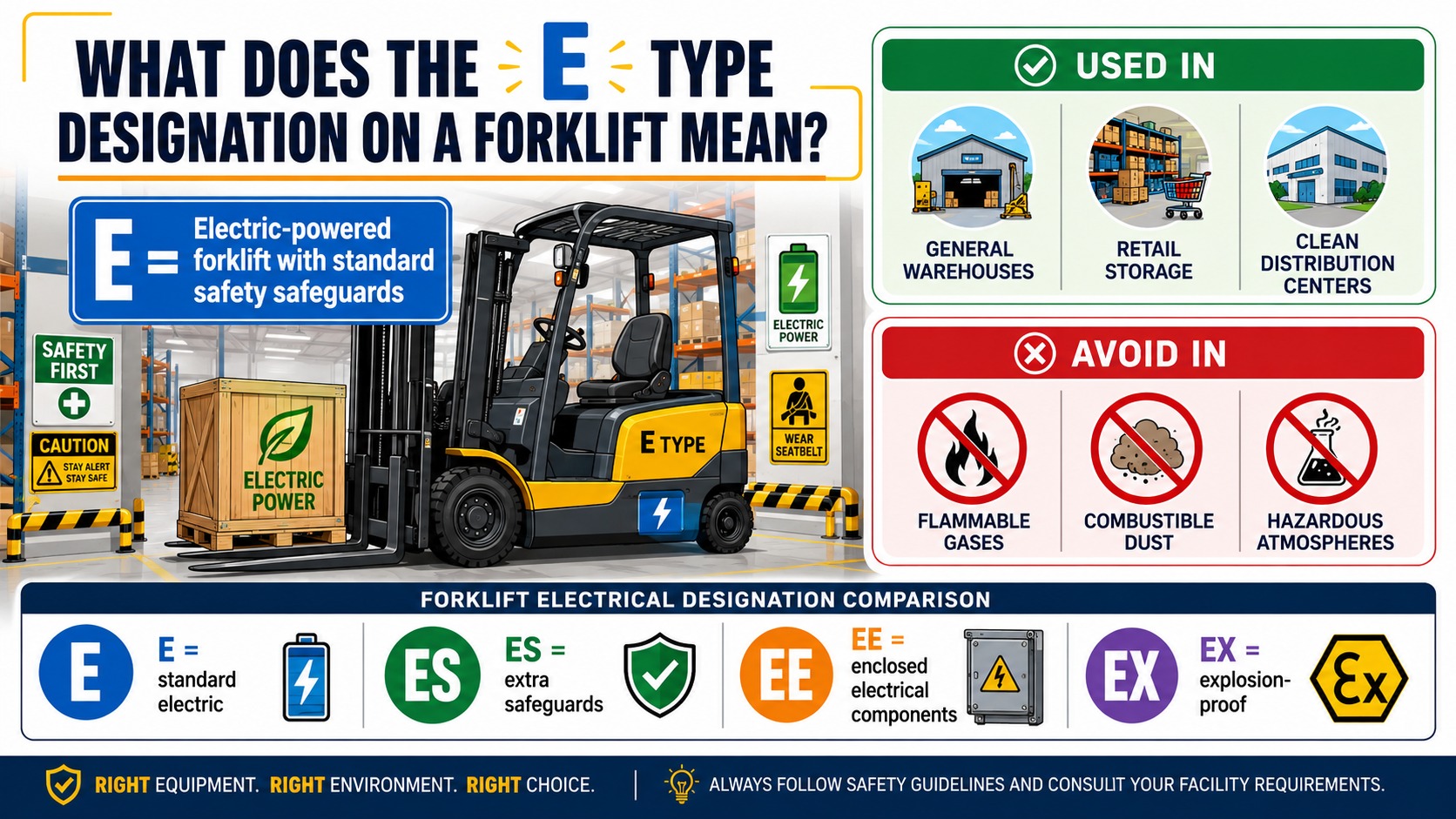
Forklift classifications such as E, ES, EE, and EX are defined by safety standards from OSHA and UL to ensure equipment is matched correctly with workplace hazard levels. These classifications help reduce fire risks and protect operators in industrial environments.
Modern electric solutions from Liftron Material Handling are designed with advanced lithium-ion battery systems, offering improved efficiency, longer runtime, and reduced maintenance compared to traditional electric forklifts.
E vs Other Electric Forklift Types
Electric forklifts are categorized into different safety levels based on their ability to operate in hazardous environments. The “E” designation represents the most basic level of electrical protection.
| Type | Meaning | Safety Level |
|---|---|---|
| E | Standard electric forklift for general use | Basic protection |
| ES | Enhanced electrical safeguards and reduced spark risk | Medium protection |
| EE | Fully enclosed electrical components for higher safety | High protection |
| EX | Explosion-proof forklift for hazardous environments | Maximum protection |
Where E-Type Forklifts Are Used
Type E forklifts are widely used in everyday industrial environments where no hazardous materials are present. These machines are ideal for efficient indoor material handling.
- General warehouses
- Retail storage facilities
- Distribution centers
- Light manufacturing plants
Because of their simplicity and efficiency, Type E forklifts are among the most commonly used electric industrial trucks.
Where E-Type Forklifts Should NOT Be Used
Despite their versatility, Type E forklifts are not suitable for hazardous environments. Using them in such conditions can create serious safety risks.
- Areas with flammable gases or vapors
- Locations with combustible dust (grain, flour, etc.)
- Chemical processing facilities
>Forklift Types in Modern Industry
Electric forklifts are part of a broader classification system that includes different machine types for different applications. Among them, counterbalance forklifts are the most widely used in warehouses and logistics operations.
Advanced models such as the DE SERIES, DL SERIES, and DD SERIES from Liftron Material Handling represent modern lithium-ion powered solutions designed for efficiency and reduced environmental impact.
Benefits of Electric Forklifts
Electric forklifts, especially modern lithium-ion powered models, offer significant advantages over traditional fuel-powered machines.
- Zero emissions for cleaner indoor environments
- Lower maintenance requirements
- Reduced operating noise
- Faster charging and longer runtime (lithium-ion systems)
These advantages make electric forklifts the preferred choice for many warehouse and logistics operations today.
Step-by-Step: Choosing the Right Forklift Type
- Identify environment: Determine whether the area is hazardous or non-hazardous.
- Check load requirements: Match forklift capacity with operational needs.
- Select classification: Choose E, ES, EE, or EX based on safety level.
- Verify manufacturer specs: Always check the data plate for compliance.
- Confirm application: Ensure suitability for warehouse or industrial use.
Conclusion
An “E” type designation on a forklift means it is a standard electric-powered machine designed for general indoor use in non-hazardous environments. It provides basic electrical safety protection but is not suitable for explosive or flammable atmospheres. Understanding this classification is essential for safe and compliant forklift operation in industrial workplaces.
Modern equipment solutions from Liftron Material Handling continue to improve efficiency and safety in electric forklift applications, especially through advanced lithium-ion technology used in the DE SERIES, DL SERIES, and DD SERIES product lines.
Add a review
Your email address will not be published. Required fields are marked *