
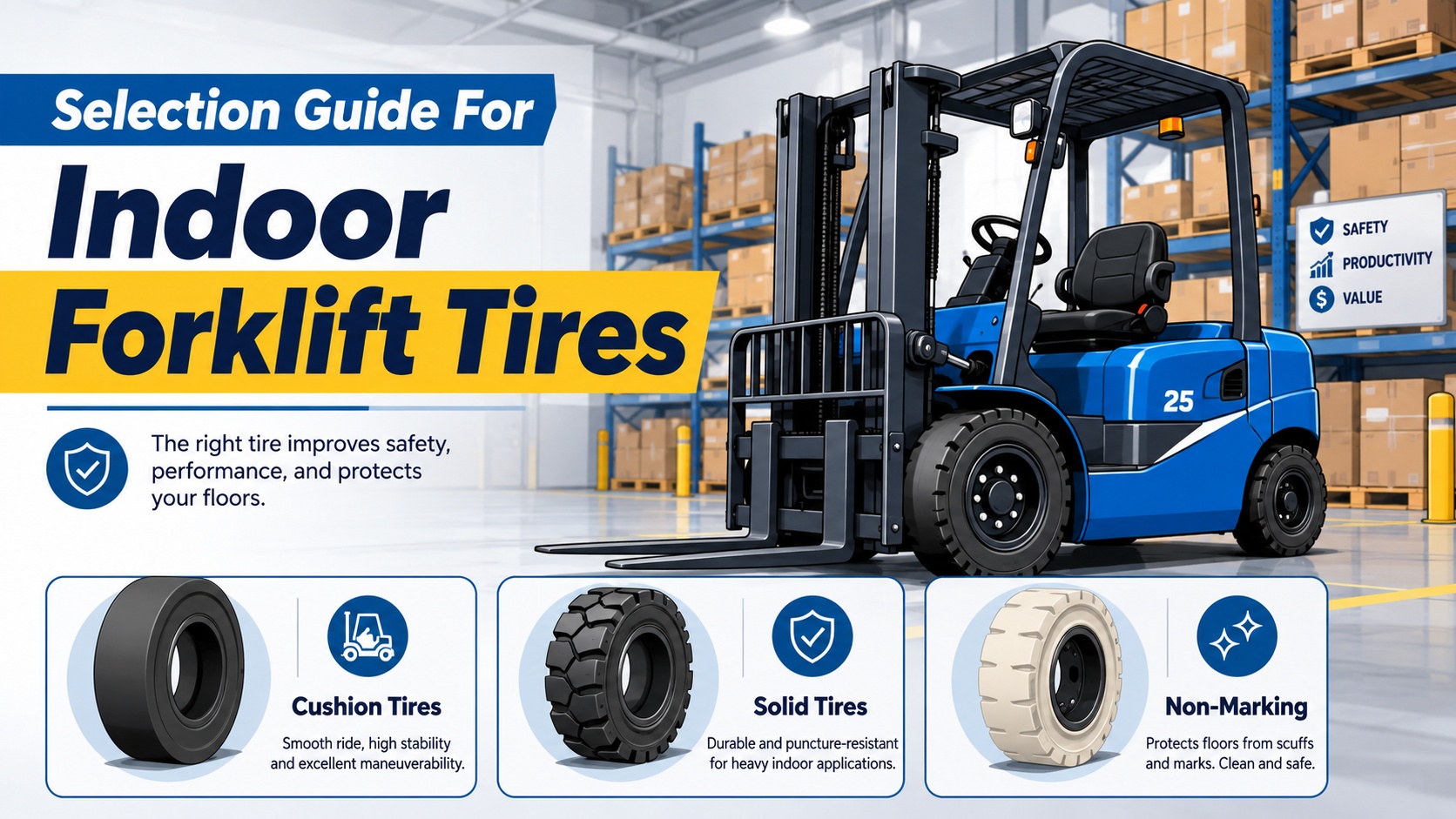
Selection Guide For Indoor Forklift Tires
Quick Answer: For indoor warehouse operations, selecting the right forklift tire is critical for safety, efficiency, floor protection, and operator comfort. The best choice depends mainly on your facility’s floor conditions, load weight, turning frequency, and whether your operation needs marking or non-marking tires.
Indoor forklift tires are one of the most important parts of a safe and productive material handling operation. Tires affect traction, braking, steering, turning radius, vibration, load stability, and floor wear. A tire that works well outdoors may be too aggressive for smooth warehouse floors, while a tire designed for clean indoor use may not perform well on rough outdoor surfaces.
In warehouses, distribution centers, manufacturing plants, food storage areas, and retail stockrooms, the right tire helps operators move pallets smoothly and safely. If you use a liftron forklift, tire selection should match the truck’s specifications, floor condition, and daily workload. Choosing the wrong tire can lead to faster wear, poor traction, floor marks, unstable loads, and higher maintenance costs.
1. Choose Your Tire Type
The first step is choosing the correct tire type for indoor work. Most indoor forklifts use cushion tires or solid tires. Cushion tires are made from solid rubber pressed onto a metal band. They are designed for smooth, flat concrete floors and offer a low profile, tight turning radius, and good maneuverability in narrow aisles.
Solid pneumatic tires are another option for forklifts that may move between indoor and outdoor areas. They are more durable than cushion tires and can handle slightly rougher surfaces, but they may not turn as tightly or protect floors as well as indoor-focused cushion tires.
Key Takeaway: For smooth indoor warehouse floors, cushion tires are often the best choice. For mixed indoor and light outdoor use, solid pneumatic tires may be more practical.
2. Select Your Material: Marking vs. Non-Marking
Indoor facilities often need to protect floors from black marks, rubber streaks, and contamination. Standard black rubber tires are durable and affordable, but they can leave marks on polished concrete, epoxy floors, tile, or clean warehouse surfaces. This may be a problem in food storage, pharmaceutical, retail, or clean manufacturing environments.
Non-marking tires are designed to reduce visible floor marks. They are usually made with lighter-colored rubber compounds. They are a strong choice for facilities where cleanliness and floor appearance matter. However, non-marking tires may wear faster than standard black tires in some applications, so buyers should compare cleanliness needs with expected tire life.
3. Determine the Tread Pattern
Tread pattern affects traction and wear. Smooth tires are often used on clean, dry indoor floors because they maximize contact with the surface and provide stable turning. Ribbed or lightly grooved tires can improve traction in areas where dust, light moisture, or debris may be present.
Deep tread patterns are usually more important outdoors than indoors. In a clean warehouse, aggressive tread may increase vibration and floor wear without adding much benefit. For indoor work, the best tread pattern should provide predictable traction without damaging floors or reducing maneuverability.
Pro Tip: If your forklift makes frequent tight turns, check tire wear more often. Indoor tires can wear quickly in high-turning areas such as docks, staging zones, and narrow aisles.
4. Check Specifications and Floor Constraints
Before changing tires, always check the forklift manufacturer’s specifications. Tire size, rim type, load rating, compound, and approved tire construction must match the forklift design. The wrong tire can affect braking, stability, ground clearance, steering, and rated capacity.
Floor constraints also matter. Some facilities have epoxy coatings, polished concrete, freezer floors, food-grade surfaces, or elevated slabs. The tire must match the surface. A tire that is too hard may reduce traction, while a tire that is too soft may wear quickly under heavy loads.
What Are the Three Types of Forklift Tires?
The three common types of forklift tires are cushion tires, pneumatic tires, and solid pneumatic tires. Cushion tires are best for smooth indoor floors and tight warehouse aisles. Pneumatic tires are air-filled and usually used outdoors because they provide shock absorption on rough ground. Solid pneumatic tires are flat-proof rubber tires that resemble pneumatic tires but are made for durability in rougher or debris-heavy environments.
For indoor warehouse work, cushion tires and solid tires are usually the most common options. Pneumatic tires are more suitable for outdoor yards, gravel, uneven surfaces, and mixed-terrain environments.
Step-by-Step Indoor Forklift Tire Selection Guide
- Check your floor surface: Identify whether your facility uses smooth concrete, polished floors, epoxy coatings, freezer floors, or mixed surfaces.
- Measure your workload: Consider load weight, shift length, travel distance, turning frequency, and how often the forklift operates each day.
- Choose the tire type: Select cushion tires for smooth indoor floors or solid pneumatic tires for mixed indoor-light outdoor use.
- Decide on marking type: Use non-marking tires for clean environments and standard black tires where durability is the priority.
- Match the tread: Choose smooth or lightly grooved tread based on traction needs, floor cleanliness, and operating conditions.
- Confirm specifications: Check tire size, load rating, rim type, and manufacturer approval before installing new tires.
What Type of Tires Does the Liftron Forklift Use?
The DE SERIES, DD SERIES, DL SERIES, and XSCZ151 models under liftron forklift use solid tires. Solid tires are practical for many warehouse and material handling applications because they are durable, stable, and less vulnerable to punctures than air-filled tires.
For indoor operations, solid tires can help reduce downtime and support consistent handling on smooth warehouse floors. When selecting tires for a Liftron forklift, buyers should still confirm the exact size, compound, and application fit with the forklift specifications and operating environment.
Selection Reminder: Liftron forklift models use solid tires, but the best indoor tire choice still depends on floor condition, load weight, cleanliness requirements, and daily usage intensity.
Conclusion
Selecting indoor forklift tires requires careful attention to tire type, rubber material, tread pattern, floor condition, and manufacturer specifications. Cushion tires are often ideal for smooth indoor floors, while solid pneumatic tires may be better for mixed-use areas. Non-marking tires are best when floor cleanliness matters.
For a liftron forklift, models such as the DE SERIES, DD SERIES, DL SERIES, and XSCZ151 use solid tires, making them suitable for many warehouse and material handling tasks. Choosing the right tire helps improve safety, protect floors, reduce downtime, and keep indoor forklift operations efficient.
Add a review
Your email address will not be published. Required fields are marked *