
Forklift Operator Tips for Tall Racking
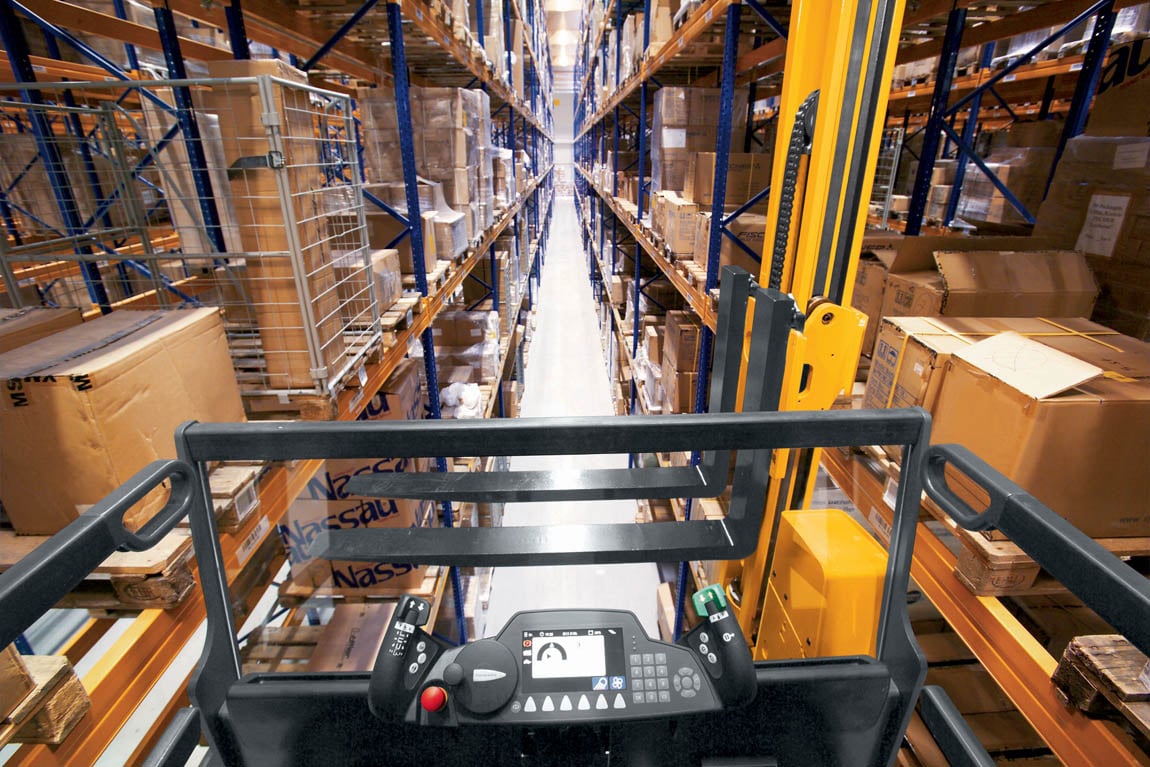
Quick Answer: Operating a forklift at heights above 8 meters requires heightened precision, a slow and deliberate pace, and strict adherence to the golden rule of load handling: keep the load stable, centered, and properly supported. To avoid tipping the equipment or damaging the facility, operators must maintain a stable posture, ensure accurate mast alignment, and use proper fork engagement before lifting, placing, or removing pallets from tall racking.
Tall warehouse racking helps businesses increase storage density, but it also creates greater operating challenges for forklift drivers. The higher a pallet is lifted, the more serious every small movement becomes. A slight steering error, unstable pallet, or uneven fork position can lead to rack damage, falling goods, product loss, or equipment instability.
For this reason, operators working around tall racking must use careful judgment and controlled movement at all times. Whether your facility uses a standard counterbalance forklift, reach truck, or narrow-aisle equipment, safe high-rack operation depends on load stability, precise positioning, and consistent operator training. A Liftron Forklift can support warehouse productivity, but the operator’s habits remain the most important factor in safe tall-racking work.
Load Management and Stability
Load management is the first rule of safe tall-rack forklift operation. Before lifting any pallet, the operator should inspect the load carefully. The pallet should be in good condition, the cartons or materials should be evenly stacked, and the load should not lean, shift, or overhang excessively.
The operator must also verify the load weight and load center. A forklift’s rated capacity is based on specific conditions, and capacity can change depending on lift height, attachment use, and how far the load center sits from the mast. Loads that are too long, too heavy, or poorly centered can reduce stability and increase the risk of tipping.
When working with tall racks, never assume that a load is safe just because the forklift can lift it at ground level. High lifting changes the stability picture. If a pallet looks damaged, unstable, or overweight, the operator should stop and report the issue before attempting to store or retrieve it.
Key Takeaway: Never lift an unstable, damaged, or poorly centered pallet into tall racking. At height, even small load problems can become serious safety hazards.
Precision Lift Operations
Precision matters more as lift height increases. Operators should approach the rack slowly and squarely, keeping the load low while traveling. The forklift should be aligned with the rack opening before the mast is raised. If the truck is angled, the forks may scrape the rack, push the pallet sideways, or damage uprights and beams.
Fork engagement is also critical. The forks should enter the pallet fully and evenly before lifting. Partial fork engagement can cause the pallet to tilt or slide, especially when the load is raised high. The operator should keep the forks level and avoid sudden mast tilt, sharp hydraulic movement, or quick steering corrections while the load is elevated.
When placing a pallet into a high rack position, lower it gently onto the beams and confirm that it is seated correctly before backing away. When removing a pallet, make sure the forks are fully inserted and the load is clear of surrounding rack components before reversing.
Rack and Load Safety
Tall racking should be treated as part of the safety system. Operators should watch for bent uprights, damaged beams, missing safety clips, loose pallet supports, blocked aisles, poor lighting, or pallets hanging too far into the aisle. These conditions should be reported immediately.
Visibility is another major concern. High racks, tall masts, and large loads can limit the operator’s view. If visibility is blocked, the facility may need spotters, mirrors, cameras, warning lights, aisle markings, or revised traffic rules. Pedestrians should be kept away from active tall-racking zones whenever possible.
Using the right equipment also matters. A Liftron Forklift may be suitable for many standard warehouse and pallet-handling tasks, but specialized narrow-aisle or high-rack applications may require different equipment types depending on aisle width and lift height.
Step-by-Step Forklift Tips for Tall Racking
- Inspect the forklift: Check brakes, tires, forks, mast chains, hydraulics, steering, horn, warning lights, and battery or fuel condition before use.
- Check the load: Make sure the pallet is not broken, the load is stable, and the weight is within the forklift’s rated capacity.
- Travel with the load low: Keep the pallet low while moving through aisles and avoid sharp turns or sudden stops.
- Align with the rack: Approach the rack slowly and squarely before raising the mast.
- Use full fork engagement: Insert the forks completely under the pallet and keep them level before lifting.
- Lift and place smoothly: Raise the load slowly, avoid sudden movement, place the pallet gently, and back away with control.
Pro Tip: Tall-rack forklift operation should never be rushed. Slow travel, smooth hydraulic control, and accurate mast alignment help prevent rack strikes, falling loads, and product damage.
Which Type of Forklift Is Best for Narrow Aisles and High Racking?
The best forklifts for narrow aisles and high racking are usually electric reach trucks and very narrow aisle, or VNA, forklifts. This category can include turret trucks, articulated forklifts, and other specialized machines designed for high-density storage. These forklifts can maneuver in aisles as narrow as 5 to 7 feet and, depending on the model and load, may lift pallets to heights exceeding 45 feet.
Electric reach trucks are common in warehouses with high racking because they can extend their forks into the rack while the truck body remains in the aisle. Turret trucks and VNA forklifts are used where storage density is even more important. Articulated forklifts can also be useful because they combine narrow-aisle handling with some general warehouse flexibility.
The best choice depends on aisle width, rack height, pallet size, load weight, floor condition, and daily throughput. A forklift that works well in wide aisles may not be the safest or most efficient choice for high racking in a narrow-aisle warehouse.
Does Liftron Forklift Offer Electric Reach Trucks and Ultra-Narrow Aisle Forklifts?
Liftron Forklift does not currently focus on electric reach trucks or ultra-narrow aisle forklifts. Its main product focus is counterbalance forklifts, which are widely used for standard warehouse handling, pallet movement, loading, unloading, and general material transport.
Counterbalance forklifts are practical for many warehouse and industrial applications, especially where operators need versatile point-to-point pallet handling. However, for very narrow aisles and extreme high-racking systems, electric reach trucks, turret trucks, or articulated forklifts are usually more suitable. Before selecting any equipment, warehouse managers should compare rack layout, lift height, travel space, and load requirements.
Selection Reminder: A counterbalance forklift is useful for many general warehouse tasks, but narrow aisles and very tall racking often require specialized reach trucks or VNA forklifts.
Conclusion
Forklift operation around tall racking requires patience, precision, and strong attention to stability. Operators should inspect equipment, verify pallet condition, approach racks slowly, engage forks fully, control mast movement, and place loads gently.
For narrow aisles and high racking, electric reach trucks and VNA forklifts are usually the best equipment choices. A Liftron Forklift is mainly focused on counterbalance forklift applications, making it a strong option for many standard warehouse tasks, while specialized high-rack environments may require dedicated narrow-aisle equipment.
Add a review
Your email address will not be published. Required fields are marked *