
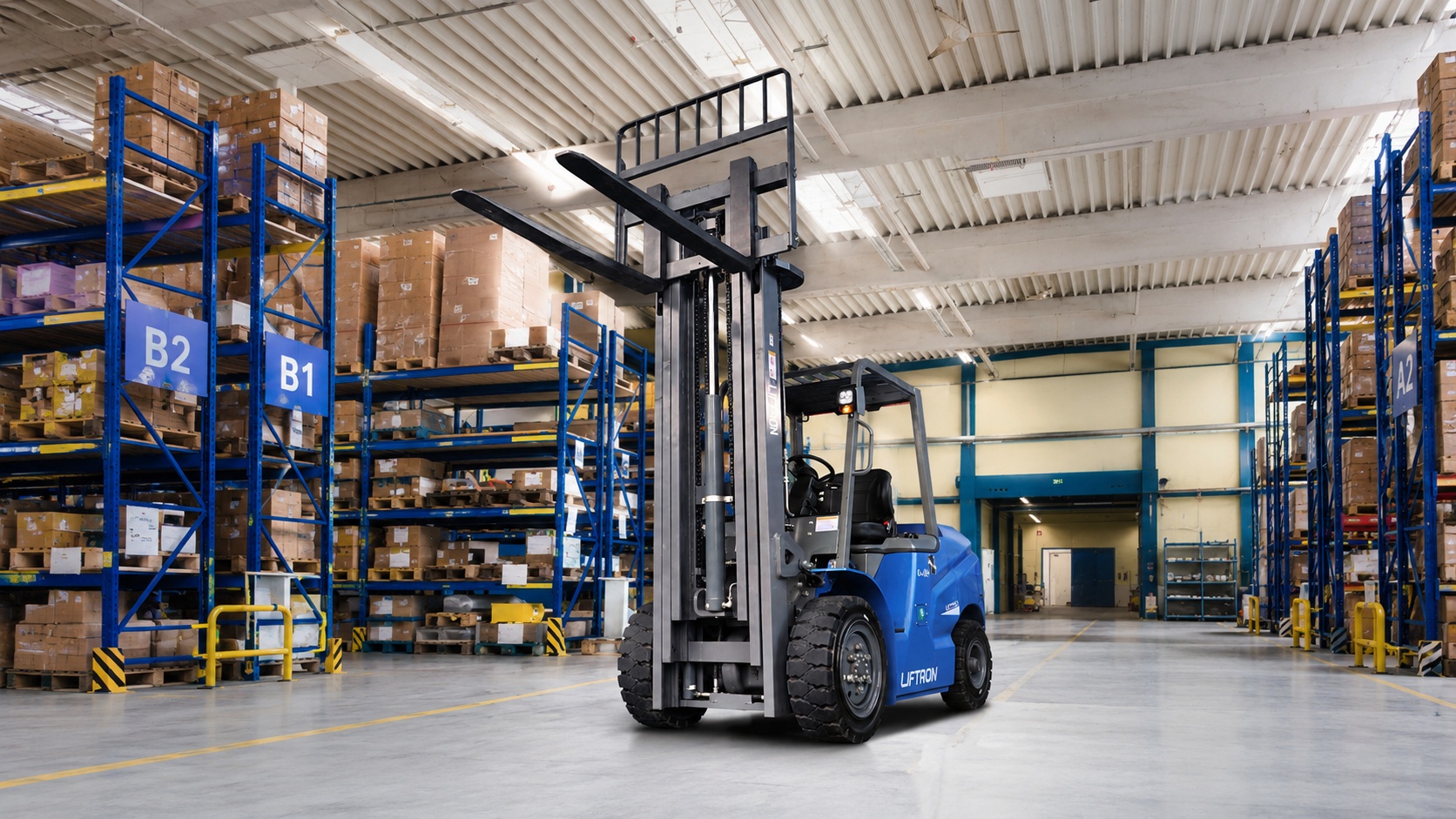
How High Can a Liftron Forklift Reach?
When choosing a liftron forklift, one of the most important specifications to check is lifting height. Forklift lifting height determines how high the forks can raise a load, which directly affects pallet stacking, truck loading, rack storage, warehouse layout, and overall material handling efficiency. For many warehouses, logistics centers, manufacturing plants, and distribution facilities, the right lifting height helps operators move goods safely and make better use of vertical storage space.
Liftron Material Handling offers the DE, DL, and DD Series, comprising ten distinct forklift models: CPD15, CPD20, CPD25, CPD30, CPD35, CPD30L, CPD35L, CPD38L, CPD50L, and CPD40D. Based on the listed specifications, the maximum lifting height for Liftron forklifts is 3 meters, which is approximately 9.84 feet. This height is suitable for many standard warehouse, loading dock, and industrial material handling applications.
Understanding Forklift Lifting Height
Forklift lifting height refers to the maximum height that the forks can raise a load. It is different from the forklift’s overall mast height, free lifting height, and lowered mast height. When comparing forklift models, buyers should understand these terms because each one affects how the forklift performs in a real working environment.
The lifting height is the main working height of the forklift. It tells you how high the forklift can lift pallets, containers, boxes, crates, or other loads. If your warehouse uses pallet racking, this specification helps determine whether the forklift can reach the required storage level.
Free lifting height is the height the forks can rise before the mast begins to extend. This matters in locations with low ceilings, containers, doorways, mezzanines, or loading areas where overhead clearance is limited. According to the available Liftron model information, free lifting height varies by model, ranging from 120 mm to 160 mm.
Liftron Forklift Models and Lifting Height
Liftron’s forklift lineup includes the DE Series, DL Series, and DD Series. These models cover different rated lifting capacities, from compact indoor handling to heavier industrial applications. Although the load capacities vary from 1500 kg to 5000 kg depending on the model, the listed lifting height across the models is 3000 mm.
| Series | Model | Power Type | Driving Type | Rated Lifting Capacity | Free Lifting Height | Maximum Lifting Height |
|---|---|---|---|---|---|---|
| DE Series | CPD15 | Electric | Sit-Down | 1500 kg | 150 mm | 3000 mm |
| DE Series | CPD20 | Electric | Sit-Down | 2000 kg | 150 mm | 3000 mm |
| DE Series | CPD25 | Electric | Sit-Down | 2500 kg | 150 mm | 3000 mm |
| DE Series | CPD30 | Electric | Sit-Down | 3000 kg | 160 mm | 3000 mm |
| DE Series | CPD35 | Electric | Sit-Down | 3500 kg | 160 mm | 3000 mm |
| DL Series | CPD30L | Electric | Sit-Down | 3000 kg | 160 mm | 3000 mm |
| DL Series | CPD35L | Electric | Sit-Down | 3500 kg | 160 mm | 3000 mm |
| DL Series | CPD38L | Electric | Sit-Down | 3800 kg | 160 mm | 3000 mm |
| DL Series | CPD50L | Electric | Sit-Down | 5000 kg | 120 mm | 3000 mm |
| DD Series | CPD40D | Electric | Sit-Down | 4000 kg | 160 mm | 3000 mm |
How High Is 3 Meters in Feet?
The maximum lifting height of 3000 mm equals 3 meters, or approximately 9.84 feet. In practical warehouse terms, this height is suitable for many common pallet handling tasks, including loading and unloading trucks, stacking pallets on lower to mid-level racks, moving materials in production areas, and organizing inventory in standard storage spaces.
For businesses that use lower racking systems or floor stacking, a 3-meter lifting height can be more than enough. It allows operators to place goods safely above floor level without requiring a very tall mast. This can also help maintain better stability and easier handling in facilities where extreme lifting height is not necessary.
Which Liftron Series Should You Choose?
Although the listed Liftron forklift models share the same maximum lifting height of 3000 mm, they differ in rated lifting capacity and application. Choosing the right series depends on your load weight, working space, operating environment, and daily workload.
DE Series for Standard Warehouse Handling
The DE Series includes CPD15, CPD20, CPD25, CPD30, and CPD35. These models cover lifting capacities from 1500 kg to 3500 kg. They are suitable for general warehouse handling, pallet transport, loading dock work, indoor movement, and light to medium material handling tasks.
If your operation mainly involves standard pallets, indoor storage, and routine warehouse workflows, the DE Series may be a practical choice. The 3000 mm lifting height supports common stacking and loading needs, while the electric power system is suitable for clean and quiet operation.
DL Series for Higher-Capacity Material Handling
The DL Series includes CPD30L, CPD35L, CPD38L, and CPD50L. These models offer rated lifting capacities from 3000 kg to 5000 kg. They are designed for heavier warehouse, logistics, and manufacturing applications where stronger lifting performance is required.
If your business handles heavier pallets, industrial materials, or denser loads, the DL Series may be a better fit. The 3000 mm lifting height remains suitable for standard racking and loading tasks, while the higher load capacity supports more demanding applications.
DD Series for Heavy-Duty Operations
The DD Series includes the CPD40D model with a rated lifting capacity of 4000 kg. This series is suitable for high-intensity material handling, industrial manufacturing, large warehouses, and heavy-duty logistics environments.
For businesses that need strong lifting capability and stable electric performance in demanding operating conditions, the DD Series can provide a practical solution. Its 3000 mm lifting height supports common industrial stacking and load positioning tasks.
What Is the Highest a Forklift Can Reach?
The highest a forklift can reach depends on the forklift type, mast configuration, load capacity, and application. Standard counterbalance forklifts commonly reach around 3 to 6 meters, depending on the mast. Some warehouse forklifts, such as reach trucks, order pickers, and very narrow aisle equipment, can reach much higher because they are designed specifically for high-bay racking and dense storage environments.
In specialized warehouse applications, some high-reach trucks can lift loads above 10 meters, and certain very narrow aisle forklifts can reach even higher. However, these machines are designed for specific indoor warehouse layouts and are not the same as general-purpose counterbalanced forklifts.
For many businesses, the highest possible lift height is not always the best choice. A forklift should be selected based on the actual rack height, load weight, floor condition, aisle width, ceiling clearance, and operator safety requirements. A taller mast may allow higher stacking, but it can also affect visibility, stability, cost, and maneuverability.
How to Decide If 3 Meters Is Enough
To decide whether a 3-meter Liftron forklift lifting height is enough, measure your actual working environment. Start by checking the height of your pallet racks, shelves, truck beds, loading docks, and storage areas. Then compare those measurements with the forklift’s maximum lifting height.
If your operation mainly involves ground-level transport, truck loading, floor stacking, or low to mid-level racking, 3 meters may be sufficient. If your warehouse uses high-bay racking or requires stacking several pallet levels high, you may need to evaluate whether a different mast configuration or specialized warehouse equipment is required.
It is also important to consider load center and capacity at height. A forklift’s rated lifting capacity is based on specific load conditions. Lifting heavy loads to maximum height requires proper load handling and attention to stability. Operators should always follow the forklift’s capacity plate and safety guidelines.
Why Lifting Height Matters for Warehouse Efficiency
The correct lifting height helps businesses improve storage efficiency and workflow. If the forklift cannot reach the required rack height, the warehouse may lose valuable vertical storage space. If the forklift is much taller or more powerful than needed, it may cost more and be harder to operate in tight spaces.
A 3000 mm lifting height offers a useful balance for many general material handling operations. It supports daily warehouse tasks without requiring a specialized high-reach design. For companies that need dependable pallet movement, loading, unloading, and standard stacking, Liftron forklifts can provide practical lifting performance.
Conclusion
So, how high can a Liftron forklift reach? Based on the listed DE, DL, and DD Series specifications, Liftron forklifts can reach a maximum lifting height of 3000 mm, which equals 3 meters or approximately 9.84 feet. This applies to ten models: CPD15, CPD20, CPD25, CPD30, CPD35, CPD30L, CPD35L, CPD38L, CPD50L, and CPD40D.
This lifting height is suitable for many standard warehouse, logistics, loading dock, and manufacturing applications. However, the right forklift should be selected based not only on lifting height but also on load capacity, aisle width, floor conditions, operating environment, and storage layout. For general material handling, a 3-meter Liftron forklift can be a practical and efficient choice.
Add a review
Your email address will not be published. Required fields are marked *