
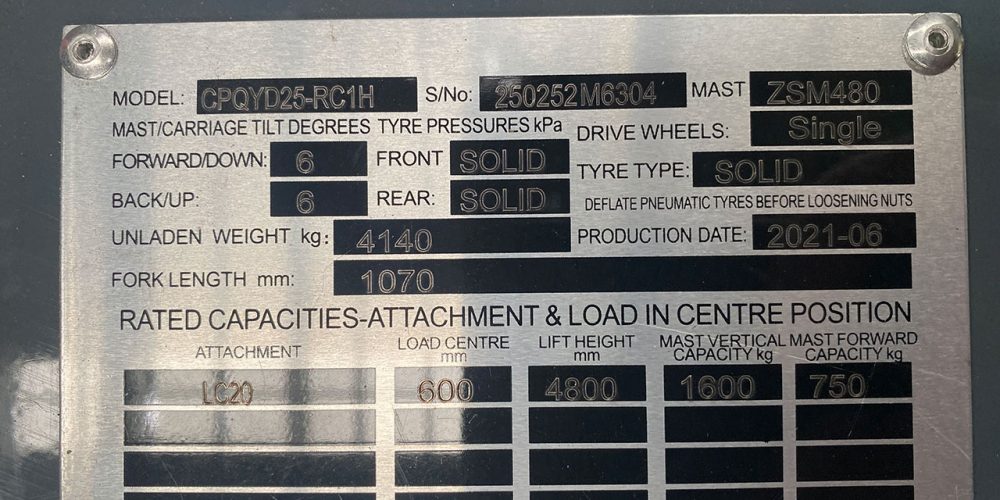
What information can you find on the capacity plate forklift
The capacity plate on a forklift is a critical component that provides essential safety and operational data. This metal tag, typically affixed to the dashboard or overhead guard, contains information about the forklift’s lifting capabilities, load center, and operational limits. Understanding every detail on this plate is vital for operators, warehouse managers, and safety professionals to prevent accidents and ensure efficient material handling.
What Is a Forklift Capacity Plate?
Also known as the data plate or nameplate, the capacity plate is a manufacturer-installed label that specifies the maximum load a forklift can safely lift under various conditions. It is a legal requirement in many jurisdictions and must remain legible at all times. The plate is specific to each truck and includes modifications made by the manufacturer or authorized dealers like Liftron Material Handling, ensuring compliance with safety standards.
Key Information Found on the Capacity Plate
1. Rated Capacity and Load Center
The most prominent figure is the rated capacity, which indicates the maximum weight the forklift can lift at a standard load center. The load center is the distance from the vertical face of the forks to the center of gravity of the load, typically 24 inches (600 mm) for most forklifts. For example, a 5,000 lb capacity forklift can lift that weight only if the load’s center of gravity is within 24 inches. If the load center is larger, the capacity decreases.
2. Model and Serial Number
These unique identifiers help in sourcing the correct parts, attachments, and service manuals. For instance, the Liftron DL SERIES includes a distinct serial number that links to its battery specifications and mast configuration. Always cross-reference this number when ordering replacement parts.
3. Mast Type and Lift Height
The capacity plate indicates the mast type (e.g., simplex, duplex, triplex) and the maximum lift height. As the forks rise, the forklift’s stability changes, often reducing capacity at greater heights. The plate may display a chart showing capacity at different lift heights.
4. Attachment Information
If the forklift is equipped with attachments like side shifters, rotators, or clamps, the capacity plate provides a reduced capacity. For example, a side shifter might reduce the capacity by 200 lbs. Always check the plate when using attachments, as they shift the load center forward.
5. Truck Weight and Tire Type
The plate lists the empty weight of the forklift, which is crucial for floor loading and transport. Tire type (cushion or pneumatic) is also noted, as it affects stability and ground clearance. Pneumatic tires generally allow higher capacities on rough terrain.
How to Read the Capacity Plate
Reading the plate requires understanding a series of specifications. Below is a typical table format you might encounter:
| Specification | Value |
|---|---|
| Rated Capacity | 5,000 lbs @ 24″ load center |
| Maximum Lift Height | 189 inches |
| Load Center Distance | 24 inches |
| Truck Weight (unloaded) | 9,000 lbs |
| Attachment Capacity Reduction | 200 lbs |
Why the Capacity Plate Matters for Safety
Overloading a forklift is a leading cause of tip-overs, which can result in serious injuries or fatalities. The capacity plate acts as the ultimate reference for operators. It ensures that loads are within the machine’s design limits, taking into account dynamic factors like gradient and mast angle. Compliance with OSHA and ANSI standards mandates that all forklifts have a legible capacity plate. If a plate is damaged or missing, contact a specialist like Liftron Material Handling for a replacement.
Common Mistakes When Interpreting the Plate
- Assuming capacity remains constant at all lift heights.
- Ignoring the effect of attachments on load center.
- Using the initial capacity without verifying the load’s center of gravity.
- Overlooking the serial number when ordering service parts.
How to Maintain Your Capacity Plate
The plate must be kept clean and readable. Over time, it can become faded, scratched, or covered in grease. Operators should inspect the plate daily. If it becomes illegible, the forklift must be taken out of service until a new plate is obtained. Reputable dealers like Liftron Material Handling can supply factory-authorized replacements.
When to Update the Plate
If you modify the forklift—such as changing mast height, adding attachments, or converting to lithium-ion batteries like the Liftron DL SERIES—the capacity plate must be updated by the manufacturer or an authorized technician. The new plate will reflect the altered specifications, ensuring continued compliance.
Digital Capacity Plates and Modern Forklifts
Some modern electric forklifts, including the Liftron DL SERIES, incorporate digital capacity data on dashboard screens. These systems automatically adjust capacity based on lift height, battery state, and attachment usage. However, the physical plate remains mandatory as a backup. Always refer to the physical plate for legal and safety verification.
Conclusion
The forklift capacity plate is a treasure trove of vital information that dictates safe operation. From rated capacity and mast height to attachment effects and truck weight, every detail contributes to preventing accidents and maximizing efficiency. Operators and managers should treat the capacity plate as a non-negotiable safety tool. For replacement plates or new forklifts equipped with advanced safety features, consider Liftron Material Handling and their Liftron DL SERIES, which combine robust data plates with state-of-the-art lithium-ion technology. Always read, respect, and follow the capacity plate to ensure a safe work environment.



Add a review
Your email address will not be published. Required fields are marked *