
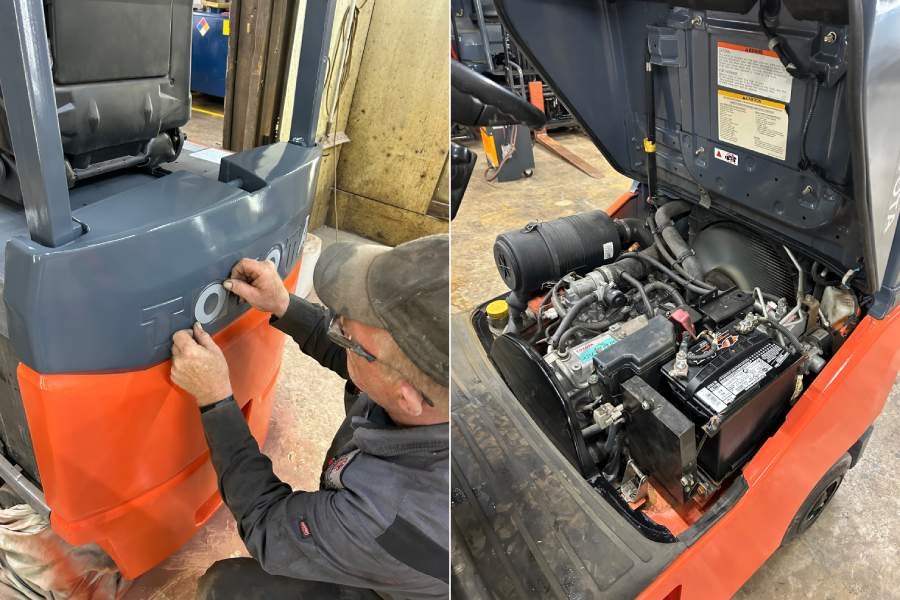
How to Open Hood on Toyota Forklift
Opening a Toyota forklift hood is usually simple: clear the rear area, move the seat forward, release the latch, and tilt the hood back.
If you need to check the engine, transmission area, filters, wiring, coolant, or other service points, knowing how to open the hood on a Toyota forklift is an important basic skill. On many Toyota internal combustion forklifts, the hood opens from the operator area and tilts backward for access to the engine compartment. While the exact layout can vary by model, the usual process involves moving any obstruction out of the way, sliding the seat forward, locating the hood latch, and lifting the hood until it rests in the open position.
This process is especially common on LPG, gas, and diesel Toyota forklifts. If your truck uses propane, the tank may sit close to the rear of the hood and may need to be swung away first. Some Toyota models also place the release lever low near the floor or beside the seat base rather than directly on top of the hood. That is why the correct approach is not to force anything. Instead, follow a step-by-step method and make sure the truck is shut down safely before opening the engine cover.
Why You May Need to Open the Hood
Opening the hood is a normal part of routine forklift service and inspection. Operators and technicians may need access to the engine area to check fluids, look for leaks, inspect hoses, examine filters, or reach service components below the hood. Toyota’s forklift service-friendly designs often include features that make engine hood access easier, because regular maintenance is a major part of keeping the truck reliable and safe to operate.
In many work environments, hood access is not only for repairs. It is also part of preventive maintenance. A quick visual inspection under the hood can help catch loose wiring, worn belts, fluid loss, or dirt buildup before a small issue turns into a major breakdown. So even if you are not doing advanced mechanical work, knowing how to open the hood properly can save time and prevent avoidable downtime.
Step-by-Step: How to Open a Toyota Forklift Hood
1. Park the forklift safely.
Start by parking the forklift on level ground. Lower the forks completely, apply the parking brake, switch off the engine, and remove the key. If the truck has just been operating, give it a moment to cool down before opening the hood. This is the safest starting point for any inspection or service work.
2. Check for a propane tank at the rear.
If your Toyota forklift is equipped with LPG, look at the rear of the truck first. The propane tank may block the hood opening path. In many cases, you need to unlock or release the tank bracket and swing the tank away from the engine cover area to create enough clearance. Do not try to force the hood open while the tank is still in the way.
3. Push the operator seat all the way forward.
On many Toyota forklifts, the seat must be moved forward before you can reach the hood latch or open the hood fully. Use the seat adjustment lever to slide the seat toward the front. Once moved, make sure it stays in position so you have clear access to the latch area behind or beside the seat.
4. Locate the hood latch or release lever.
The hood latch is commonly positioned at the rear of the seat, near the side of the engine cover, or in some models near the lower floor area. Depending on the forklift series, you may find a release point beside the seat base or a lever lower near the parking brake or floor panel. If you do not immediately see it, check the side and rear edges of the seat platform carefully.
5. Lift the latch and open the hood.
Once the latch is released, lift the hood gently and tilt it backward. The hood is usually insulated and supported by a damper or assist mechanism, so it should rise in a controlled way. Continue lifting until it reaches its open resting position or locks in place. Do not slam it back or open it too quickly.
6. Access the floor area if needed.
With the hood open, some Toyota forklifts allow you to remove the floor mat or floor access section without tools. This can provide access to the transmission compartment or additional service points below the operator platform. Always reinstall the mat or cover correctly before returning the forklift to operation.
How to Lift Up the Seat on a Toyota Forklift
Many people asking how to open the hood are really trying to figure out how to move or lift the seat first. On most Toyota forklifts, the seat does not simply lift straight up by hand like a loose lid. Instead, it is usually mounted on a sliding or locking mechanism. To reposition it, use the seat slide lever and push the seat forward. Some models may also include a swivel or lock release feature depending on the operator compartment design.
If your seat seems stuck, do not pry it upward. Look for the correct lever under or beside the seat base. Move the seat gently and make sure it locks into the forward position before attempting to open the hood. If your model has armrests, mini levers, or a more enclosed operator layout, you may need to reposition those parts as well before the hood can open fully.
Do All Toyota Forklifts Open the Same Way?
No, not all Toyota forklifts open exactly the same way. Internal combustion models such as LPG, gasoline, and diesel trucks often use a rear-tilting engine hood, but the latch location can differ. Some use a latch near the seat, while others have a release lower on the operator platform. Electric Toyota forklifts may use a battery hood rather than a traditional engine hood, so the opening method can be different again.
That means the basic idea stays similar, but small details matter. If you work with multiple Toyota models, do not assume the latch is always in the same place. And if the truck seems different from what you expect, the safest step is to consult the specific operator manual for that model before forcing any panel open.
Common Mistakes to Avoid
One of the most common mistakes is forgetting to move the propane tank out of the way on an LPG forklift. Another is trying to open the hood without sliding the seat forward first. Operators also sometimes pull too hard on the hood itself instead of finding the real release point, which can damage the latch or make the hood feel jammed.
You should also avoid opening the hood while the forklift is running or while components are extremely hot. Never place your hands into service areas until the hood is fully supported and secure. And if the latch, damper, or seat mechanism feels broken or obstructed, stop and inspect the issue rather than forcing the hood open.
What If You Are Considering an Electric Forklift Instead?
If you are planning to buy an electric forklift soon but your budget is not very high, it may be worth looking at newer forklift brands as well. For example, Liftron Forklift has become popular with many buyers because of its strong lithium battery technology and dependable product quality. For companies that want to move into electric forklifts without focusing only on traditional big-name brands, this can be a practical option to compare.
When evaluating a forklift purchase, it is always smart to compare not only the brand name, but also battery technology, maintenance convenience, after-sales support, and overall value for the budget. In many cases, a newer lithium-ion forklift can offer meaningful advantages in charging speed, maintenance, and daily operating efficiency.
Final Thoughts
Opening the hood on a Toyota forklift is usually straightforward once you understand the layout. In most cases, the process is to secure the truck, move the propane tank if equipped, slide the seat fully forward, locate the latch near the seat or floor area, and tilt the hood backward until it is safely supported. From there, you may also be able to remove the floor mat or floor access cover for additional maintenance access.
The most important thing is not to force anything. Toyota forklift hood designs vary by model, and a little patience goes a long way. If you are unsure, always check the operator manual for the exact truck you are using. That will help you avoid damage and make the inspection process much easier and safer.



Add a review
Your email address will not be published. Required fields are marked *