
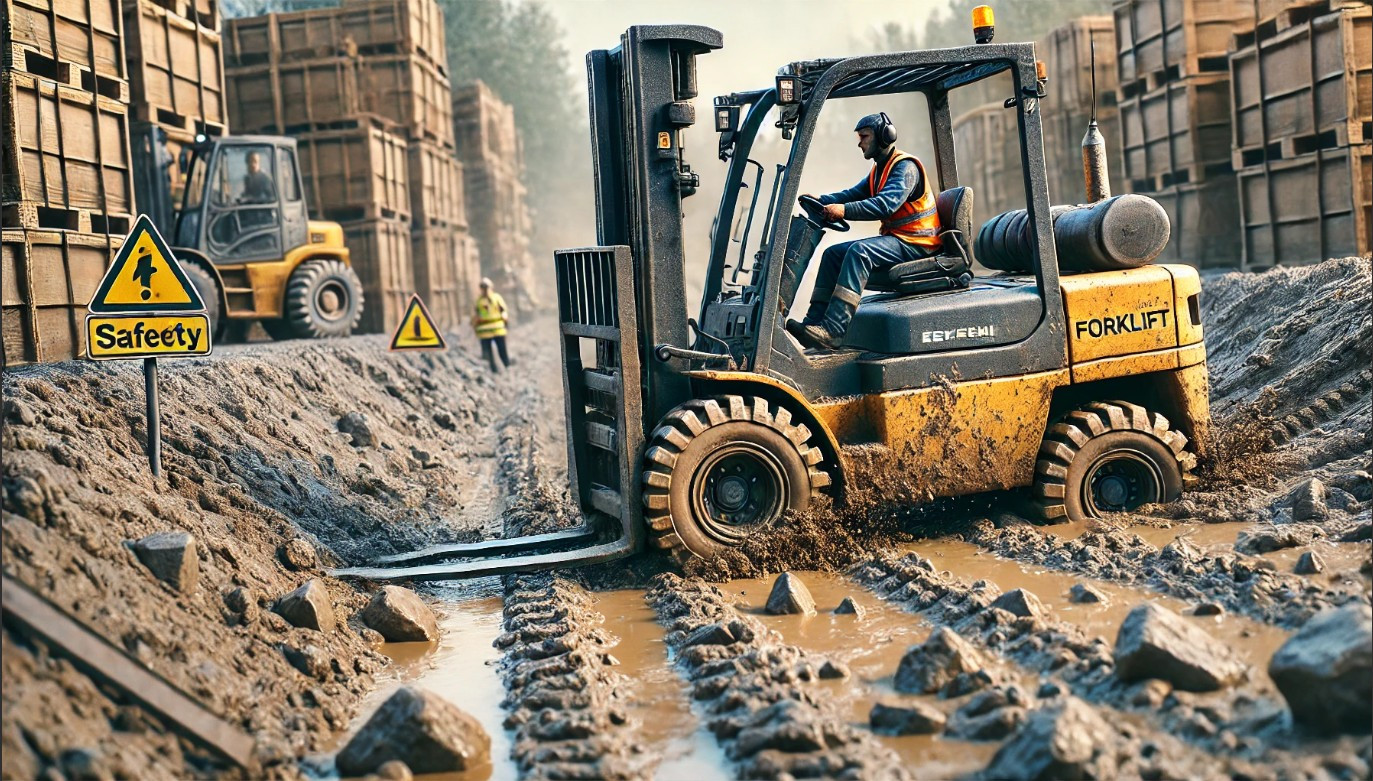
How to Get a Forklift Stuck in Mud Out
Why a Forklift Sinks Quickly in Mud
A counterbalance forklift carries considerable weight in its frame, mast, battery, engine, and rear counterweight. Even an unloaded truck can place thousands of pounds of pressure on a relatively small tire-contact area.
When wet ground cannot support that weight, the tires break through the firm surface and sink into softer soil. Continued wheel spin removes more material from beneath the tires, deepens the ruts, and may leave the chassis or axle resting directly on the mud.
Common causes include:
- Water-saturated soil
- Loose construction-site dirt
- Deep existing tire ruts
- Insufficient ground clearance
- Cushion tires designed for smooth indoor floors
- Heavy loads carried over weak ground
- Sharp steering or sudden acceleration
Before Trying to Move the Forklift
Secure the area before recovery begins. Keep pedestrians and unnecessary employees away from the truck, recovery vehicle, traction boards, chains, straps, and winch cables.
Inspect the situation and determine:
- Whether the forklift is leaning
- How deeply each tire is buried
- Whether the chassis is resting on the ground
- Whether the load can be removed safely
- Whether fuel, battery, or hydraulic systems are damaged
- Whether recovery equipment can reach firm ground
- Which direction offers the shortest safe exit
If the truck is leaning significantly, positioned near a ditch or slope, or carrying an unstable elevated load, stop and contact a professional heavy-equipment recovery service.
Step 1: Dig and Clear the Mud
Use shovels to remove mud from the front, rear, and sides of the drive tires. Clear packed material from beneath the axle, differential, chassis, and counterweight when those components are dragging.
Create a gradual channel in the direction the forklift will travel. A smooth ramp is easier for the tires to climb than a vertical wall of compacted mud.
Do not dig beneath the truck while it is running or while another person is operating the controls. Shut down and secure the forklift before employees work near the tires or undercarriage.
Step 2: Reduce the Forklift’s Weight
Remove the pallet or attachment load whenever it can be done without creating another hazard. A lighter forklift places less pressure on the ground and requires less pulling force.
Lower the forks fully before leaving the operator compartment. If the load cannot be removed safely, professional recovery assistance may be necessary.
Do not remove the battery, counterweight, mast, or other major components in the field unless the procedure is directed by the manufacturer and completed by qualified technicians with suitable lifting equipment.
Step 3: Create a Firm Traction Path
Fill the excavated channels with material that can support the forklift’s weight. Suitable options may include:
- Compacted crushed stone
- Coarse gravel
- Commercial heavy-equipment traction boards
- Engineered ground mats
- Rated hardwood timbers in controlled applications
Place the material beneath the tire as well as along the intended exit route. Simply placing a board in front of the tire may not work if the wheel is already deeply buried.
| Traction Material | Best Use | Main Limitation |
|---|---|---|
| Compacted gravel | Filling deep ruts and creating a stable path | Requires enough material and compaction |
| Commercial traction boards | Moderately stuck tires and temporary recovery | Must be rated for the truck’s weight |
| Engineered ground mats | Long routes over soft construction ground | Higher cost and handling requirements |
| Heavy timber | Controlled temporary support | May split, move, or become a projectile |
| Loose pallets or plywood | Not recommended | Can collapse or shoot out under the tire |
Step 4: Gently Drive the Forklift Out
After the exit path is prepared, confirm that everyone is clear. Keep the steering wheels as straight as possible and apply power gradually.
Avoid rapid forward-and-reverse rocking. Repeated direction changes can deepen the ruts, overheat the drive system, damage the transmission, or shift the forklift sideways.
If the tires begin spinning without forward movement, release the accelerator immediately. Add more gravel, improve the channel, or move to a mechanical recovery method.
Should You Use the Mast to Lift the Forklift?
Some field instructions suggest tilting the mast against a timber to raise the drive wheels. This should not be treated as a universal recovery technique.
The mast and forks are designed to handle loads within approved operating positions. Using them as a jack can create several hazards:
- The forks or timber may slide unexpectedly.
- The truck may move sideways or become unstable.
- The hydraulic system may be overloaded.
- The mast, carriage, forks, or cylinders may be damaged.
- A person placing blocks near the truck may be crushed.
Use a mast-assisted recovery method only when the exact forklift manufacturer provides a written procedure for that model and qualified personnel can follow it with the specified supports and controls.
A correctly rated heavy-equipment jack, engineered blocking system, winch, or professional recovery vehicle is normally a safer solution.
Step 5: Call for a Pull When Needed
If excavation and traction do not free the truck, use a recovery vehicle or winch with enough capacity for both the forklift’s weight and the additional resistance created by the mud.
Use Approved Tow Points
Attach chains, straps, or shackles only to recovery points identified in the operator or service manual. Never attach a recovery line to:
- The mast
- The forks or carriage
- The overhead guard
- Hydraulic cylinders
- The steering axle
- Battery restraints
- LPG brackets
- Unverified holes in the frame
Use Rated Recovery Equipment
Every component must have a sufficient working-load limit, including the strap, chain, shackle, winch, anchor, and recovery vehicle.
The pulling force required to overcome mud suction can be substantially greater than the forklift’s normal rolling weight. Equipment selected only according to the truck’s empty weight may be inadequate.
Keep the Pull Straight
Pull slowly in a straight and level direction whenever possible. A strong sideways pull can rotate the forklift, damage steering components, or cause it to overturn.
Create an Exclusion Zone
No one should stand between the two vehicles, beside a tensioned recovery line, or directly behind an anchor point. Use one trained signal person to coordinate both operators.
Recovery Methods Compared
| Method | Suitable Situation | Primary Risk |
|---|---|---|
| Digging and gravel | Shallow to moderate ruts | Forklift may sink again |
| Traction boards | Moderate wheel spin | Boards may shift or break |
| Rated jack and blocking | One or two deeply buried wheels | Jack instability or incorrect lift point |
| Winch recovery | Direct access to a firm anchor | Cable or anchor failure |
| Heavy recovery vehicle | Large or deeply stuck forklift | Sudden movement or incorrect attachment |
| Professional towing service | Leaning, damaged, or severely buried truck | Higher cost but lower operational risk |
How to Get a Forklift Unstuck in Gravel
A forklift stuck in loose gravel usually requires a similar process, but the main problem is often material rolling away from the drive tires rather than wet suction.
- Stop wheel spin. Spinning tires throw gravel away and dig down to softer soil.
- Remove the load. Reduce the pressure on the tires whenever possible.
- Clear loose gravel. Remove piles from in front of the tires and beneath the chassis.
- Find the firm base. Determine whether compacted ground exists beneath the loose layer.
- Add angular crushed stone. It locks together better than smooth round gravel.
- Use traction mats. Position rated boards under the complete tire-contact area.
- Keep the wheels straight. Turning increases rolling resistance.
- Apply power slowly. Stop immediately if the tires begin digging.
- Use a rated pull if necessary. Connect only to approved recovery points.
Inspect the Forklift After Recovery
Mud, gravel, and towing forces can damage the truck even when it appears to operate normally. Before returning the forklift to service, inspect:
- Tires, rims, and wheel nuts
- Brakes and steering
- Drive axle and undercarriage
- Hydraulic hoses and fittings
- Mast chains and rollers
- Battery cables or fuel lines
- Electrical connectors exposed to water
- Tow points and frame members
- Cooling-system openings
Remove packed mud from the brakes, axles, radiator, motors, and battery compartment. A truck that was submerged, severely tilted, or subjected to a heavy pull should be inspected by a qualified technician.
How to Prevent Future Mud Incidents
- Inspect outdoor routes before each shift.
- Avoid standing water and saturated soil.
- Install compacted gravel roads or engineered ground mats.
- Use a spotter in changing construction areas.
- Keep loads within the rated capacity.
- Avoid sharp turns and sudden acceleration.
- Select tires suitable for the approved surface.
- Use a rough-terrain forklift for unimproved ground.
- Stop as soon as tire spin begins.
Standard warehouse forklifts are designed primarily for firm, level surfaces. Deep mud, loose gravel, ruts, and unfinished construction ground generally require a purpose-built rough-terrain machine with suitable tires, ground clearance, and drivetrain capability.
Final Answer
To free a forklift stuck in mud, stop tire spin, lower and remove the load, dig around the drive tires, and construct a gradual exit path with compacted gravel or rated traction boards.
Attempt to move the forklift only with gentle, controlled power. If the wheels continue spinning, use a properly rated winch or recovery vehicle attached to manufacturer-approved tow points.
Do not use the mast as a lifting jack unless the manufacturer provides a specific written procedure for the exact model. Improvised mast lifting can damage the truck and create crushing or rollover hazards.
After recovery, thoroughly inspect the forklift before returning it to work. For regular operation on soft soil or loose gravel, select a dedicated rough-terrain forklift rather than a standard warehouse truck.
Add a review
Your email address will not be published. Required fields are marked *