
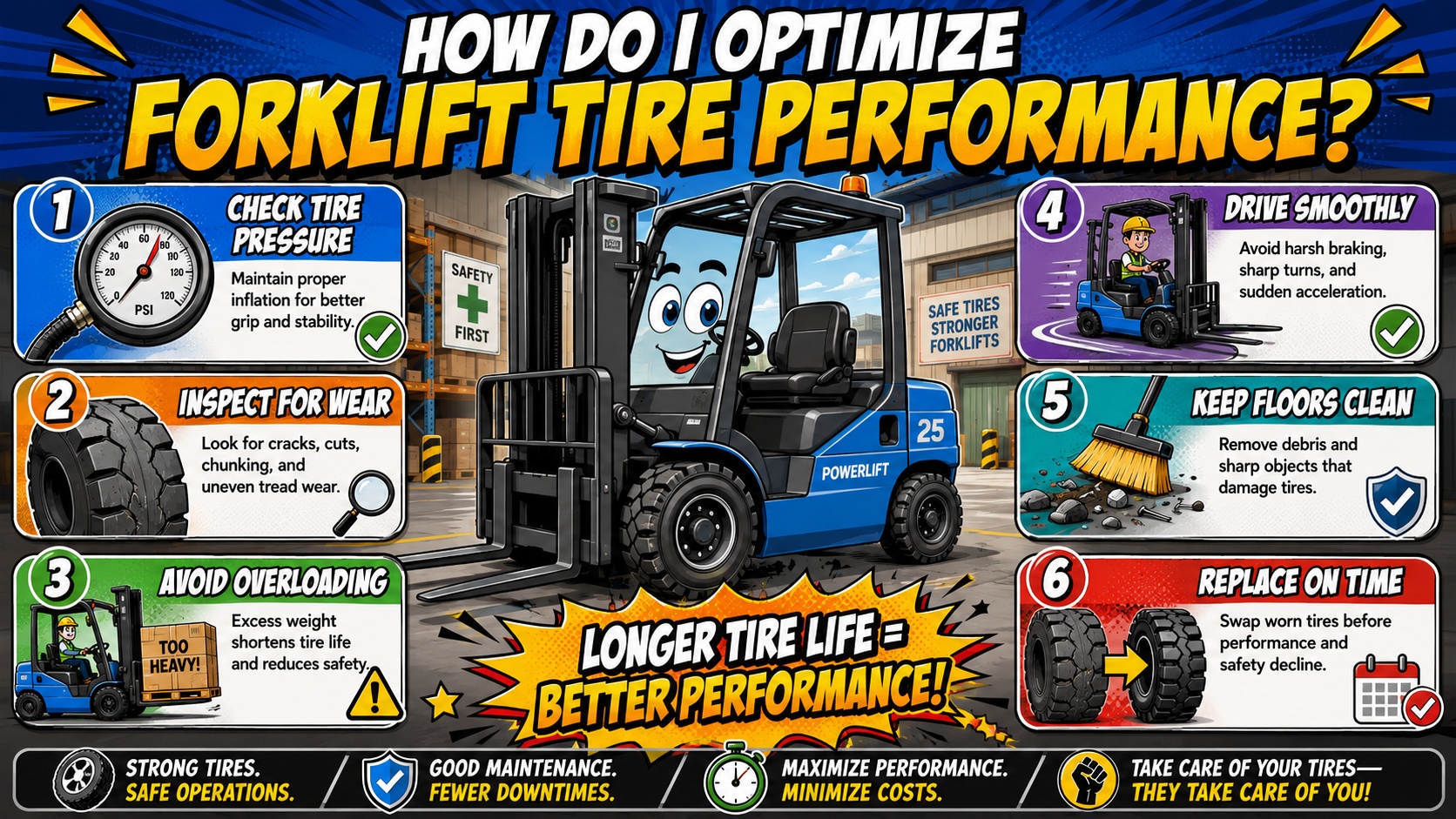
How do I optimize forklift tire performance
Optimizing forklift tire performance is essential for reducing downtime, lowering operational costs, and improving warehouse safety. From pneumatic to solid tires, every choice impacts your material handling equipment’s traction, load stability, and fuel efficiency. This guide provides actionable strategies to maximize tire lifespan, enhance grip, and maintain consistent performance across your fleet, ensuring your operations run smoothly even in demanding environments.
Understanding Forklift Tire Types and Their Performance Factors
Before diving into optimization techniques, it is critical to understand the three main tire categories used in industrial forklifts. Each type offers distinct advantages depending on the surface, load weight, and duty cycle.
Pneumatic Tires
These air-filled tires provide excellent shock absorption and traction on uneven outdoor surfaces. However, they are prone to punctures and require frequent pressure checks. To optimize performance, maintain tire pressure within the manufacturer’s recommended PSI range. Underinflated tires increase rolling resistance, which can drain battery life in electric models and reduce fuel economy in internal combustion units.
Solid (Cushion) Tires
Solid tires are standard in indoor warehouses due to their puncture-proof design and lower maintenance. They offer superior stability on smooth concrete floors but can cause excessive vibration on rough surfaces. To extend their life, ensure your warehouse floors are clean and free of debris that could cause uneven wear.
Polyurethane Tires
Often found on electric pallet jacks and reach trucks, polyurethane tires provide low rolling resistance and excellent floor protection. They are quieter than rubber but can wear out quickly under heavy loads. Optimizing their performance involves matching the tire’s load rating exactly to your typical weight requirements.
Key Strategies to Optimize Forklift Tire Performance
Implementing the following best practices can significantly increase tire lifespan by up to 30% while improving safety and productivity.
1. Maintain Proper Tire Pressure
For pneumatic tires, check pressure daily using a calibrated gauge. Inflate tires to the cold pressure specified on the sidewall. Incorrect pressure leads to center or shoulder wear, reducing traction and increasing the risk of blowouts. For solid tires, confirm there is no separation between the rubber and the steel band.
2. Perform Regular Visual Inspections
Train operators to perform a quick visual check before each shift. Look for cuts, chunks, embedded debris, and uneven wear patterns. Early detection of small issues prevents catastrophic failures. Pay special attention to the tread depth and sidewalls, as damage here can compromise tire integrity.
3. Implement Load Management Practices
Overloading a forklift is the fastest way to degrade tire performance. Always comply with the truck’s load capacity chart. Distribute the load evenly and ensure the center of gravity is within safe limits. Excessive weight forces tires to deform more, generating heat that accelerates wear in both solid and pneumatic options.
4. Optimize Driving Techniques
Aggressive acceleration, hard braking, and sharp turns create significant scrubbing forces on tires. Train operators to accelerate smoothly, reduce speed before turns, and avoid abrupt stops. On solid tires, curb impacts can cause internal delamination. On pneumatic tires, sharp turns at speed can cause sidewall failure.
5. Match Tire Compound to Your Floor Surface
Different floor surfaces require different rubber compounds. For abrasive concrete, a harder compound resists wear. For polished or coated floors, a softer compound provides better traction without marking. Many suppliers offer multiple compound options for the same tire size. For example, Liftron Material Handling offers customizable tire solutions tailored to specific floor finishes and load conditions.
Common Tire Wear Patterns and Their Root Causes
Understanding what different wear patterns indicate helps you address underlying mechanical problems before they affect tire performance.
| Wear Pattern | Likely Cause | Corrective Action |
|---|---|---|
| Center wear (pneumatic) | Overinflation | Reduce tire pressure to specification |
| Edge wear (pneumatic) | Underinflation | Increase tire pressure; check for leaks |
| Cupping or scalloping | Out-of-balance tire or worn wheel bearings | Balance tire; inspect and replace bearings |
| Flat spots (solid tires) | Aggressive braking or skidding | Retrain operator; adjust braking system |
| Uneven sidewall wear | Incorrect wheel alignment or curbing | Check alignment; avoid curb impacts |
How Tire Selection Affects Warehouse Efficiency
Choosing the right tire for your application directly impacts cycle times, energy consumption, and maintenance schedules. If you operate in a multi-shift warehouse with mixed loads, consider the Liftron DL SERIES, which integrates advanced tire management systems. These forklifts are designed to work with specific tire profiles that maximize energy recovery during braking, further optimizing overall performance.
For high-speed applications, select tires with a lower rolling resistance to reduce energy draw. For heavy-duty environments, choose tires with a higher load index and reinforced sidewalls. Consulting with a manufacturer like Liftron Material Handling ensures you get tires engineered for your specific duty cycle, whether that is continuous loading, cold storage, or outdoor rough terrain.
Case Study: Extending Tire Life in a Cold Storage Facility
A regional logistics company operating at -20°F found that their standard solid tires were lasting only 4 months. The cold temperature caused the rubber to harden, leading to rapid chunking. After switching to a cold-storage-specific compound recommended by Liftron Material Handling, tire life extended to 14 months. Additionally, they implemented a daily pressure and condition check protocol, reducing unplanned tire replacements by 60%.
Conclusion and Action Plan
Optimizing forklift tire performance requires a systematic approach: proper selection, consistent maintenance, and operator training. Start by auditing your current tire conditions and identifying any recurring wear patterns. Then, review your application requirements to ensure you are using the right tire type and compound. Finally, enforce daily inspections and load management rules across your team.
For expert guidance on selecting the best tires for your fleet, contact Liftron Material Handling. Their technical team can assess your facility and recommend tires and maintenance programs that reduce costs and increase uptime. Explore their Liftron DL SERIES for integrated solutions that pair advanced traction control with durable tire options, delivering measurable improvements from day one.
Add a review
Your email address will not be published. Required fields are marked *