
Can You Put Pneumatic Tires on a Cushion Tire Forklift?
Quick Answer: In most cases, no. You cannot simply put pneumatic tires on a cushion tire forklift. Cushion tire forklifts and pneumatic tire forklifts are engineered differently, with different frames, axles, wheel wells, ground clearance, and mounting systems. Converting one into the other is usually expensive, impractical, and unsafe compared with buying or renting the correct forklift type.
Forklift tires are not interchangeable in the same way car tires might be changed for another tread pattern. A forklift is designed from the ground up around a specific tire type. Tire size, tire height, axle position, counterweight balance, turning radius, mast angle, undercarriage clearance, and rated capacity all work together as one engineered system.
This is why a cushion tire forklift should normally stay on cushion tires. If you need outdoor performance, rough-terrain capability, or better traction on gravel, dirt, or broken asphalt, switching the whole machine to a pneumatic-tire forklift is usually the better solution. A modern liftron forklift can also be selected based on the specific work environment, load capacity, and tire requirements.
Why the Swap Doesn't Work
The main reason the swap does not work is that cushion tire forklifts and pneumatic tire forklifts are built for different environments. Cushion tire forklifts are compact machines designed for smooth indoor floors, tight aisles, loading docks, trailers, and warehouse spaces. Pneumatic tire forklifts are built with larger tires, higher ground clearance, and stronger outdoor mobility.
Mounting System
Cushion tires are usually press-on tires. They are pressed onto a metal hub and designed for compact indoor forklift frames. Pneumatic tires, by contrast, are mounted on rims and are much larger in diameter and width. Because the mounting systems are different, pneumatic tires cannot simply be installed on cushion tire wheels.
To make pneumatic tires fit, the forklift would need major changes to the wheel assemblies, axle setup, and possibly the frame. These modifications are rarely practical and may void the manufacturer’s specifications.
Frame Clearance
Pneumatic tires are much larger than cushion tires. A cushion tire forklift usually has limited clearance around the wheel wells, counterweight, frame, mast area, steering components, and undercarriage. Larger pneumatic tires may rub against the body, hit steering parts, or interfere with safe turning.
Even if a tire could physically fit, the larger diameter would change forklift height, center of gravity, tilt geometry, and ground contact. These changes can affect how the machine handles, brakes, turns, and lifts.
Safety and Stability
Forklift stability depends on the original engineering of the truck. Changing tire type can alter the stability triangle, lifting behavior, steering response, and rated capacity. A forklift that becomes taller or less predictable may be more likely to tip, especially while turning or carrying loads.
Safety Warning: Never modify forklift tires, wheels, axles, or frame components without written approval from the manufacturer or a qualified engineering authority.
Cushion Tire Forklift vs. Pneumatic Tire Forklift
| Feature | Cushion Tire Forklift | Pneumatic Tire Forklift |
|---|---|---|
| Primary use | Indoor warehouses, docks, smooth concrete floors | Outdoor yards, gravel, asphalt, dirt, rougher surfaces |
| Tire design | Press-on solid cushion tire | Air-filled or solid pneumatic-style tire |
| Ground clearance | Lower ground clearance | Higher ground clearance |
| Turning radius | Compact and tight for indoor aisles | Larger turning radius for outdoor mobility |
| Ride comfort | Firm ride on smooth floors | More cushioning on rough ground |
| Conversion difficulty | Not practical to convert to pneumatic tires | Designed for pneumatic-style tires from the factory |
Your Alternative Options
While you generally cannot switch to air-filled pneumatic tires on a cushion tire forklift, you still have several practical options. The right choice depends on whether you need better indoor grip, limited outdoor movement, or full outdoor capability.
Switch to Traction Cushion Tires
If you only need better grip on slick warehouse floors, polished concrete, loading docks, or slightly wet indoor areas, traction cushion tires may help. These tires are still designed for cushion tire forklifts, but they use tread patterns or compounds that improve grip compared with smooth press-on tires.
This is usually the most realistic upgrade for a cushion tire forklift because it keeps the machine within its intended tire category while improving traction.
Use the Correct Forklift for Outdoor Work
If your job requires regular travel over gravel, rough asphalt, dirt, outdoor yards, ramps, or uneven loading areas, the better solution is to use a forklift designed for those conditions. A pneumatic tire forklift or outdoor-capable electric forklift will usually offer better ground clearance, traction, and operator comfort.
Switch to Solid Pneumatics on a Pneumatic Forklift
If you already have a pneumatic-tired forklift and want to avoid flats from sharp debris, you may be able to swap air-filled pneumatic tires for solid pneumatic tires. Solid pneumatics look similar to air tires but are made from solid rubber, reducing the risk of punctures.
Pro Tip: If your cushion tire forklift is being forced outdoors every day, the issue is not only the tire. The entire forklift may be the wrong machine for the application.
Step-by-Step: How to Choose the Right Tire Solution
- Identify the current forklift type: Confirm whether the forklift is designed for cushion tires or pneumatic-style tires.
- Check the data plate: Review model information, rated capacity, approved tire size, and any manufacturer tire requirements.
- Inspect the work surface: Determine whether the forklift operates on smooth concrete, wet floors, asphalt, gravel, dirt, or mixed surfaces.
- Define the traction problem: Decide whether you need better indoor grip, outdoor mobility, puncture resistance, or shock absorption.
- Ask a qualified dealer: Confirm approved tire options before ordering replacement tires or making modifications.
- Choose the safer option: Upgrade to traction cushion tires, use a pneumatic forklift, or rent the correct machine for the job.
What Type of Tires Does the Liftron Forklift Use?
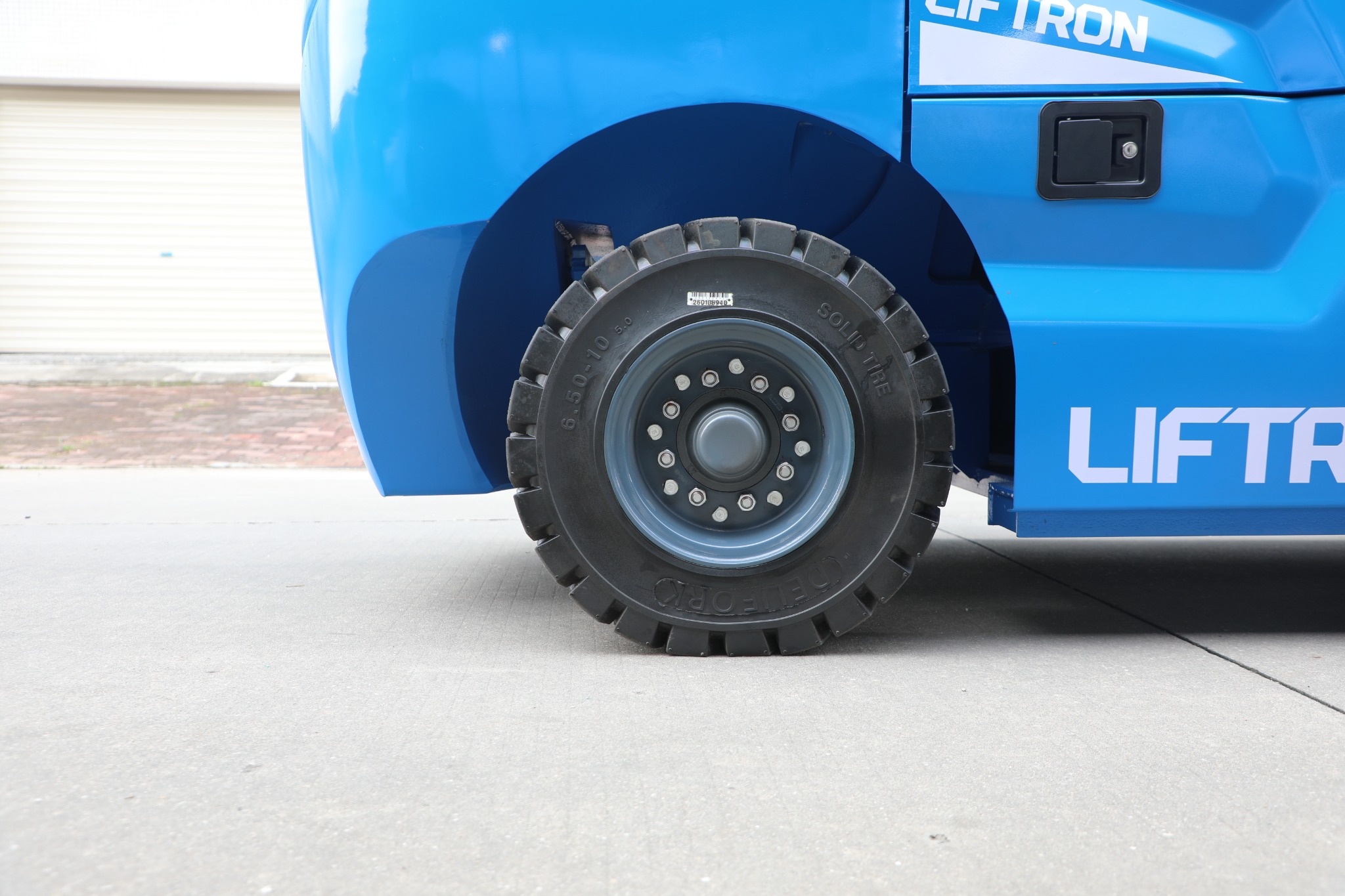
The liftron forklift lineup is equipped with high-quality solid tires. These tires deliver excellent durability and stability in demanding working environments. Their puncture-proof design eliminates the risk of flats, reduces maintenance requirements, and ensures consistent performance on uneven or high-traffic surfaces.
Solid tires are often a practical choice for warehouses, manufacturing facilities, logistics centers, and mixed-use environments where uptime matters. Because they do not require air pressure, they reduce the risk of sudden flats and help operators maintain consistent performance throughout the shift.
Before selecting a liftron forklift or any other forklift, consider the surface conditions, aisle width, load capacity, lift height, tire type, and whether the machine will be used indoors, outdoors, or both.
Selection Reminder: Tire choice should match the forklift design. Do not try to solve an outdoor application problem by forcing the wrong tire type onto the wrong forklift.
Conclusion
So, can you put pneumatic tires on a cushion tire forklift? Generally, no. The mounting system, frame clearance, axle design, and stability requirements are completely different. A conversion would require major modifications and may create safety risks.
If you need more grip indoors, consider traction cushion tires. If you need real outdoor performance, use a pneumatic tire forklift or choose equipment designed for the application. A liftron forklift with high-quality solid tires can provide durability, stability, and low-maintenance performance for demanding material handling environments.
Add a review
Your email address will not be published. Required fields are marked *