
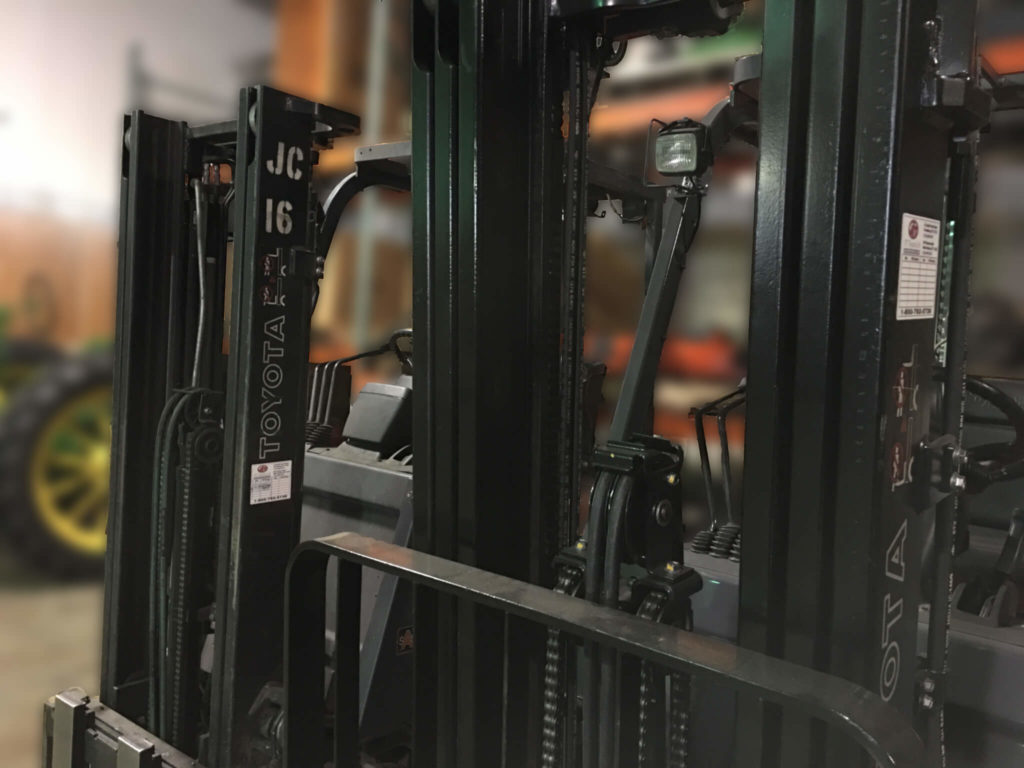
What Is Free Lift on a Forklift?
Understanding free lift is important when selecting and operating a forklift. The correct free lift specification helps prevent collisions with ceilings, containers, trailers, and warehouse structures while improving efficiency during pallet handling operations.
Free lift refers to how high a forklift’s forks can rise without extending the mast upward. A forklift with greater free lift can handle pallets in low-clearance areas more safely because the mast remains at a lower overall height.
How Does Free Lift Work on a Forklift?
A forklift mast consists of several vertical sections that extend upward when lifting loads. During normal lifting, the forks and carriage rise first. Once the available free lift distance is reached, the mast sections begin extending.
The amount of free lift depends on the forklift mast design, hydraulic cylinder configuration, and the number of mast stages. Warehouses, distribution centers, and transportation operations often select forklifts with specific free lift capabilities based on their working environment.
Why Is Free Lift Important?
Free lift directly affects where and how a forklift can operate. A forklift with insufficient free lift may not be suitable for environments with low ceilings or restricted spaces.
| Application Area | Why Free Lift Matters | Benefit |
|---|---|---|
| Shipping Containers | Allows lifting pallets without raising the mast into the container roof | Prevents overhead damage |
| Truck Trailers | Helps stack pallets under limited roof height | Improves loading efficiency |
| Low Doorways | Keeps mast height lower during movement | Reduces collision risks |
| Warehouse Racking | Allows controlled pallet positioning | Improves storage safety |
Free Lift vs Maximum Lift Height
Free lift and maximum lift height are two different forklift specifications. Maximum lift height describes how high the forks can travel when the mast is fully extended. Free lift describes how far the forks can rise before the mast itself starts extending.
| Feature | Free Lift | Maximum Lift Height |
|---|---|---|
| Definition | Fork movement before mast extension | Total fork lifting capability |
| Main Purpose | Working in low-clearance areas | High stacking applications |
| Mast Movement | No significant mast extension | Mast sections extend upward |
| Typical Use | Containers, trailers, low buildings | Warehouses and storage racks |
Types of Free Lift on Forklifts
Forklifts generally have two main types of free lift systems. The correct choice depends on the working environment and required lifting performance.
1. Limited Free Lift
Limited free lift means the forks can only rise a short distance before the mast sections begin extending. This design is common on basic forklift models and standard warehouse applications.
Typically, limited free lift provides only several inches of fork movement before mast extension starts. While suitable for open areas, it may not be ideal for low-height environments.
2. Full Free Lift (FFL)
Full Free Lift (FFL) allows the forks and carriage to travel much higher before the mast extends. This is achieved through a dedicated central hydraulic cylinder positioned inside the mast.
Full free lift is especially useful for operations involving containers, trailers, cold storage facilities, and warehouses with height restrictions.
| Free Lift Type | Fork Movement | Common Applications |
|---|---|---|
| Limited Free Lift | Short lifting distance before mast extension | Open warehouses and general handling |
| Full Free Lift | Maximum fork movement without mast extension | Containers, trailers, restricted spaces |
How to Choose the Right Free Lift Forklift
Selecting the correct forklift requires evaluating workplace conditions, lifting requirements, and available overhead space.
- Measure Overhead Clearance: Check door heights, container ceilings, trailer heights, and warehouse restrictions.
- Determine Required Lift Height: Identify how high pallets must be stacked during normal operations.
- Choose the Correct Mast Type: Select limited free lift or full free lift based on application needs.
- Check Load Capacity: Ensure the forklift maintains sufficient capacity at the required lift height.
- Review Manufacturer Specifications: Compare mast options and free lift measurements before purchasing equipment.
Always check the forklift data plate for mast height, free lift, and rated capacity. Installing the wrong mast configuration can create safety risks and reduce operational efficiency.
Examples of Free Lift Applications
Free lift is especially valuable in several industries where space is limited:
- Logistics and Distribution: Loading and unloading pallets inside trailers and containers.
- Food Storage: Operating in cold rooms with restricted ceiling heights.
- Manufacturing: Moving materials around equipment and production lines.
- Retail Warehousing: Handling inventory in compact storage areas.
Common Free Lift Mistakes
Operators should understand free lift limitations to avoid unsafe situations. Common mistakes include:
- Ignoring mast height changes during lifting operations.
- Assuming free lift equals maximum lifting height.
- Using a forklift with insufficient clearance for the application.
- Failing to check manufacturer specifications before operation.
Conclusion
Free lift is an important forklift specification that determines how high the forks can rise before the mast extends. It improves safety and productivity in areas with limited overhead clearance.
For operations involving trailers, containers, and low-height warehouses, forklifts with full free lift capability provide greater flexibility and safer load handling. Understanding free lift helps businesses choose the right equipment and reduce workplace risks.
Add a review
Your email address will not be published. Required fields are marked *