
What Is an Advantage of an Articulated Forklift?
What Is an Articulated Forklift?
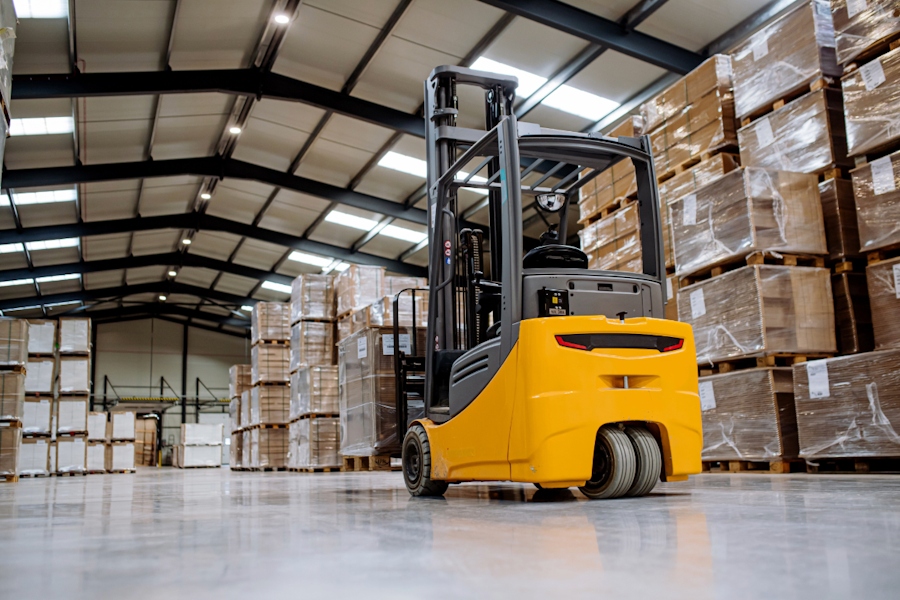
An articulated forklift is a powered industrial truck designed for narrow-aisle pallet handling. Unlike a conventional forklift, which turns mainly by steering its rear wheels, an articulated model has a pivoting joint between the front mast section and the rear chassis.
When the operator enters a rack aisle, the front portion can swing toward the pallet location. This allows the truck to place or retrieve a load without requiring the wide right-angle turning space normally needed by a standard counterbalance forklift.
Articulated forklifts are commonly used in:
- High-density pallet warehouses
- Distribution centers
- Cold-storage facilities
- Manufacturing plants
- Building-material warehouses
- Food and beverage operations
- Facilities combining outdoor unloading with indoor racking
The Main Advantage: Narrow-Aisle Maneuverability
The pivoting front section is the defining feature of an articulated forklift. It lets the mast turn toward the rack while the truck occupies relatively little aisle width.
Depending on the model, pallet dimensions and layout, articulated forklifts may work in aisles around 1.6 to 2.2 meters wide. A conventional counterbalance truck often requires considerably more turning space.
This narrow-aisle capability can allow a warehouse to:
- Reduce the distance between rack rows
- Add more rack runs within the same building
- Increase the number of pallet positions
- Use previously wasted floor space
- Delay or avoid moving to a larger facility
1. Increased Warehouse Storage Capacity
How It Works
In a conventional warehouse, aisles must be wide enough for the forklift to turn the entire truck and pallet approximately 90 degrees before entering the rack opening.
An articulated truck requires less turning space because the front mast section pivots independently. Narrower travel aisles leave more floor area available for racking.
The Operational Advantage
Some warehouse layouts can gain up to approximately 50% more pallet locations compared with layouts designed around wider conventional aisles. The actual increase varies according to the original aisle width, building shape, columns, exits, sprinklers and rack configuration.
Additional storage density can reduce:
- Building expansion costs
- External storage expenses
- Long travel distances
- Product movement between separate facilities
- Energy use in cold-storage buildings
2. Road-to-Rack Efficiency
Many narrow-aisle warehouse systems use two types of equipment. A counterbalance forklift unloads trailers and places pallets in a staging area, while a reach or turret truck moves them into the rack.
An articulated forklift may be able to perform both tasks. It can collect a pallet from a loading dock, travel across a yard or warehouse floor and place the load directly into narrow-aisle racking.
This is often called road-to-rack or truck-to-rack operation.
| Handling Method | Typical Process | Operational Effect |
|---|---|---|
| Two-truck system | Counterbalance truck unloads; narrow-aisle truck stores | Requires staging and an additional pallet handoff |
| Articulated forklift | One truck unloads, travels and places the pallet in the rack | May reduce double handling and waiting time |
| Fixed VNA system | Dedicated guided truck works only within narrow aisles | High storage density but may require support equipment |
Reducing double handling can lower the risk of pallet damage, misplaced inventory and delays between receiving and storage.
3. Versatile Indoor and Outdoor Operation
Many articulated forklifts are designed with rubber tires and enough ground clearance to operate on ordinary warehouse floors, loading areas and reasonably maintained outdoor surfaces.
This provides greater flexibility than certain specialized very-narrow-aisle trucks that remain permanently inside guided rack aisles.
An articulated truck may be used for:
- Trailer loading and unloading
- Yard-to-warehouse pallet transport
- Ground-level block stacking
- High-level rack placement
- Order staging
- Long-load or specialized handling with approved configurations
However, outdoor suitability depends on tire type, ground condition, weather protection, gradeability and manufacturer specifications. An articulated warehouse truck should not automatically be treated as a rough-terrain forklift.
4. Less Need for Specialized Flooring
Some guided VNA systems require very flat floors because the truck travels with minimal clearance between the load and rack structure. Floor irregularities can make the mast sway or affect high-level positioning.
Many articulated models can operate without embedded guide wires or floor-mounted guidance rails. This may reduce the cost and disruption involved in converting an existing warehouse.
They may also tolerate normal industrial floors better than certain dedicated turret systems. Nevertheless, the floor must still be strong, level and maintained in safe condition.
Potholes, broken joints, steep slopes and severe unevenness can reduce stability and rack-placement accuracy, especially when loads are lifted high.
5. Flexible Pallet Handling
The articulated steering system can help the operator align the forks with pallets at different rack positions. Depending on the model and approved attachment, the truck may handle:
- Standard pallets
- Wide pallets
- Long loads
- Building materials
- Drums or appliances with attachments
- Irregularly shaped products
Versatility does not eliminate capacity limits. Long loads, attachments and extended load centers can reduce the forklift’s residual capacity and increase aisle requirements.
6. Reduced Fleet Size
A facility may be able to replace separate counterbalance and narrow-aisle machines with one articulated truck for certain workflows.
A smaller fleet can reduce:
- Equipment purchase or rental costs
- Maintenance schedules
- Battery or fuel requirements
- Parking and charging space
- Operator handoffs
- Traffic congestion
However, one articulated truck may not replace every machine. High-volume loading docks, pedestrian-operated pallet handling and specialized order picking may still require additional equipment.
Articulated Forklift vs. Conventional Forklift
| Feature | Conventional Counterbalance Forklift | Articulated Forklift |
|---|---|---|
| Steering design | Rear-wheel steering with fixed mast orientation | Pivoting front mast section plus chassis steering |
| Aisle requirement | Generally requires wider turning space | Designed for narrow and very narrow aisles |
| Loading-dock work | Highly suitable for general loading and unloading | Many models can also work at docks |
| Rack storage | Suitable where aisles provide enough turning room | Designed for dense high-level racking |
| Storage density | Lower when wider aisles are required | Potentially higher because aisles can be narrower |
| Operator learning curve | More familiar to many operators | Requires training for articulated steering behavior |
| Purchase complexity | Many common models and configurations | More specialized selection and layout planning |
What Is the Difference Between a Forklift and an Articulated Forklift?
“Forklift” is a broad term for powered industrial trucks designed to lift and move materials. An articulated forklift is one specific type within that broader category.
A conventional counterbalance forklift has a mast fixed to the front of the truck and turns by steering the rear wheels. The complete vehicle must rotate within the aisle to face a rack location.
An articulated forklift has a joint that allows the mast and front axle assembly to swing relative to the rear chassis. This creates a much tighter stacking maneuver.
The difference affects:
- Required aisle width
- Steering behavior
- Operator visibility
- Rack-entry technique
- Training requirements
- Warehouse layout design
Are Articulated Forklifts Easier to Drive?
They can be highly maneuverable, but they are not automatically easier for an inexperienced operator. The pivoting front section responds differently from a standard counterbalance truck.
The operator must understand:
- Front-end swing
- Rear chassis movement
- Load position during articulation
- Clearance from uprights and rack guards
- Correct entry and exit angles
- Travel direction with obstructed visibility
OSHA requires training to address the specific truck type and the workplace conditions where it will be operated. An employee trained only on a standard sit-down truck should receive additional instruction and evaluation before operating an articulated model.
Potential Disadvantages to Consider
Although articulated forklifts provide major space advantages, they may not be the best choice for every operation.
| Consideration | Possible Limitation |
|---|---|
| Initial cost | Specialized equipment may cost more than a basic counterbalance truck |
| Operator training | Drivers must learn articulated steering and clearance behavior |
| Maintenance | The articulation joint and specialized steering components require inspection |
| Floor and yard conditions | Severely uneven ground may limit safe use |
| Throughput | A dedicated VNA system may be faster in certain high-volume applications |
| Capacity at height | Residual capacity must be checked for the required lift height |
How to Decide Whether an Articulated Forklift Is Right for You
- Measure the existing aisles. Record the clear distance between rack faces and all guards.
- Identify pallet dimensions. Include pallet overhang and the largest regular load.
- Determine maximum lift height. Record the highest beam and pallet placement level.
- Confirm required capacity. Include attachment weight and actual load center.
- Review dock and yard work. Determine whether one truck must operate indoors and outdoors.
- Calculate potential rack gains. Compare the existing layout with a narrow-aisle proposal.
- Check floor condition. Inspect joints, slopes, damage and load-bearing capacity.
- Arrange an on-site demonstration. Test the truck using actual pallets and aisles.
- Plan operator training. Provide truck-specific formal instruction and practical evaluation.
- Compare total cost. Include racking changes, fleet reduction, maintenance and productivity.
How Much Storage Can an Articulated Forklift Add?
Manufacturers commonly state that an articulated forklift layout can increase storage capacity by up to approximately 50%. This figure is possible when a warehouse replaces wide aisles with substantially narrower ones.
The actual improvement could be lower when the building contains:
- Closely spaced support columns
- Fixed conveyor systems
- Multiple fire exits
- Irregular wall shapes
- Low ceilings
- Large staging areas
- Oversized pallets
A professional warehouse layout should calculate both pallet capacity and safe operating clearances rather than maximizing rack rows without considering traffic flow.
Safe Operation in Narrow Aisles
Narrow aisles provide less clearance between the truck, load and rack structure. Operators must control speed and keep loads centered.
Good practices include:
- Travel only within designated routes
- Keep pedestrians out of active narrow aisles
- Inspect rack protectors and aisle ends
- Approach pallet locations at controlled speed
- Use horns, lights and mirrors at intersections
- Report rack impacts immediately
- Lower the load before leaving the aisle
- Follow the truck’s capacity plate
Conclusion
The main advantage of an articulated forklift is its ability to place pallets in very narrow aisles. The pivoting mast section reduces turning space and allows warehouses to install more racks within the same floor area.
Articulated forklifts can also improve road-to-rack efficiency by performing outdoor unloading, indoor transport and high-level stacking with one machine. This may reduce double handling and the need for multiple truck types.
Compared with a conventional forklift, an articulated model requires less aisle width but has different steering characteristics and training needs.
The best results come from matching the truck to the actual pallet size, lift height, floor condition and warehouse layout. An on-site demonstration and professional aisle study can confirm whether the expected storage and productivity gains are realistic.
Add a review
Your email address will not be published. Required fields are marked *