
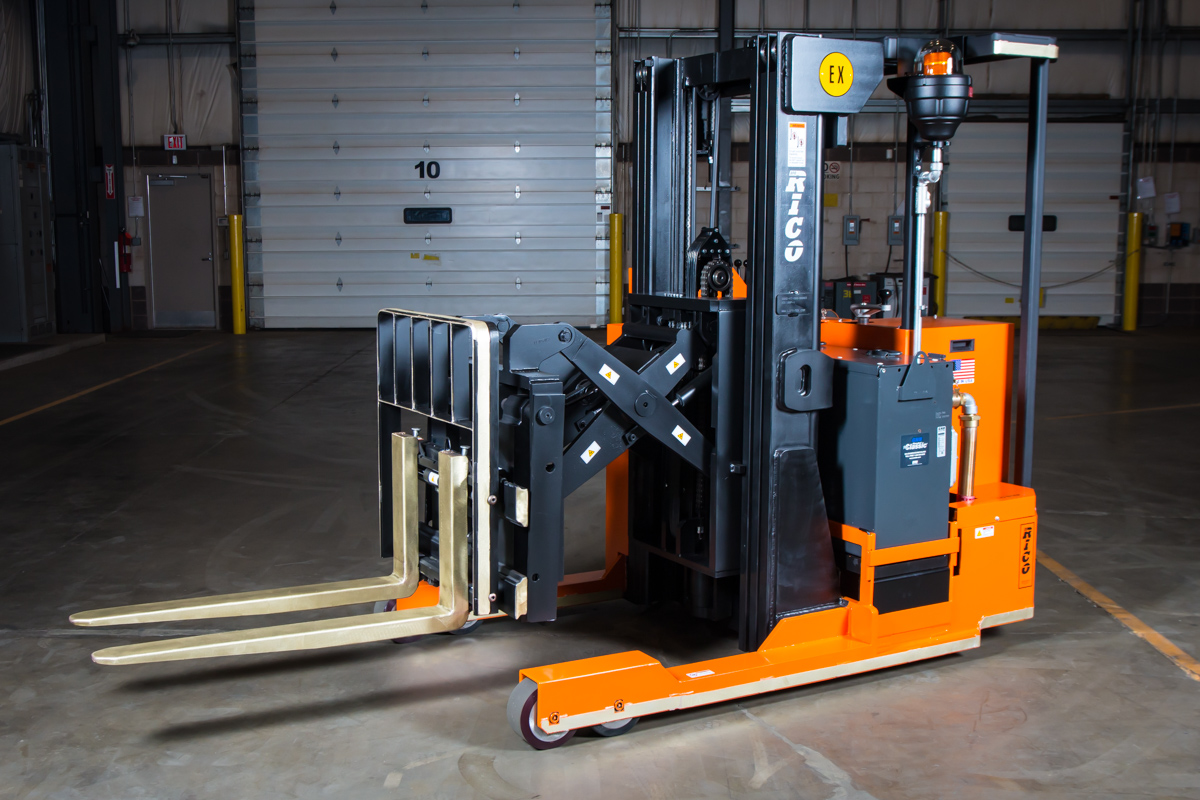
How to Raise Forks on a Straddle Stacker
How to Raise Forks on a Straddle Stacker
A straddle stacker raises its forks through a hydraulic lifting system. The forks are attached to a carriage that moves up and down along the mast. When the operator activates the lift control, hydraulic pressure pushes the lift cylinder upward, raising the forks and the pallet.
The basic lifting process is simple, but safe operation depends on correct positioning, load balance, fork placement, and smooth control. A stacker should never be used to lift an unstable, damaged, oversized, or overweight load.
Unlike a full-sized counterbalance forklift, a straddle stacker uses two forward support legs that go around the pallet. These straddle legs help stabilize the load while the forks lift vertically. This makes the machine useful for tight warehouse aisles, small stockrooms, and indoor pallet stacking.
Main Controls Used to Raise the Forks
The control method depends on the type of straddle stacker. Electric models use buttons or rocker switches on the tiller handle. Manual models use a pump handle or foot pedal. Semi-electric models usually use electric lifting but may require manual travel.
| Stacker Type | How the Forks Raise | Operator Action |
|---|---|---|
| Manual Straddle Stacker | Manual hydraulic pump | Pump the handle or foot pedal |
| Semi-Electric Straddle Stacker | Battery-powered hydraulic lift | Press the raise button or toggle switch |
| Fully Electric Straddle Stacker | Electric lift motor and hydraulic system | Use fingertip lift controls on the tiller |
Operating Step-by-Step
1. Position the Stacker
Drive or push the stacker slowly toward the pallet. The forks should enter the pallet squarely, not at an angle. The straddle legs should pass around the outside of the pallet or load area.
Before lifting, check that the floor is level, the pallet is not damaged, and the load is stable. Make sure the forks are spaced correctly and inserted deeply enough to support the pallet evenly.
2. Center the Load
A centered load is easier to lift and safer to move. The weight should be balanced across both forks. If the pallet is heavier on one side, the stacker may become unstable during lifting or turning.
Never lift a pallet that is leaning, broken, loosely wrapped, or wider than the stacker can safely handle.
3. Engage the Lift
Once the load is properly positioned, engage the lift control slowly. On a powered model, press the raise button or toggle switch on the tiller handle. On a manual model, pump the handle or use the foot pedal until the forks begin to rise.
Raise the forks smoothly. Avoid sudden lifting because abrupt movement can shift the load, stress the pallet, or reduce stability.
4. Raise Only as High as Needed
For travel, raise the load only high enough to clear the floor. If you are stacking, continue lifting until the pallet reaches the correct rack or shelf height. Do not travel with the load raised high.
5. Transport the Load
If the model has mast tilt, tilt the mast slightly backward before moving to help secure the load. Many walkie stackers have limited or no mast tilt, so operators should rely on correct fork placement, low travel height, and smooth movement.
Move slowly and avoid sudden turns. Keep pedestrians clear and use the horn at intersections or blind areas.
6. Lower for Unloading
To lower the load, press the lower button on an electric model or carefully operate the release pedal or valve on a manual model. Lower the forks gently until the pallet rests securely on the floor, rack, or storage surface.
How High Should the Forks Be When Traveling With a Load?
When operating a straddle stacker with a load, the forks should be kept low while traveling. A common safe travel height is about 2 to 4 inches off the floor, or just high enough for the pallet to clear the ground and avoid dragging.
The exact height can depend on floor condition, pallet type, workplace rules, and the manufacturer’s instructions. The safest principle is to keep the load as low as practical during travel and raise it only when placing or stacking.
| Fork Height | Best Use | Safety Impact |
|---|---|---|
| 2–4 inches above floor | Normal loaded travel | Improves stability and keeps center of gravity low |
| Higher than necessary | Should be avoided during travel | Increases tip risk and reduces control |
| Rack placement height | Only when stopped at the storage position | Used for stacking or unloading |
Why Fork Height Matters
Fork height affects stability. When the forks are raised, the load’s center of gravity also rises. The higher the load, the easier it is for the machine to become unstable during turning, stopping, or traveling over uneven floor surfaces.
Keeping the load low helps the stacker remain stable and easier to control. It also reduces the chance of striking racks, beams, doors, sprinkler systems, or other warehouse structures.
Pre-Lift Safety Checklist
Before raising the forks, operators should complete a quick safety check. This helps prevent pallet drops, load shifts, and equipment damage.
- Confirm the load weight is within rated capacity.
- Check that the pallet is not cracked or broken.
- Make sure the forks are fully inserted.
- Center the load across both forks.
- Verify that the straddle legs are properly positioned.
- Check for people near the load area.
- Inspect the floor for debris, slopes, or wet spots.
- Make sure there is overhead clearance before lifting.
- Use smooth lift control instead of sudden movement.
How the Hydraulic Lift System Works
A straddle stacker uses hydraulic pressure to raise the forks. When the operator activates the lift function, the pump pushes hydraulic fluid into the lift cylinder. As pressure builds, the cylinder extends and raises the carriage along the mast.
On powered stackers, an electric motor runs the hydraulic pump. On manual stackers, the operator creates pressure by pumping the handle or foot pedal. In both cases, the hydraulic system converts force into vertical lifting motion.
| Hydraulic Component | Function |
|---|---|
| Hydraulic Pump | Creates pressure to raise the forks |
| Lift Cylinder | Extends upward as hydraulic pressure increases |
| Hydraulic Fluid | Transfers force through the lifting system |
| Control Valve | Controls lifting and lowering movement |
| Mast and Carriage | Guide the forks vertically |
Common Mistakes When Raising Forks
- Raising the load before the forks are fully inserted
- Lifting an off-center pallet
- Trying to lift more than the rated capacity
- Raising the load too quickly
- Traveling with the forks raised too high
- Turning sharply while the load is elevated
- Failing to check overhead clearance
- Standing too close to the mast, forks, or load
- Lowering the pallet too quickly
- Using a damaged pallet or unstable load
Step-by-Step Guide to Raising Forks Safely
- Inspect the straddle stacker before use.
- Check the rated capacity on the data plate.
- Confirm the pallet weight and load stability.
- Approach the pallet slowly and squarely.
- Align the straddle legs around the pallet.
- Slide the forks fully under the load.
- Center the load evenly on both forks.
- Check overhead clearance before lifting.
- Press the raise button or operate the manual pump.
- Raise the forks slowly and smoothly.
- Stop at travel height if moving the load.
- Keep the load low while traveling.
- Raise to rack height only when stopped and positioned.
- Lower the load gently into place.
- Back away carefully and lower the forks after use.
When to Use a Straddle Stacker
A straddle stacker is useful when a warehouse needs to lift pallets in tight spaces but does not need a full-sized forklift. It is designed for smooth indoor floors, moderate travel distances, and pallet stacking tasks.
The straddle-leg design also helps when handling pallet styles that may not work well with fork-over stackers. Because the support legs travel around the pallet instead of directly underneath it, the machine can support a wider range of pallet configurations.
Powered vs Manual Fork Raising
| Feature | Powered Lift | Manual Lift |
|---|---|---|
| Operator Effort | Low | Higher |
| Lift Speed | Faster and more consistent | Slower |
| Best For | Frequent lifting and daily warehouse use | Occasional or light-duty lifting |
| Control Method | Button or toggle switch | Hand pump or foot pedal |
| Productivity | Higher | Lower |
Conclusion
To raise the forks on a straddle stacker, position the machine squarely, center the load, insert the forks fully, and use the hydraulic lift control. Electric and semi-electric models use a raise button or toggle switch, while manual models use a pump handle or foot pedal.
When traveling with a load, keep the forks low, usually about 2 to 4 inches above the floor or just high enough to clear the surface. This keeps the center of gravity low and improves stability. For warehouses that need compact pallet handling, a straddle stacker is a practical solution for lifting, moving, and stacking loads safely in tight spaces.


Add a review
Your email address will not be published. Required fields are marked *