
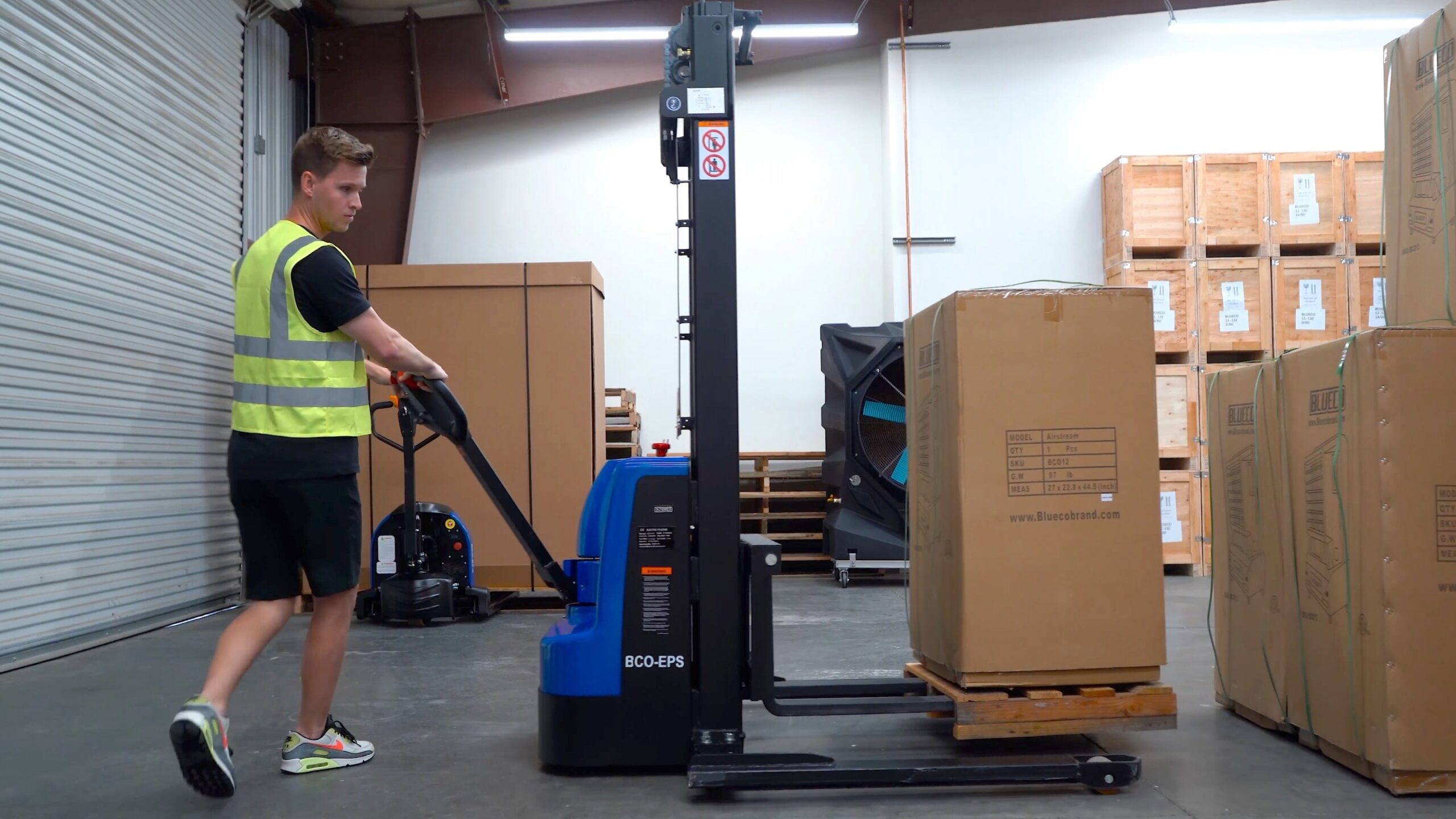
How to Operate a Straddle Stacker
What Is a Straddle Stacker Used For?
A straddle stacker is a compact material handling machine used to lift, move, and stack pallets in warehouses, stockrooms, production areas, and narrow aisles. It has two forward support legs, also called straddle legs, that extend around the pallet. These legs help support the load while the forks lift it vertically.
Unlike a full-size sit-down forklift, a straddle stacker is usually operated from a walk-behind position. The operator controls steering, travel, lifting, lowering, and braking through the tiller handle. This makes the machine useful for indoor facilities where space is limited and loads do not require a large riding forklift.
A straddle stacker is especially helpful when working with pallets that need side support, when stacking in tight aisles, or when a business wants a more compact and cost-effective alternative to a traditional forklift.
Main Controls on a Straddle Stacker
Before operating the machine, the operator should understand the basic controls. Most electric straddle stackers use a tiller handle with travel buttons, lift and lower buttons, horn button, emergency reverse button, and braking functions.
| Control | Function | Operator Note |
|---|---|---|
| Tiller Handle | Controls steering and travel position | Keep both hands ready and steer smoothly |
| Travel Throttle | Moves the stacker forward or backward | Use slow, controlled acceleration |
| Lift Button | Raises the forks and load | Lift only when the stacker is stable |
| Lower Button | Lowers the forks and load | Lower slowly and watch foot clearance |
| Horn | Warns pedestrians and other operators | Use at corners, intersections, and blind spots |
| Emergency Reverse | Moves the machine away from the operator in an emergency | Test during inspection if required by procedure |
| Emergency Stop | Cuts power to stop operation | Use only when immediate shutdown is needed |
1. Pre-Shift Inspection
Safe operation begins before the stacker moves. A pre-shift inspection helps identify mechanical, hydraulic, electrical, or wheel problems before they become dangerous.
Walk around the machine and check for visible damage. Inspect the forks, mast, chains, hydraulic hoses, wheels, battery, controls, warning labels, and data plate. Make sure the forks are not bent, cracked, or uneven. Check for hydraulic leaks near the cylinder and hoses.
For electric models, confirm that the battery is charged and securely connected. Make sure the charger cable is unplugged before operation. Test the horn, travel controls, lift/lower controls, brakes, and emergency stop in a safe area.
Pre-Shift Inspection Checklist
- Check forks for bends, cracks, or uneven height.
- Inspect mast rails, chains, and rollers.
- Look for hydraulic fluid leaks.
- Check wheels for damage, flat spots, or debris.
- Confirm the battery is charged and properly connected.
- Test the horn and warning devices.
- Test lift and lower functions.
- Test steering and braking response.
- Verify the data plate is readable.
- Report defects before using the machine.
2. Positioning and Loading
After inspection, move the straddle stacker slowly toward the pallet. Keep the forks low and make sure the path is clear. The straddle legs should line up so they pass around the outside of the pallet while the forks slide under the load.
Approach the pallet squarely. Do not enter at an angle unless the area and load allow safe repositioning. The forks should be centered under the pallet and inserted fully enough to support the load evenly.
Before lifting, check that the pallet is not damaged, broken, leaning, or overloaded. The load should be stable, centered, and within the rated capacity of the machine.
| Loading Step | Correct Practice |
|---|---|
| Approach | Move slowly and squarely toward the pallet |
| Fork Entry | Insert forks fully and evenly under the load |
| Straddle Legs | Position legs around the pallet for stability |
| Load Check | Confirm the pallet is stable and within capacity |
| Visibility | Make sure you can see the direction of travel |
3. Lifting and Traveling
Once the forks are fully positioned, use the lift control to raise the load just enough to clear the floor. Avoid lifting higher than necessary while traveling. A raised load increases the center of gravity and can make the stacker less stable.
When traveling with a load, keep the load low, move slowly, and avoid sudden turns. The operator should stay aware of the rear of the machine, the straddle legs, the pallet, and nearby pedestrians.
Because the machine is steered by the rear wheel or tiller assembly, the rear can swing during turns. Always leave enough clearance from racks, walls, pallets, and people.
When Traveling With a Load, How High Should the Forks Be?
When operating a straddle stacker, the forks should be kept as low as practical while still clearing the floor and any small surface transitions. A common safe travel height is about 2 to 4 inches off the ground, or just high enough to prevent the pallet from dragging.
The exact height may vary by model, floor condition, pallet type, and workplace policy. The key rule is simple: keep the load low during travel and raise it only when you are ready to stack or place it.
| Fork Position | When to Use | Safety Result |
|---|---|---|
| 2–4 inches above floor | Normal loaded travel | Low center of gravity and better stability |
| Higher than needed | Should be avoided during travel | Increases tip risk and reduces visibility |
| Stacking height | Only at rack or placement point | Used for placing or retrieving loads |
4. Stacking and Parking
When you reach the stacking location, stop the machine completely before lifting the load higher. Do not raise the load while turning or moving quickly.
Align the pallet with the rack beam, shelf, or storage position. Raise the forks smoothly to the required height. Move the stacker forward carefully until the pallet is correctly positioned. Lower the pallet slowly until it rests securely on the rack or floor. Then back away carefully after confirming the forks are clear.
When parking, lower the forks fully to the ground, return the controls to neutral, turn off the power, and park in an approved area. Do not block exits, fire equipment, aisles, emergency routes, or loading dock access.
Step-by-Step Operating Guide
- Put on required PPE, such as safety shoes and high-visibility clothing.
- Complete the pre-shift inspection.
- Check the battery, controls, forks, mast, wheels, and brakes.
- Turn on the stacker and test the controls in a clear area.
- Approach the pallet slowly with forks lowered.
- Position the straddle legs around the pallet.
- Insert the forks fully under the load.
- Check that the load is stable and within rated capacity.
- Raise the forks just enough to clear the floor.
- Travel slowly with the load low.
- Use the horn at corners and blind areas.
- Stop completely before raising the load to stacking height.
- Place the load carefully and lower it smoothly.
- Back away only after the forks are clear.
- Lower the forks, turn off power, and park safely.
Safe Steering and Turning
A straddle stacker turns differently from a car or a full-size forklift. Many models steer through the rear wheel or tiller assembly. This gives the machine a tight turning radius, but it also means the rear of the stacker can swing outward.
Turn slowly, especially in narrow aisles. Never make sharp turns with an elevated load. If visibility is limited, stop and reposition rather than guessing.
- Reduce speed before turning.
- Watch for tail swing.
- Keep hands and feet clear of pinch points.
- Do not turn on ramps or uneven surfaces.
- Keep the load centered and low.
- Use a spotter if the area is congested.
Operating on Ramps or Slopes
Straddle stackers are designed mainly for smooth, level indoor floors. Use extra caution on ramps, dock plates, and slopes. Follow the manufacturer’s instructions and your workplace policy.
If ramp operation is allowed, move slowly, keep the load controlled, and avoid turning on the slope. Do not use a straddle stacker on steep, damaged, wet, or uneven ramps.
Common Mistakes to Avoid
- Skipping the pre-shift inspection
- Using the stacker with damaged forks or poor brakes
- Overloading beyond the rated capacity
- Traveling with forks raised too high
- Turning sharply with a load
- Standing too close to the mast or forks
- Allowing pedestrians near the load path
- Operating on rough or wet floors
- Blocking aisles or emergency exits when parking
- Charging or servicing the machine incorrectly
Why Choose a Straddle Stacker?
A straddle stacker is a practical choice for businesses that need compact lifting equipment for indoor pallet handling. It offers good stability, narrow aisle maneuverability, and lower operating cost compared with many larger forklifts.
Because the straddle legs support the pallet from both sides, the machine can handle certain pallet types that may not work well with fork-over designs. This makes it useful for small warehouses, retail backrooms, production areas, and storage facilities.
Conclusion
Operating a straddle stacker involves four main stages: pre-shift inspection, positioning and loading, lifting and traveling, and stacking and parking. The operator uses the tiller handle to steer and fingertip controls to raise or lower the forks.
When traveling with a load, the forks should be kept low, usually around 2 to 4 inches above the floor or just high enough to clear the surface. Keeping the load low improves stability and reduces the chance of tipping. With proper training, smooth operation, and careful load handling, a straddle stacker can be a safe and efficient tool for warehouse pallet handling.


Add a review
Your email address will not be published. Required fields are marked *