
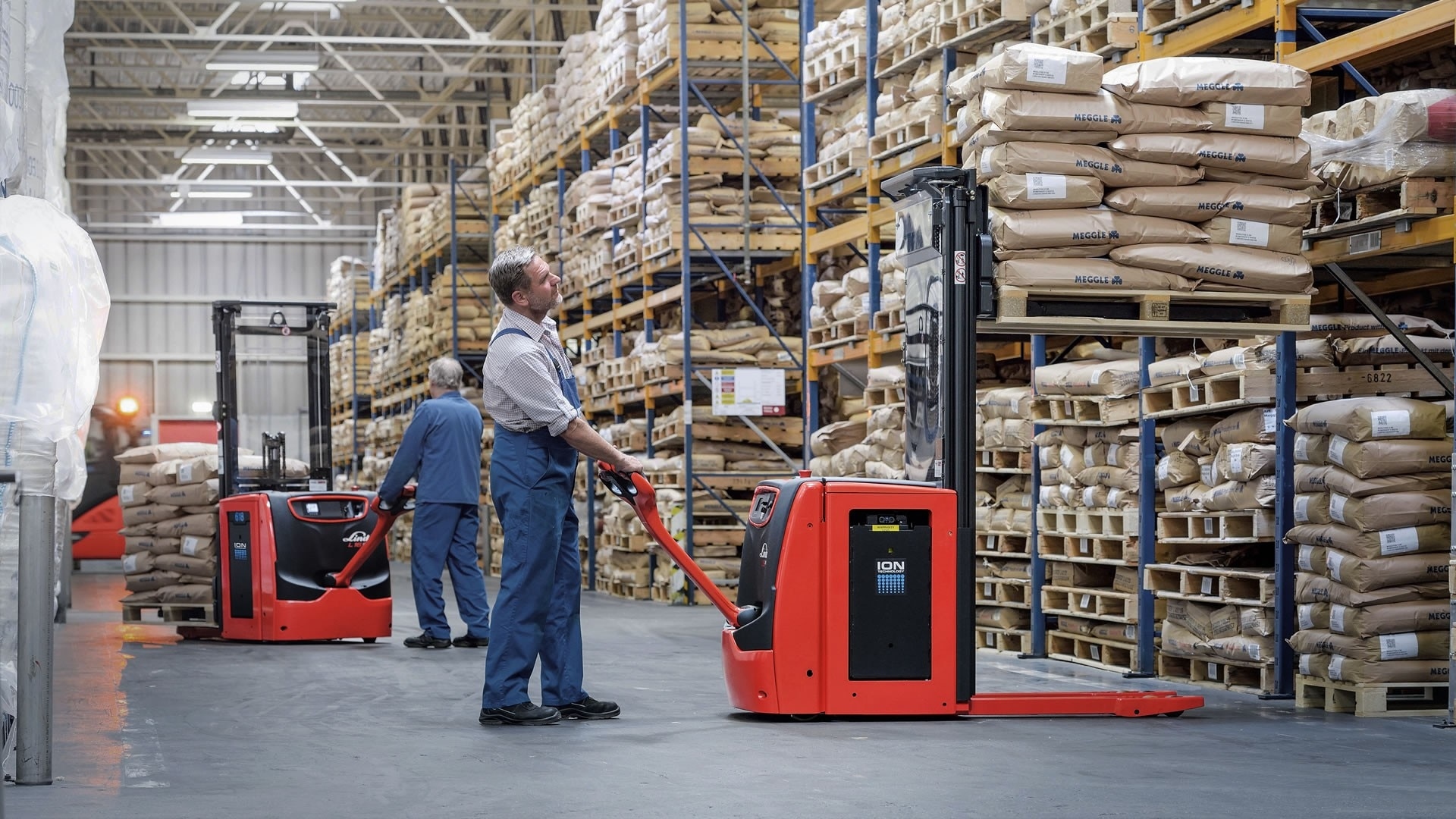
Which Wheels Steer a Straddle Stacker?
Which Wheels Steer a Straddle Stacker?
On most straddle stackers, the steering function comes from the rear wheels or rear drive wheel. The front wheels, usually located under the straddle legs, are mainly load-bearing wheels. They help support the pallet, stabilize the machine, and carry weight close to the floor, but they normally do not steer the machine.
This steering layout is important because straddle stackers are designed for tight warehouse aisles, pallet positioning, and indoor material handling. By steering from the rear, the operator can pivot the stacker more easily and make controlled turns in limited space.
A straddle stacker is not steered like a car, where the front wheels usually turn. Instead, the operator guides the stacker with a tiller handle, and the rear wheel assembly changes direction. This allows the stacker to swing and pivot around the load area.
How Straddle Stacker Steering Works
A straddle stacker uses a compact steering system designed for warehouse maneuverability. The operator controls the direction through a tiller handle or center tiller arm. When the operator moves the tiller, the rear steering wheel or rear caster assembly pivots, causing the stacker to turn.
The front load wheels remain aligned with the straddle legs. These wheels carry much of the load weight when the forks are supporting a pallet. Because they are not used for steering, they provide stable support and help keep the load path predictable.
| Wheel Location | Main Function | Does It Steer? |
|---|---|---|
| Rear drive wheel | Provides traction and directional control on many electric stackers | Yes |
| Rear swivel caster wheels | Pivot when the handle is moved on manual or semi-electric models | Yes |
| Front load wheels | Support the load under the straddle legs | Usually no |
| Stabilizer wheels | Help balance the chassis during operation | Usually no or limited movement |
Rear Steering vs Front Load Wheels
The rear steering wheels and front load wheels have very different jobs. The rear steering system controls the stacker’s movement direction. The front wheels carry load weight and support the machine when the forks lift or transport a pallet.
This arrangement allows the stacker to work in tight spaces while keeping the load stable. When the operator turns the tiller, the rear of the machine changes direction, and the front load area follows.
Because of this design, operators need to be aware of pivot behavior. The back of the stacker may swing outward during a turn. This is especially important in narrow aisles, near racking, or when turning close to another pallet.
Steering on Semi-Electric and Manual Stackers
Semi-electric and manual stackers often use rear swivel caster wheels for steering. The operator manually pushes or pulls the tiller handle, and the rear caster wheels pivot to guide the machine.
In a semi-electric stacker, lifting may be powered by an electric motor while travel may still require manual pushing. In that case, the operator physically moves the stacker while steering through the handle.
This type of stacker is simple, cost-effective, and suitable for lighter warehouse tasks. However, it requires more physical effort than a fully electric stacker.
| Stacker Type | Steering Method | Operator Effort |
|---|---|---|
| Manual Stacker | Rear swivel casters controlled by handle movement | High manual effort |
| Semi-Electric Stacker | Rear caster steering with powered lift function | Moderate manual effort |
| Fully Electric Stacker | Rear drive wheel steered through tiller arm | Lower manual effort |
Steering on Fully Electric Stackers
Fully electric stackers typically use a rear drive wheel that both powers and steers the machine. The operator turns the tiller arm, and the drive wheel rotates to guide the stacker.
Many fully electric stackers offer a wide steering arc, sometimes allowing very tight turning in warehouse aisles. This makes them useful for pallet staging, rack loading, and repeated daily movement.
Because the drive wheel provides traction, steering, and braking control, operators should inspect it regularly. Worn wheels, poor traction, debris, or floor damage can affect steering accuracy and stopping distance.
Why Front Wheels Usually Do Not Steer
The front wheels on a straddle stacker are usually positioned under the straddle legs. These wheels are designed to carry the load and help support the machine when lifting pallets.
If the front load wheels were also used for steering, the load path could become less stable and more complex. Fixed front load wheels allow the stacker to maintain stable support under the pallet while the rear wheels handle direction changes.
This design is similar to many warehouse machines where the load wheels support weight and the rear wheel assembly controls movement.
What Types of Stackers Does Liftron Material Handling Offer?
Liftron Material Handling offers stacker options for different warehouse applications, including semi-electric and fully electric models. These machines are designed for pallet handling, stacking, and indoor warehouse movement.
| Liftron Stacker Type | Model | Typical Application |
|---|---|---|
| Fully Electric Stacker | CDD15 Fork Over Stacker | Powered travel and lifting for efficient pallet stacking |
| Semi-Electric Stacker | CDD15B Walkie Pallet Stackers | Warehouse stacking with powered lift and compact operation |
| Semi-Electric Stacker | CTD15 Straddle Stacker | Straddle-leg pallet handling for loads that need leg support |
CDD15 Fork Over Stacker
The CDD15 Fork Over Stacker is a fully electric stacker option. A fully electric design is useful for operations that require repeated pallet movement, reduced operator fatigue, and smoother travel control.
In fully electric stackers, steering is commonly handled through the rear drive wheel and tiller system. This helps the operator guide the machine through tight warehouse spaces with less physical pushing effort.
CDD15B Walkie Pallet Stackers
The CDD15B Walkie Pallet Stackers are semi-electric stackers designed for compact warehouse work. Semi-electric models are practical for facilities that need powered lifting but do not require full electric travel for every movement.
These stackers are commonly guided by the operator through the tiller handle, with rear wheel movement helping control direction.
CTD15 Straddle Stacker
The CTD15 Straddle Stacker uses straddle legs to support and stabilize pallet loads. This type of design is useful when the machine needs to lift and place pallets while keeping the load supported between the legs.
On straddle stackers, the rear wheels typically provide steering while the front load wheels under the straddle legs support the load.
How to Steer a Straddle Stacker Safely
Safe steering requires slow movement, smooth handle control, and awareness of the stacker’s pivot behavior. Operators should never force a sharp turn at high speed or while the load is raised.
- Inspect the steering wheel, caster wheels, and load wheels before use.
- Check the floor for debris, wet areas, cracks, or uneven surfaces.
- Keep the forks low while traveling.
- Move the tiller slowly and avoid sudden steering changes.
- Turn wide enough to avoid rack impact and tail swing.
- Watch both the load and rear of the stacker during turns.
- Reduce speed before entering narrow aisles.
- Keep pedestrians clear of the operating area.
- Never turn sharply with a raised load.
- Park with forks lowered and controls neutralized.
Common Steering Mistakes
- Turning too quickly in narrow aisles
- Forgetting rear tail swing
- Dragging the stacker sideways
- Operating with damaged caster wheels
- Using the stacker on rough or uneven floors
- Traveling with the load raised too high
- Turning without checking for pedestrians
- Overloading the stacker beyond rated capacity
- Ignoring worn drive wheels or poor traction
- Operating without training on the specific model
How Steering Affects Turning Radius
The turning radius of a straddle stacker depends on wheelbase, tiller design, drive wheel angle, and chassis length. Fully electric stackers with rear drive wheel steering can often pivot tightly, making them efficient in narrow warehouse areas.
Semi-electric and manual models may require more operator effort, especially when loaded. The heavier the load, the more carefully the operator must guide the machine.
| Factor | Effect on Turning |
|---|---|
| Rear wheel steering angle | Greater angle can improve tight turning |
| Load weight | Heavier loads require slower, smoother turns |
| Floor condition | Wet or rough floors reduce control |
| Wheel condition | Worn wheels affect steering accuracy |
| Operator technique | Smooth tiller control improves safety |
Conclusion
A straddle stacker is usually steered by its rear wheels or rear drive wheel. The front wheels under the straddle legs are mainly fixed load wheels that support the pallet and help stabilize the stacker.
Semi-electric and manual stackers are steered by pivoting rear caster wheels through the tiller handle, while fully electric stackers are commonly steered by rotating the rear drive wheel. For warehouse operations, Liftron Material Handling offers options such as the CDD15 Fork Over Stacker, CDD15B Walkie Pallet Stackers, and CTD15 Straddle Stacker.


Add a review
Your email address will not be published. Required fields are marked *