
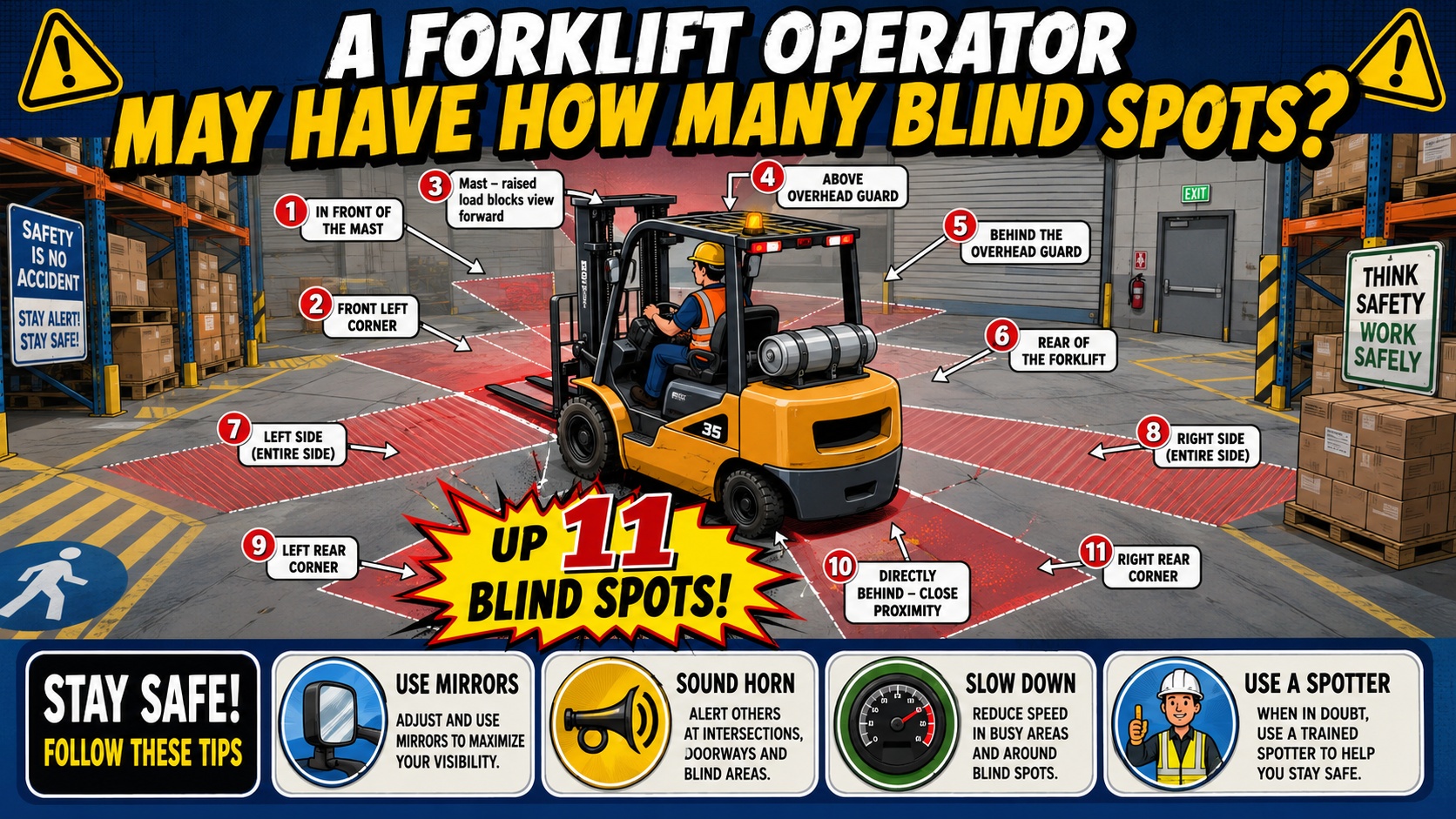
A forklift operator may have how many blind spots
Every forklift operator knows that visibility is a critical safety factor. But how many blind spots does a typical forklift actually have? The answer can surprise even experienced drivers, and understanding these hidden zones is the first step to preventing workplace accidents. For any facility investing in material handling equipment, recognizing these limitations is essential for operator training and choosing the right machinery.
Understanding the Standard Forklift Blind Spot Count
A standard counterbalance forklift has between four to six major blind spots depending on the load and mast configuration. These areas are where the operator’s direct line of sight is completely obstructed. The most dangerous zones are directly in front of the mast (especially when carrying a load), directly behind the overhead guard, the rear corners on both sides, and the area immediately under the forks. When carrying a wide or tall load, these blind spots expand dramatically.
Front Blind Spots: The Load and Mast Area
The most significant blind spot is directly in front of the forklift. When forks are raised above about 18 inches, the mast structure and the load itself block the operator’s view of the ground ahead. This creates a blind zone extending up to 20 feet in front of the vehicle. Pedestrians, floor markings, or small obstacles disappear entirely. This is why traveling with the load lowered close to the ground is a fundamental safety rule.
Rear Blind Spots: The Overhead Guard Problem
The overhead guard, essential for operator protection, creates a massive rear blind spot. The operator cannot see anything directly behind the forklift without turning their body. Additionally, the rear counterweight and steering tires block the view of the lower rear area. Side pillars supporting the overhead guard also create narrow but critical blind zones on both rear corners. In a standard forklift, the operator typically cannot see a person standing within 6 to 10 feet directly behind the machine.
Factors That Increase Blind Spot Danger
Several operational and environmental factors make these blind spots even more hazardous. Here is a breakdown of the main contributors:
- Load size and shape: Wide or tall loads multiply front blind spots by 300% or more.
- Mast type: High-visibility masts (with chains on the outside) reduce central blind spots compared to standard masts.
- Lighting conditions: Poor warehouse lighting makes it impossible for operators to see into shadows within blind zones.
- Operator seating position: Fatigue or improper posture can reduce an operator’s natural head-turning range.
- Footwear and noise: Pedestrians wearing noise-canceling headphones may not hear the forklift approaching from a blind spot.
Practical Consequences of Blind Spots in Warehouses
In a busy warehouse, a forklift operator may have how many blind spots at any given moment? The number changes constantly. When turning in a narrow aisle, the operator loses sight of the opposite side of the aisle. When stacking at height, the operator cannot see the forks or the rack beam. Statistics from industrial safety boards show that over 70% of forklift-pedestrian accidents occur because the operator could not see the person until it was too late. This is not a driver error; it is a fundamental design limitation.
How Modern Forklifts Reduce Blind Spots
Forklift manufacturers have developed multiple solutions to mitigate these visibility issues. One of the most effective is the adoption of high-visibility masts and compact overhead guard designs. Liftron Material Handling has integrated several innovations that directly address blind spots. Their DL SERIES models feature a streamlined mast design that minimizes the central obstruction, giving operators a clearer view of the fork tips and the ground ahead.
Technology-Assisted Visibility Solutions
Beyond design changes, technology plays a key role. Many modern forklifts now include:
- 360-degree camera systems that provide a bird’s-eye view.
- Proximity sensors and alarms that alert operators to objects in blind zones.
- Blue spot lights projected onto the floor to warn pedestrians of the forklift’s path.
- Reverse speed limiters that automatically slow the truck when reversing.
The Liftron DL SERIES incorporates many of these features as standard or optional equipment, significantly reducing the risk associated with blind spots. The combination of a high-visibility mast with optional camera systems creates a much safer operating environment.
Case Study: Reducing Blind Spot Accidents in a Distribution Center
A large beverage distributor in the Midwest experienced three pedestrian near-misses in a single quarter. The root cause was consistently identified as operator blind spots during right-angle stacking maneuvers. The facility replaced its aging fleet with DL SERIES forklifts from Liftron Material Handling. Within six months, the number of reported blind-spot-related incidents dropped to zero. The facility manager credited the improved visibility from the mast design and the addition of rear-facing cameras. Operators reported feeling significantly more confident when maneuvering in tight aisles filled with pallets and foot traffic.
This real-world improvement underscores a critical point: while a forklift operator may have how many blind spots that are inherent to the machine, proper equipment design and technology can eliminate most of the danger. The distributor’s data showed that operator training alone had been insufficient to solve the problem. The physical design of the forklift was the limiting factor.
Best Practices for Managing Forklift Blind Spots
Even with the best equipment, operators and facility managers must follow protocols. Training should specifically address the question “a forklift operator may have how many blind spots” by having operators physically map out the blind zones of their specific machine. Standard operating procedures should include:
- Always traveling with the load as low as possible (4-6 inches off the ground).
- Using a spotter when operating in congested areas or near blind corners.
- Installing convex mirrors at intersection points in the warehouse.
- Frequent operator breaks to prevent fatigue that reduces scanning behavior.
- Daily pre-shift inspections to ensure lights and cameras are functional.
Training Programs That Address Blind Spots
Effective training goes beyond a classroom lecture. Operators should practice a blind-spot demonstration exercise. One common technique is to have an operator sit in the forklift while a colleague places traffic cones or even a mannequin in several blind spots. The operator then identifies where they can and cannot see. This exercise makes the abstract concept of “how many blind spots” into a tangible reality. Combining this practical training with equipment like the Liftron DL SERIES, which offers better visibility, creates the safest possible working environment.
Conclusion: Safety Starts with Design and Awareness
The question “a forklift operator may have how many blind spots” is not just a trivia fact—it is a daily safety challenge. While standard forklifts have 4 to 6 permanent blind zones, the real number varies with load conditions and warehouse layout. The most effective solution combines operator vigilance with equipment designed to minimize these hazards. Liftron Material Handling offers a range of forklifts engineered from the ground up with visibility as a top priority. By choosing a DL SERIES model, facilities invest in technology that actively reduces blind spots, protecting both operators and pedestrians. Remember: every blind spot eliminated is a potential accident avoided. Your warehouse safety record depends on understanding and managing these invisible zones.
| Blind Spot Location | Cause | How Liftron DL SERIES Helps |
|---|---|---|
| Front center (below forks) | Mast and load obstruction | High-visibility mast design reduces central blind zone |
| Rear directly behind truck | Overhead guard and counterweight | Optional rear camera with display in operator cabin |
| Right rear corner | Overhead guard pillar | Rear corner proximity sensors |
| Left rear corner | Overhead guard pillar | Blue spot warning lights on both sides |
| Under the forks | Fork carriage and chains | Improved fork tip visibility via mast design |
Add a review
Your email address will not be published. Required fields are marked *