
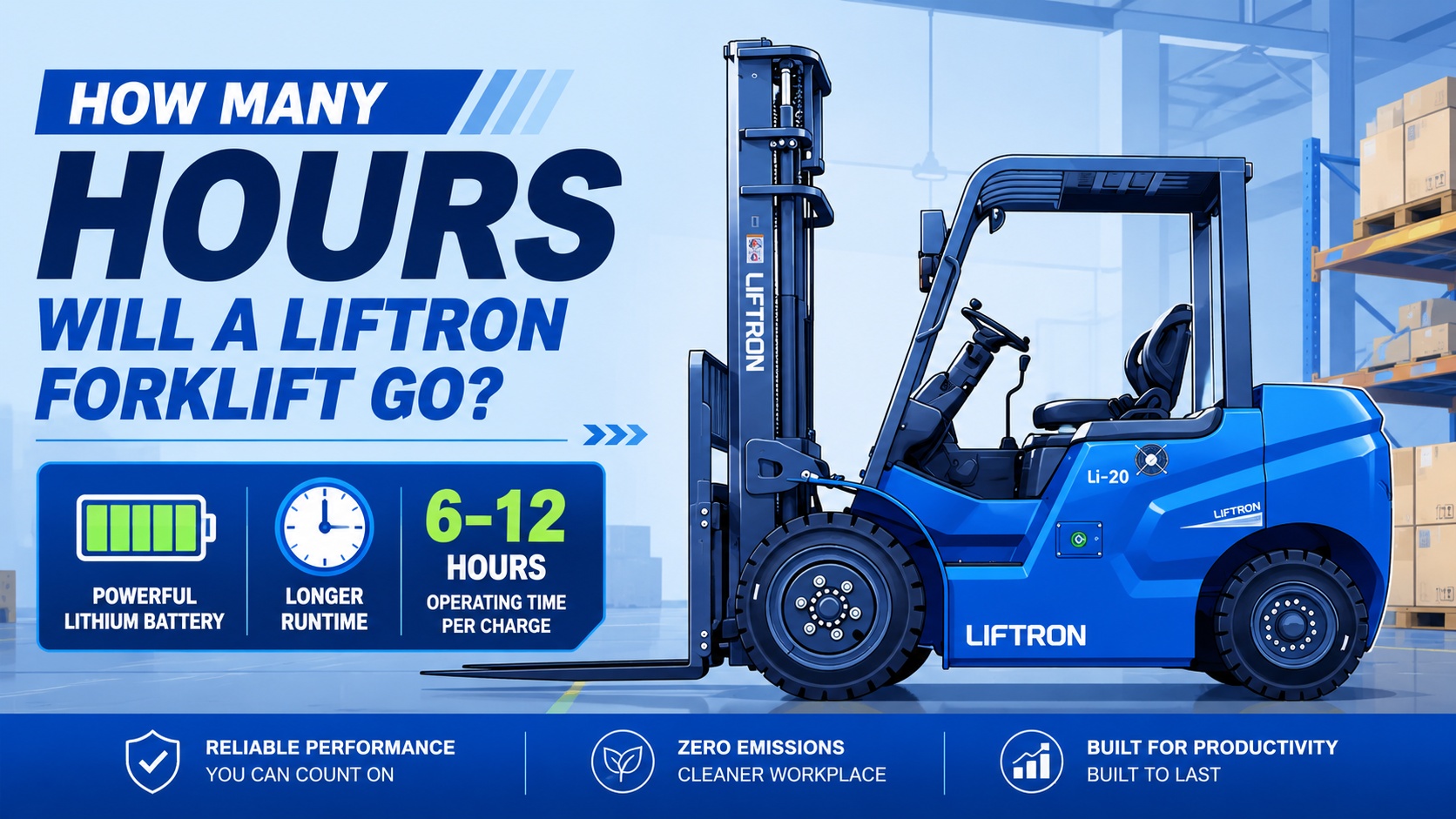
How Many Hours Will a Liftron Forklift Go?
Quick Answer: A Liftron electric forklift will typically run for 6 to 12 hours on a single charge, depending on battery size, load weight, travel distance, lift frequency, floor conditions, attachments, and operator habits. With lithium-ion technology, many Liftron models also support fast opportunity charging during breaks, lunches, and shift changes.
Runtime is one of the first questions buyers ask when comparing electric forklifts. A warehouse manager wants to know whether the forklift can finish a full shift, support overtime, or work across multiple shifts without slowing down production. The answer depends on the exact model and battery package, but a liftron forklift is generally designed around lithium battery power for efficient daily material handling.
In practical warehouse use, a Liftron electric forklift may run about 6 to 12 hours on a single charge. Lighter applications, smooth floors, moderate travel, and fewer lift cycles can extend runtime. Heavy lifting, long travel routes, ramps, cold conditions, high-speed operation, and frequent hydraulic use can shorten runtime.
What Determines Liftron Forklift Runtime?
Forklift battery life is not measured by battery size alone. A battery with more amp-hours usually stores more energy, but the real runtime depends on how much power the forklift consumes while working. A truck moving light pallets across smooth warehouse floors will use less energy than a forklift lifting heavy loads all day on ramps or rough surfaces.
| Runtime Factor | How It Affects Hours Per Charge | Best Practice |
|---|---|---|
| Battery capacity | Larger lithium batteries can support longer operation | Match battery size to shift length and workload |
| Load weight | Heavier loads require more lifting and travel power | Avoid exceeding rated capacity and plan efficient routes |
| Lift frequency | Frequent mast lifting uses hydraulic energy | Stage loads efficiently and reduce unnecessary lifts |
| Travel distance | Long routes drain the battery faster | Improve warehouse layout and reduce empty travel |
| Floor and terrain | Ramps, rough floors, and debris increase energy use | Keep travel paths clean and well maintained |
| Operator habits | Hard acceleration and aggressive driving reduce runtime | Train operators to drive smoothly and safely |
Typical Battery Range and Single-Charge Runtime
Liftron electric forklifts are commonly discussed with lithium battery options ranging from roughly 60V/260Ah to 80V/640Ah, depending on model and capacity class. In simple terms, higher voltage and higher amp-hour capacity can provide more stored energy. However, the forklift’s actual runtime still depends on load demand and working conditions.
For many indoor and mixed-use warehouse operations, a 6 to 12 hour range is a useful planning estimate. A lighter warehouse shift may approach the upper end of that range, while heavy-duty loading, high travel distance, and continuous operation may fall closer to the lower end.
Important Note: Always confirm the exact battery voltage, amp-hour rating, charger type, and expected runtime with the current model specification sheet or dealer before purchasing.
Why Lithium-Ion Helps Extend Usable Working Time
Liftron models feature maintenance-free lithium batteries with zero memory effect. This means operators can plug the forklift in during lunch, breaks, shift changes, or idle time without damaging the battery through partial charging. This is a major advantage compared with older lead-acid habits, where charging schedules and battery maintenance were more restrictive.
Opportunity charging can make a big difference in busy facilities. Even short top-ups throughout the day can help the forklift stay available longer, especially in multi-shift operations. Instead of swapping heavy batteries or waiting for long charging cycles, the team can work charging into the normal rhythm of the shift.
Pro Tip: If your operation has natural pauses during the day, opportunity charging can help a lithium-powered forklift stay productive across longer working windows.
How Long Does the Whole Forklift Last?
Battery runtime answers one question: how long the forklift can work on one charge. Vehicle lifespan answers a different question: how many operating hours the forklift can deliver before major rebuild or replacement becomes likely.
As a general planning range, a Liftron forklift, like many industrial forklifts, may be built to last between 10,000 and 20,000 operational hours before needing a major rebuild or replacement, assuming it is properly maintained. The actual lifespan depends on daily workload, charging habits, maintenance quality, operator behavior, indoor or outdoor exposure, and whether the truck is used within its rated capacity.
Estimated Runtime by Application
| Application Type | Workload Description | Estimated Runtime Pattern |
|---|---|---|
| Light warehouse use | Moderate pallet movement, smooth floors, limited heavy lifting | Often closer to the upper runtime range |
| Standard distribution work | Regular loading, unloading, staging, and travel | Usually fits within a normal shift with planned charging |
| Heavy-duty loading | Frequent lifting, heavier loads, ramps, and longer travel | May require opportunity charging or larger battery capacity |
| Multi-shift operation | Extended daily use with minimal downtime | Best supported with fast charging and disciplined charge planning |
How to Get More Hours From a Liftron Forklift
- Choose the right battery size: Match voltage and amp-hour capacity to your shift length, average load weight, and travel distance.
- Use opportunity charging: Plug in during breaks, lunch, shift changes, and idle time to extend daily availability.
- Train operators: Smooth acceleration, controlled braking, and efficient travel routes help reduce energy waste.
- Maintain floors and routes: Clean, smooth travel paths reduce rolling resistance and improve battery efficiency.
- Inspect tires regularly: Worn or damaged tires can increase drag, reduce stability, and waste energy.
- Avoid unnecessary idling: Power down equipment during long inactive periods when safe and appropriate.
- Follow charging instructions: Use the recommended charger and follow the manufacturer’s battery care guidelines.
Are Liftron Forklifts Good?
Many buyers ask, Are Liftron Forklifts Good? The answer depends on your application, but Liftron lithium electric forklifts can be a strong fit for businesses that want reduced maintenance, clean indoor operation, opportunity charging, and practical electric material handling performance.
A liftron forklift may be especially useful in warehouses, logistics centers, manufacturing facilities, and distribution operations where uptime and simple battery care matter. The key is selecting the right model, battery size, lift capacity, tire type, and charger setup for your workload.
Buying Reminder: Do not choose a forklift based only on maximum runtime. Consider capacity, lift height, aisle width, charger compatibility, service support, tire type, and total operating cost.
Conclusion
A Liftron electric forklift will typically run for 6 to 12 hours on a single charge, depending on battery size, workload, travel distance, lift intensity, and operating conditions. Lithium-ion technology helps extend daily availability through fast opportunity charging and zero memory effect.
For total vehicle life, a properly maintained liftron forklift may serve for thousands of operating hours, often in the general 10,000 to 20,000 hour planning range before major rebuild or replacement. To get the best results, match the forklift and battery to your real workday, not just a brochure estimate.
Add a review
Your email address will not be published. Required fields are marked *