
What Jobs Can You Get With a Forklift License?
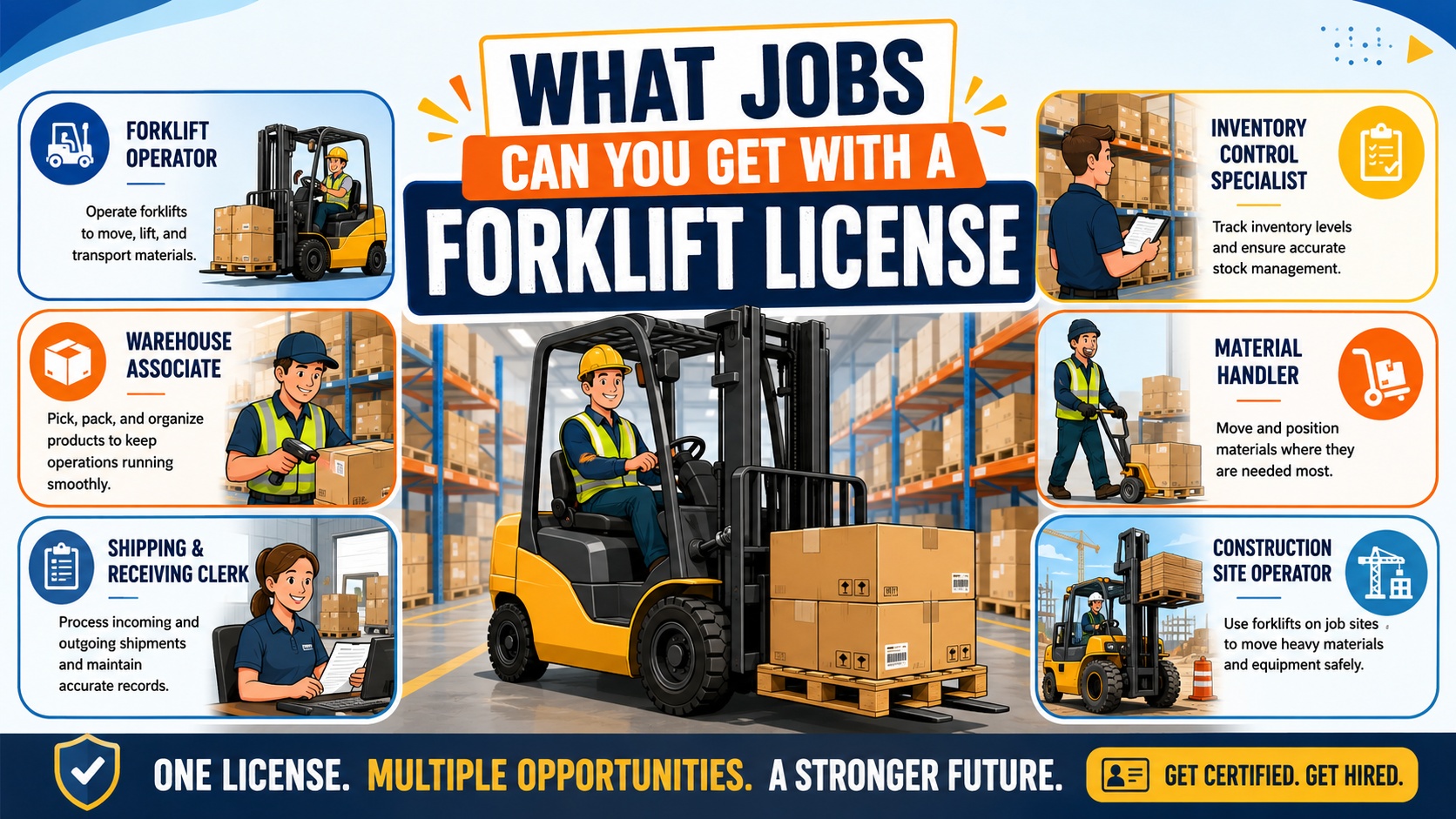
Quick Answer: A forklift license qualifies you for material handling, logistics, and supply chain roles. Common positions include Forklift Operator, Warehouse Associate, Shipping/Receiving Clerk, Inventory Control Specialist, Order Selector, Freight Handler, and Material Handler. These jobs usually involve moving, stacking, loading, unloading, organizing, and tracking freight.
A forklift certification is one of the most practical credentials for people who want to work in warehouses, distribution centers, manufacturing plants, construction supply yards, retail backrooms, and logistics operations. It proves that you have completed training to operate a powered industrial truck safely and understand the basics of load handling, inspections, visibility, stability, and workplace traffic.
Although many entry-level warehouse jobs do not require a college degree, a forklift license can make your application stronger. Employers often prefer candidates who can safely move pallets, load trucks, organize inventory, and support fast-paced supply chain operations from the first day on the job.
Common Jobs You Can Get With a Forklift License
A forklift certification opens doors across several industries. Some jobs focus mostly on driving equipment, while others combine forklift operation with inventory control, shipping paperwork, team leadership, or customer service. The more skills you add, the more valuable your certification becomes.
| Job Title | Main Duties | Typical Work Setting |
|---|---|---|
| Forklift Operator | Move pallets, load trucks, stack freight, inspect equipment, and follow safety rules | Warehouses, distribution centers, factories |
| Warehouse Associate | Pick, pack, label, move, and organize products using manual tools and forklifts | E-commerce, retail distribution, logistics |
| Shipping/Receiving Clerk | Load and unload shipments, check paperwork, verify quantities, and stage freight | Loading docks, warehouses, manufacturing plants |
| Inventory Control Specialist | Track stock, cycle count, move products, and support accurate warehouse records | Distribution centers, cold storage, parts warehouses |
| Material Handler | Supply production lines, move raw materials, and transport finished goods | Manufacturing and production facilities |
Logistics and Distribution Jobs
Logistics and distribution are among the most common fields for certified forklift operators. These jobs focus on moving products quickly, safely, and accurately through the supply chain.
Freight Handler
Freight handlers load and unload trucks, trailers, containers, and staging areas. A forklift license helps because freight is often heavy, palletized, or stored in high-volume dock environments. This role is common in freight terminals, third-party logistics companies, and large distribution centers.
Order Selector
Order selectors pick products for customer orders. Some work with pallet jacks, reach trucks, or order pickers. A forklift license can help you qualify for roles that require moving larger quantities of product or working in racking systems.
Warehouse Lead or Supervisor
Experienced operators may move into warehouse lead or supervisor roles. These jobs often involve assigning tasks, checking productivity, training new workers, monitoring safety, and coordinating shipping schedules. Forklift experience is valuable because supervisors need to understand how warehouse movement works in real conditions.
Career Tip: A forklift license can get you into the warehouse, but leadership, inventory software, safety knowledge, and reliability help you move up.
Manufacturing and Production Jobs
Manufacturing facilities often depend on forklift operators to keep production lines moving. Without reliable material handling, machines may sit idle, parts may arrive late, and finished goods may not reach storage or shipping on time.
Material Handler
Material handlers move raw materials, components, packaging, and finished goods throughout a facility. They may bring parts to production lines, remove completed pallets, organize staging areas, and support shipping departments. This is one of the most common jobs for anyone with a forklift license.
Assembly Line Support
Assembly line support workers help keep production areas stocked. They may use forklifts to move bins, pallets, racks, tools, or finished products. In fast-moving plants, the ability to operate a forklift safely can make you more flexible and useful to the team.
Pro Tip: Manufacturing employers often value workers who can operate forklifts, read work orders, follow safety procedures, and understand basic inventory flow.
Construction and Specialized Trades
Forklift certification can also support jobs outside traditional warehouse settings. Construction suppliers, lumber yards, equipment dealers, masonry yards, and jobsite logistics teams often need operators who can move heavy materials safely.
Construction Site Operator
Construction site operators may move pallets of bricks, concrete products, lumber, roofing materials, tools, or equipment. Some sites use rough-terrain forklifts or telehandlers, which may require additional training because the equipment and ground conditions are different from indoor warehouse forklifts.
Machinery Installer or Rigger
Machinery installers and riggers move heavy machines, equipment, and industrial components. Forklift certification can be useful, but these jobs may also require rigging knowledge, load securement skills, signaling, and experience with cranes or specialized lifting equipment.
Retail and Event Setup Jobs
Retail and event operations also use forklifts, especially when moving large shipments, staging displays, or setting up temporary structures. These jobs may combine customer service, physical work, and equipment operation.
Freight Team Associate
Large retailers and home improvement stores often hire freight team associates to unload trucks, restock departments, move palletized products, and organize storage areas. A forklift license can help you qualify for higher-responsibility tasks, especially in stores that handle appliances, lumber, outdoor products, or building materials.
Event Setup Coordinator
Event setup teams may move staging, barricades, flooring, lighting equipment, tents, or boxed supplies. Forklift operation can be helpful in convention centers, stadiums, trade shows, and large outdoor events where heavy materials must be moved quickly.
Which Forklift License Pays the Most?
The highest-paying forklift-related jobs are usually not basic entry-level warehouse operator jobs. Higher pay often comes from specialized equipment, difficult work environments, extra certifications, shift premiums, or leadership duties.
| Higher-Paying Path | Why It May Pay More | Extra Skills That Help |
|---|---|---|
| Warehouse Lead or Supervisor | Includes responsibility for people, safety, productivity, and workflow | Leadership, inventory systems, training experience |
| Heavy-Duty Forklift Operator | Handles heavier loads, larger equipment, and higher-risk environments | Large-capacity forklifts, load charts, safety procedures |
| Rigger or Machinery Mover | Moves expensive, oversized, or complex industrial equipment | Rigging, signaling, load securement, mechanical knowledge |
| Cold Storage Operator | May offer premium pay due to freezer conditions and specialized operation | Cold storage safety, PPE, inventory accuracy |
| CDL Driver With Forklift Skills | Combines truck driving and material handling ability | CDL, loading/unloading, freight handling |
Pay Reminder: A forklift license helps you qualify, but pay depends on location, experience, shift, industry, union status, equipment type, and added skills.
How to Build a Better Career With a Forklift License
- Start with entry-level warehouse work: Build experience in receiving, shipping, picking, packing, and safe equipment operation.
- Learn multiple forklift types: Add experience with sit-down forklifts, reach trucks, pallet jacks, order pickers, and rough-terrain forklifts.
- Improve inventory skills: Learn scanning systems, warehouse management software, cycle counting, and stock rotation.
- Build safety knowledge: Become the operator who follows inspections, speed limits, pedestrian rules, and load capacity guidelines.
- Add leadership skills: Train new operators, help organize shifts, and communicate clearly with supervisors.
- Consider related credentials: A CDL, rigging training, OSHA safety courses, or heavy equipment experience can open higher-paying paths.
Why Equipment Knowledge Matters
Employers value operators who understand the equipment they use. Knowing how a forklift works, how to inspect it, and how to match the machine to the job can make you safer and more productive. Operators who understand load capacity, battery charging, tire condition, visibility, and stability are more useful than drivers who only know how to move forward and backward.
Modern electric forklifts are also becoming more common in warehouses because they can support clean indoor operation and efficient material handling. As equipment changes, workers who keep learning will have better long-term career options.
Conclusion
A forklift license can help you qualify for many jobs in logistics, warehousing, manufacturing, construction, retail, and event setup. Common roles include Forklift Operator, Warehouse Associate, Freight Handler, Order Selector, Shipping/Receiving Clerk, Material Handler, and Inventory Control Specialist.
The best-paying paths often involve leadership, specialized equipment, heavy-duty handling, cold storage, rigging, or combining forklift skills with a CDL. If you want to grow your career, use your forklift license as a starting point, then add experience, safety knowledge, and related skills that employers value.
Add a review
Your email address will not be published. Required fields are marked *