
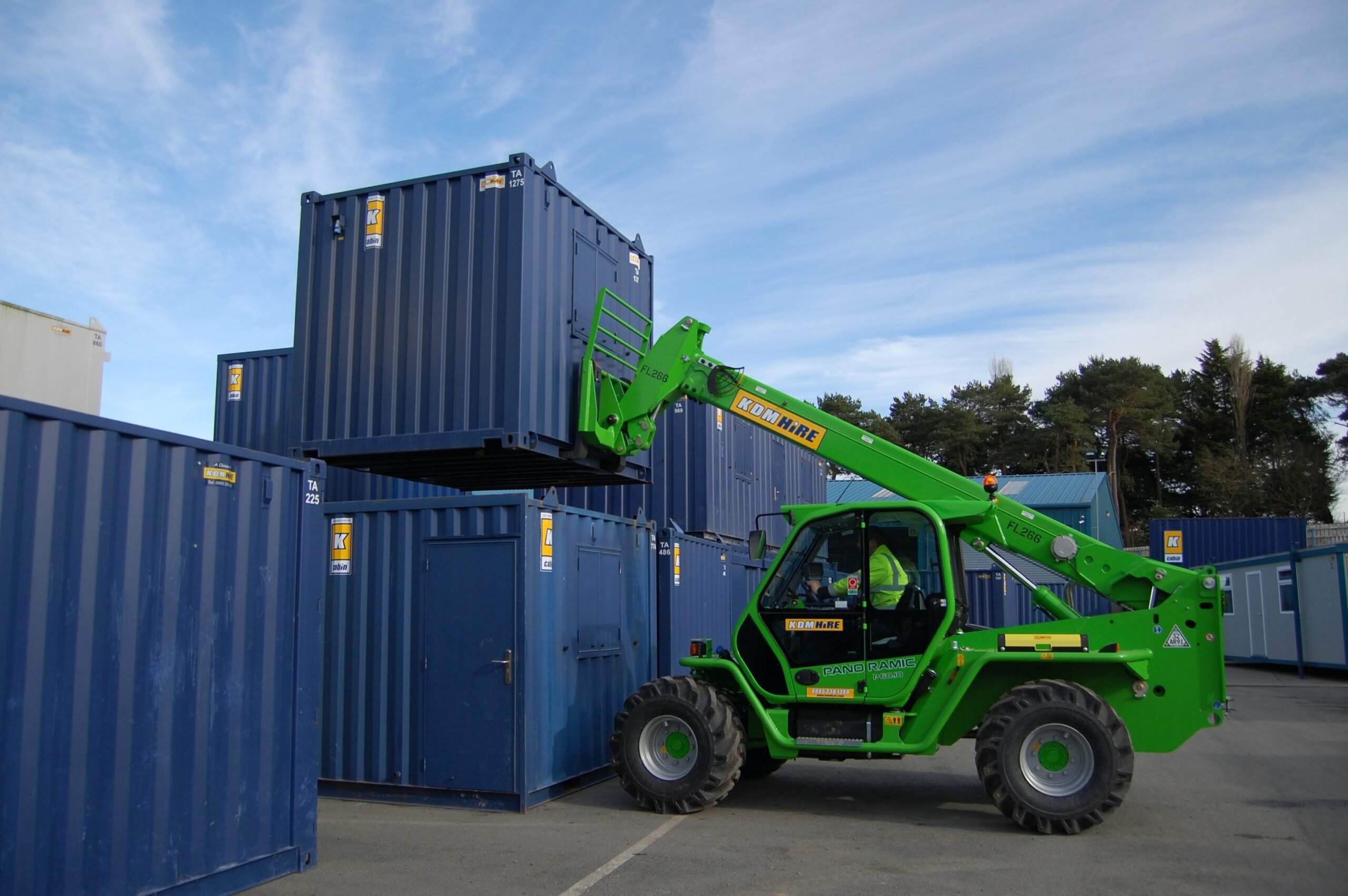
Can a Telehandler Lift a Container?
A telehandler can lift an empty or lightly loaded container, but the lift must match the machine’s rated capacity and load chart.
Yes, a telehandler can lift a shipping container in certain situations, but this does not mean every telehandler can safely lift every container. The most important rule is that the lift must stay within the telehandler’s rated capacity, attachment rating, boom position, and load chart limits. In most cases, a telehandler is suitable for moving empty or lightly loaded containers, not fully loaded shipping containers.
A standard 20-foot empty shipping container usually weighs roughly 4,500 to 5,000 lbs, or about 2 to 2.3 tonnes. A standard 40-foot empty container usually weighs about 8,000 to 9,000 lbs, or about 3.6 to 4 tonnes. Many telehandlers can handle these empty weights when the boom is kept low and retracted. However, a fully loaded container can weigh tens of thousands of pounds, which is far beyond the safe lifting range of most standard telehandlers. Fully loaded containers normally require specialized equipment such as reach stackers, container handlers, cranes, or heavy-capacity forklifts.
Safely lifting a container with a telehandler requires careful planning. Operators must check the load chart, confirm the container weight, use the correct attachment, work on firm and level ground, and keep the boom as low and close to the machine as possible. Guessing is dangerous because telehandler capacity decreases dramatically as the boom extends outward or upward.
Key Factors Before Lifting a Container
| Safety Factor | What It Means |
|---|---|
| Container Weight | Confirm whether the container is empty, lightly loaded, or fully loaded before attempting any lift. |
| Load Chart | Check the specific telehandler’s capacity at the required boom height, reach, and attachment setup. |
| Attachment Type | Use suitable fork extensions, fork pockets, spreader beams, or twist-lock attachments when required. |
| Ground Conditions | Operate only on firm, level, stable ground and use stabilizers when the machine is equipped with them. |
| Boom Position | Keep the boom low and retracted as much as possible to maintain stability and reduce tip-over risk. |
1. Weight Limits and Load Charts
The first question is not simply, “Can a telehandler lift a container?” The better question is, “Can this specific telehandler lift this specific container in this exact position?” Telehandler lifting capacity is not fixed. It changes based on boom angle, boom extension, attachment weight, load center, machine setup, and ground conditions.
An empty 20-foot container may be within the lifting ability of many standard telehandlers. An empty 40-foot container may still be possible for some larger machines, but it requires more caution because the container is longer, heavier, and harder to stabilize. A lightly loaded container may be possible only if the total weight remains within the load chart.
As the boom extends forward, capacity drops quickly. A machine that can lift a heavy load close to the chassis may only lift a much smaller load when the boom is extended. This is one of the most common causes of telehandler tip-over incidents. Operators must never rely only on the machine’s maximum advertised capacity. The actual safe capacity must come from the load chart for the exact lift position.
Before lifting, confirm the container’s empty weight and any cargo weight inside. If the container is sealed or the contents are unknown, do not assume it is light. Unknown load weight should be treated as a serious hazard.
2. Required Attachments
Using the correct attachment is essential. Standard telehandler forks are often around 48 to 60 inches long. A shipping container is typically 8 feet wide, or 96 inches. That means standard forks may not reach far enough to safely engage both fork pockets or support the container properly.
Fork extensions may be needed, often in the 7-foot to 8-foot range, depending on the container and lift method. However, fork extensions reduce capacity and must be rated for the load. They should never be homemade, damaged, loose, or used beyond their approved limits.
If the container has fork pockets, the forks should be inserted fully and evenly. Partial fork engagement can damage the container floor or cause the container to slide or drop. The operator should tilt back slightly to stabilize the load, but excessive tilt can also create instability.
For better safety, a spreader bar, lifting frame, or twist-lock attachment may be preferred. These connect to the container’s top corner castings and help reduce slipping, swinging, and uneven loading. A proper container lifting attachment is usually safer than trying to lift a container with standard forks alone.
3. Safety Best Practices
Safe container lifting starts with the ground. Telehandlers can become unstable on soft, sloped, uneven, or loose surfaces. Before lifting, inspect the work area. The surface should be firm, level, and capable of supporting the combined weight of the telehandler, attachment, and container. If the machine has stabilizers, use them according to the operator’s manual.
Keep the boom low and retracted whenever possible. The higher and farther the load moves away from the machine, the more unstable the telehandler becomes. If the container must be moved, travel slowly, keep the load low, avoid sharp turns, and never carry the load higher than necessary.
Workers should stay clear of the container and the telehandler’s operating area. No one should stand under or near a suspended container. Use a spotter only when needed, and make sure the spotter remains outside the fall zone and has clear communication with the operator.
Weather conditions also matter. Wind can affect large containers, especially when lifted from the top or raised higher than necessary. A container has a large surface area, so strong wind can increase swinging and side loading. If conditions are unsafe, postpone the lift.
When a Telehandler Should Not Lift a Container
A telehandler should not lift a container if the container is fully loaded, the weight is unknown, the ground is unstable, the required reach exceeds the load chart, the attachment is not rated, or the operator is not trained for the task. It should also not be used if the load chart is missing, unreadable, or does not include the attachment being used.
Fully loaded shipping containers should be handled by equipment designed for that purpose. Reach stackers, container handlers, cranes, and heavy-capacity forklifts are built for heavier container operations. Trying to use an undersized telehandler can result in tip-over, dropped loads, equipment damage, and severe injuries.
Checklist Before Lifting a Container with a Telehandler
| Checklist Item | Safe Action |
|---|---|
| Confirm Weight | Verify empty weight and cargo weight before the lift. |
| Review Load Chart | Check capacity at the exact boom angle, reach, height, and attachment configuration. |
| Inspect Attachment | Use rated forks, fork extensions, spreader beam, or twist-lock attachment. |
| Inspect Ground | Operate only on firm, level, stable ground. |
| Control Work Area | Keep all workers clear of the fall zone and travel path. |
| Keep Boom Low | Keep the load low and close to the machine whenever possible. |
Conclusion
A telehandler can lift a shipping container, but only when the container is empty or lightly loaded and the lift falls within the machine’s rated load chart. Empty 20-foot and 40-foot containers may be manageable for suitable telehandlers, but fully loaded containers require specialized heavy-duty equipment.
Safe lifting depends on weight confirmation, correct attachments, full fork-pocket engagement, firm level ground, proper stabilizer use, and careful boom control. Before attempting any container lift, always reference the operator’s manual and the telehandler’s capacity load chart. If there is any doubt about the weight, reach, ground condition, or equipment rating, do not lift the container with a telehandler.
Add a review
Your email address will not be published. Required fields are marked *