
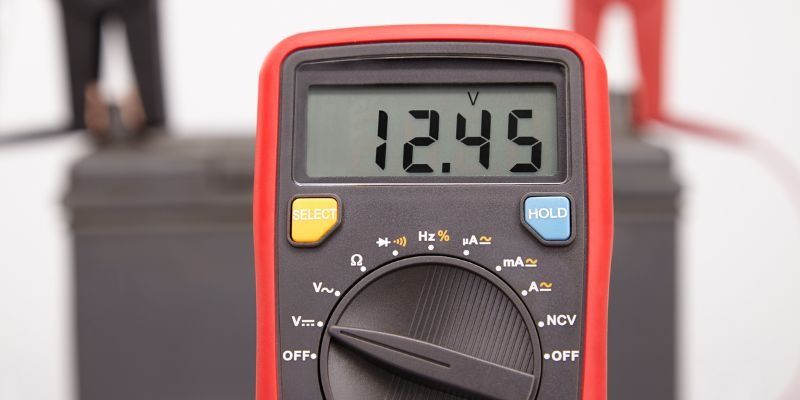
How to Test a Forklift Battery with a Multimeter: Complete 2026 Guide
To test a forklift battery with a multimeter, fully charge it and let it rest for 4–6 hours. Set the multimeter to DC Voltage (200V range) and probe the main terminals (red to +, black to -). A healthy, fully charged battery should read approximately 2.10–2.14 volts per cell (VPC), for example, 50.4–51.36V for a 48V battery.
Why Testing Forklift Batteries with a Multimeter Is Essential
Regular voltage testing helps detect weak cells, sulfation, or failing batteries before they cause unexpected downtime or safety issues. A multimeter provides a quick, accurate snapshot of battery health when used correctly. Combined with specific gravity tests (for lead-acid) and load testing, it gives a complete picture of battery condition. Testing should be part of every preventive maintenance schedule to maximize battery life and forklift uptime.
Safety First
Always wear acid-resistant gloves, safety goggles, and protective clothing. Work in a well-ventilated area. Never smoke or use open flames near batteries. Disconnect the battery from the forklift or set the truck to “Tow/Storage” mode before testing. Have baking soda and water ready to neutralize spills. Never test a battery that is leaking, swollen, or showing obvious physical damage — replace it immediately.
Fully Charge & Rest the Battery
Begin with a full charge using the correct charger for your battery type (lead-acid or lithium). After charging, allow the battery to rest for 4–6 hours (or overnight) so the surface charge dissipates. This “rested voltage” gives the most accurate reading. Never test immediately after charging or after heavy use — the results will be misleading.
Set Up the Multimeter
Use a digital multimeter capable of measuring at least 100V DC. Set it to the DC Voltage range (usually 200V). Ensure the probes are clean and in good condition. For 48V systems, the 200V range is ideal. For higher-voltage packs (80V+), use a 1000V-rated meter or test individual battery sections separately.
Connect Probes and Read Voltage
Locate the main positive and negative terminals on the battery pack. Touch the red probe to the positive terminal and the black probe to the negative terminal. Record the voltage. For a 48V (24-cell) battery, expect 50.4–51.36V on a healthy, fully charged pack (2.10–2.14 volts per cell). For a 36V system, expect 37.8–38.52V. Individual cell voltages should be very close — a difference greater than 0.05V between cells indicates imbalance.
Interpret Results
A healthy battery shows voltage within the expected range and consistent readings across cells. If voltage is low after resting, the battery may need charging or replacement. Significant cell voltage variation points to a failing cell. After testing under load (drive the forklift briefly and re-measure), a healthy battery should not drop more than 5–7% from the rested reading.
Signs of a Failing Battery
Replace the battery if you notice:
- Voltage drops too low when the forklift is under load
- Specific gravity (measured with a hydrometer) is much lower than specifications
- Significant, rapid voltage differences between cells
- Physical damage such as cracked cases, leaking fluid, or swollen cells
- Heavy corrosion or burning on terminal tips
What Is the Voltage of a Forklift Battery?
A standard 48V forklift battery should read approximately 50.4–51.36V when fully charged and rested. A 36V battery should read 37.8–38.52V. Individual cells should each show 2.10–2.14V. Under load, voltage will naturally drop, but a healthy pack should not fall below 1.90V per cell during normal operation. Lithium-ion forklift batteries show a flatter voltage curve, typically staying between 3.2–3.4V per cell throughout most of the discharge cycle.
Conclusion
Testing a forklift battery with a multimeter is a fast, effective way to assess health and catch problems early. Always follow the full procedure — full charge, rest period, correct range, and careful interpretation — to get reliable results. Regular testing combined with proper charging and maintenance can extend battery life significantly and prevent costly downtime.




Add a review
Your email address will not be published. Required fields are marked *