

Market Share of LiFePO4 in the Golf Cart Market
Lithium-ion batteries, with LiFePO4 accounting for a large share of golf-cart lithium systems, are estimated to represent roughly 47% of global golf cart battery market revenue in recent market analyses. Lead-acid still holds a substantial installed-base advantage, but lithium adoption is accelerating as electric golf carts expand and OEMs offer more factory lithium options.
How Large Is LiFePO4’s Share of the Golf Cart Battery Market?
The golf cart battery market is in the middle of a major technology transition. For decades, flooded lead-acid batteries were the default choice because they were familiar, widely available, and inexpensive to purchase.
That balance is changing quickly. Recent industry estimates place lithium-ion batteries at approximately 47% of global golf cart battery market revenue. In golf cart applications, much of this lithium growth is associated with LiFePO4 chemistry because it offers long cycle life, strong thermal stability, consistent voltage delivery, and low routine maintenance.
Lead-acid remains important because millions of older golf carts still use traditional multi-battery systems. However, replacement cycles are increasingly creating opportunities for lithium upgrades.
| Market Indicator | Current Direction |
|---|---|
| Lithium-Ion Golf Cart Battery Revenue Share | Approximately 47% in recent industry estimates |
| Lead-Acid Position | Still holds a large installed base due to lower upfront cost |
| Electric Golf Cart Share | About 54.2% of the broader golf cart market in 2025 estimates |
| Electric Golf Cart Outlook | Projected to exceed 70% by 2034 in some market forecasts |
| Fastest Growth Area | Lithium-ion battery systems and factory lithium-equipped carts |
Why LiFePO4 Is Growing So Quickly
LiFePO4 adoption is not being driven by one feature alone. Golf course fleets, resorts, dealers, and private owners are looking at lifetime operating cost rather than purchase price alone.
Longer Battery Life
Lead-acid golf cart batteries commonly require replacement after several years depending on maintenance, climate, charging behavior, and usage. LiFePO4 systems are designed for much longer cycle life and can remain in service significantly longer when correctly operated.
That longer replacement interval helps offset the higher initial purchase price and can improve total cost of ownership for high-use golf carts.
Lower Maintenance Requirements
Traditional flooded lead-acid batteries require watering, terminal inspection, corrosion management, and careful charging practices. LiFePO4 batteries eliminate routine water topping and acid maintenance.
For golf course fleets with dozens or hundreds of carts, reducing battery maintenance can save substantial labor time.
Lower Weight
Lithium battery systems can be much lighter than a comparable multi-battery lead-acid pack. Depending on the original configuration, converting to lithium can remove hundreds of pounds from a golf cart.
Lower weight can improve acceleration, reduce rolling resistance, and potentially reduce turf impact on golf courses.
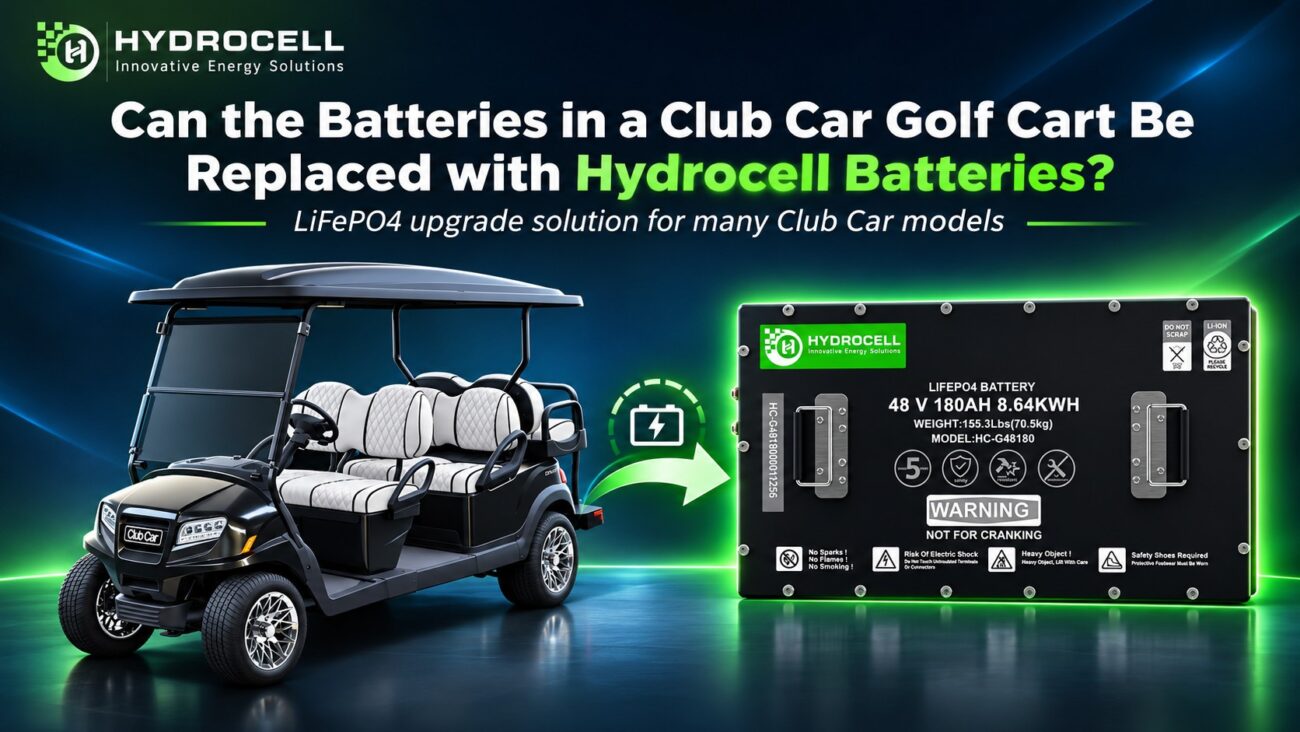
A lithium conversion should not be selected by voltage alone. Battery dimensions, capacity, continuous discharge current, peak current, charger compatibility, connectors, BMS communication, and vehicle controller requirements should all be checked before installation.
Electric Golf Carts Are Accelerating Lithium Adoption
The broader golf cart market is also becoming more electric. Recent market estimates indicate that electric-powered golf carts represented about 54.2% of the global market in 2025, with some forecasts expecting electric models to exceed 70% of the market by 2034.
This matters because every additional electric golf cart creates demand for a battery system. As manufacturers move toward newer lithium platforms, LiFePO4 becomes increasingly important in both factory production and replacement markets.
The growth of electric golf carts and the shift from lead-acid to lithium are reinforcing each other. More electric carts increase battery demand, while better lithium technology makes electric carts more attractive to fleets and individual owners.
OEM Adoption of LiFePO4 Golf Cart Batteries
One of the strongest signals for LiFePO4 adoption is the increasing availability of factory lithium golf carts.
Major golf cart manufacturers and newer premium brands have increasingly introduced lithium as either a standard configuration or a premium factory option. This reduces one of the historical barriers to lithium adoption because buyers no longer need to convert a lead-acid cart after purchase.
For OEMs, lithium systems can also support modern vehicle electronics such as digital dashboards, GPS systems, infotainment, lighting, refrigeration accessories, and higher-output electric motors.
Aftermarket Conversion Is Another Major Growth Segment
The installed base of lead-acid golf carts remains enormous, which makes aftermarket conversion an important part of LiFePO4 market growth.
When an older lead-acid pack reaches the end of its life, owners increasingly compare the cost of another lead-acid set with a single integrated lithium battery.
Common aftermarket systems include 36V, 48V, and 72V lithium packs. In many modern golf carts, 48V LiFePO4 batteries are particularly common because they balance capacity, performance, packaging, and compatibility with widely used golf cart electrical systems.
LiFePO4 vs. Lead-Acid for Golf Carts
| Factor | LiFePO4 | Lead-Acid |
|---|---|---|
| Initial Cost | Higher | Lower |
| Routine Watering | Not required | Required for flooded batteries |
| Weight | Lower | Higher |
| Voltage Delivery | More consistent through discharge | Voltage gradually drops during discharge |
| Cycle Life | Generally much longer | Shorter under comparable heavy-use conditions |
| Charging | Typically faster | Usually slower |
| Acid Maintenance | None | Required for flooded systems |
Total Cost of Ownership Is Driving Fleet Decisions
The higher purchase price of a LiFePO4 battery can make lead-acid appear cheaper at first. Fleet managers, however, increasingly evaluate the cost over several years.
A lithium system can reduce battery replacement frequency, watering labor, corrosion cleanup, charging downtime, and the need to manage multiple lead-acid batteries as one pack.
For high-use fleets, these savings can potentially create a payback period within a few years, although the exact return depends on battery price, utilization, electricity cost, maintenance labor, and the battery system being replaced.
Performance Is Becoming More Important in Premium Golf Carts
Modern golf carts are carrying more electrical equipment than earlier generations. Large displays, GPS systems, upgraded audio, lighting, refrigerators, USB charging, accessories, and more powerful motors all increase electrical demand.
LiFePO4 batteries are well suited to these applications because they can maintain relatively stable voltage under load and support substantial discharge current when correctly specified.
The lighter battery package can also free up vehicle payload that would otherwise be consumed by a heavy lead-acid pack.
Which Hydrocell LiFePO4 Batteries Are Suitable for Golf Carts?
Hydrocell develops a dedicated G-Series of LiFePO4 batteries for electric golf cart applications. The product family includes multiple voltage and capacity configurations intended for different vehicle requirements.
A representative model is the HC-G48105, a 48V-class 105Ah LiFePO4 battery designed specifically for golf carts.
| HC-G48105 Specification | Published Value |
|---|---|
| Battery Chemistry | LiFePO4 |
| Voltage Class | 48V |
| Capacity | 105Ah |
| Stored Energy | Approximately 5.38 kWh |
| Life Cycles | 3,500+ cycles |
| Continuous Discharge Current | 100A |
| Quick Charge Time | Approximately 2–3 hours |
The HC-G48105 is particularly relevant to many 48V golf cart applications because 105Ah provides a practical balance between capacity, weight, and runtime. Hydrocell also offers other G-Series battery configurations for carts requiring different capacity levels.
The HC-G48105 should not automatically be treated as compatible with every 48V golf cart. Confirm battery dimensions, controller requirements, charger profile, connectors, continuous and peak current, and communication requirements before replacement.
Which Golf Cart Brands Can Use a 48V 105Ah LiFePO4 Battery?
A 48V 105Ah lithium battery may be suitable for many golf carts from manufacturers such as E-Z-GO, Tara, Club Car, and Yamaha when the original vehicle uses a compatible 48V electrical system.
For example, Hydrocell identifies the HC-G48105 as a close specification match for Tara models using a 48V 105Ah lithium system, provided the physical, electrical, charging, and communication requirements are also compatible.
This same compatibility process should be followed for every brand and model rather than assuming that all 48V carts use identical battery systems.
What Will LiFePO4 Market Share Look Like Next?
LiFePO4’s share of the golf cart battery market is likely to continue increasing as several trends move in the same direction: electric golf carts are gaining market share, OEM lithium availability is expanding, old lead-acid fleets are reaching replacement age, and owners are becoming more familiar with lithium technology.
Lead-acid batteries are unlikely to disappear immediately. Their lower initial price and enormous installed base will keep them relevant, particularly in price-sensitive markets.
However, the direction of the market increasingly favors lithium for new premium carts, high-utilization fleets, and owners who prioritize lower maintenance and longer service life.
LiFePO4 is moving from a premium upgrade toward a mainstream golf cart power solution. The transition will likely occur fastest in new OEM carts, commercial fleets, and aftermarket replacements where lower maintenance and longer cycle life provide the greatest economic benefit.
Conclusion
LiFePO4 has become one of the most important technologies in the golf cart battery market, with lithium-ion batteries estimated at roughly 47% of global golf cart battery revenue in recent industry analyses. Growing electric golf cart sales, OEM adoption, aftermarket conversions, longer cycle life, lower weight, faster charging, and reduced maintenance are all supporting further growth. For owners and fleets considering a 48V lithium upgrade, Hydrocell products such as the HC-G48105 provide a golf-cart-focused LiFePO4 option that combines 105Ah capacity, long cycle life, and fast charging in an integrated battery system.

Add a review
Your email address will not be published. Required fields are marked *