
How to Change Cushion Forklift Wheels
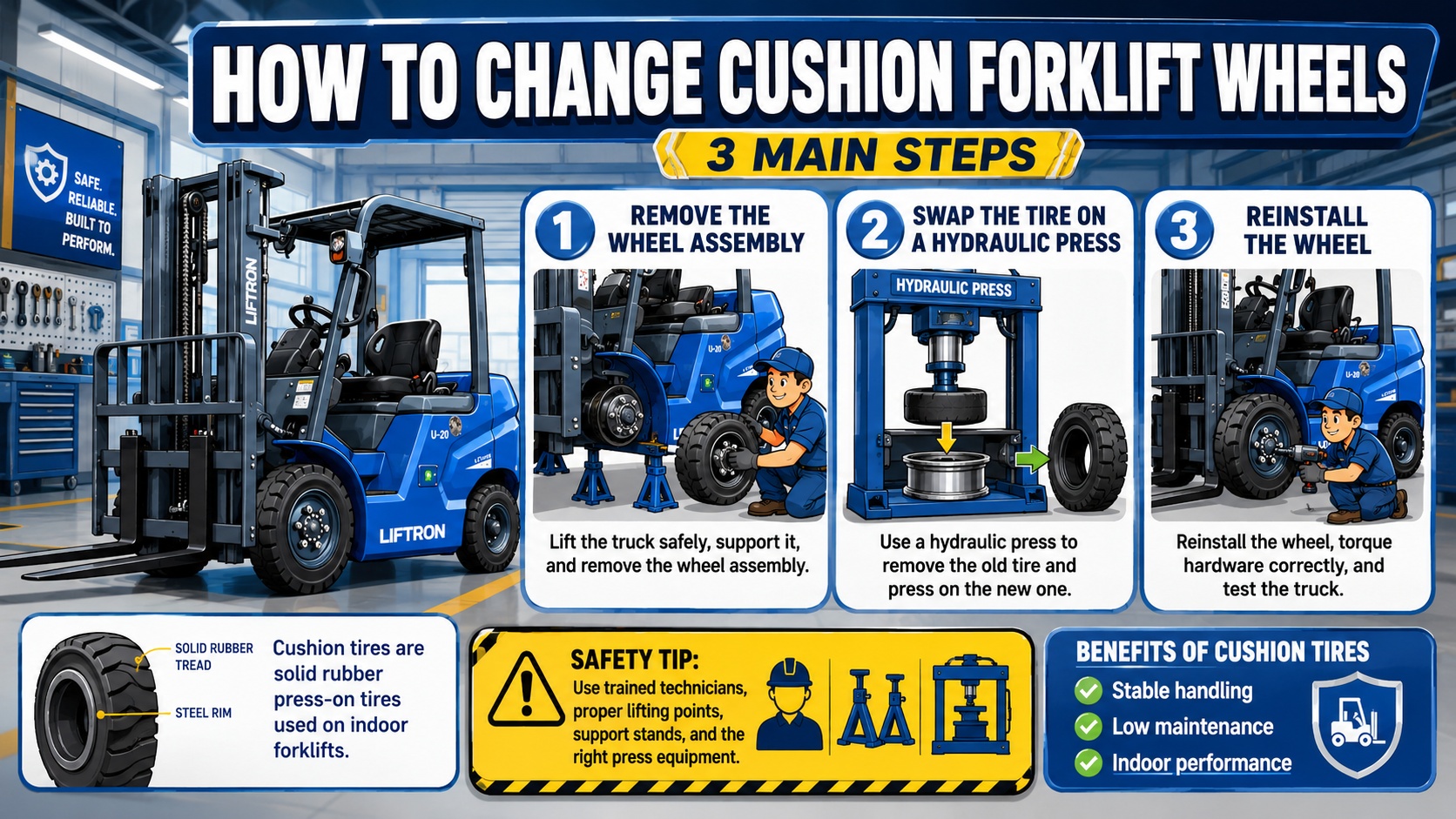
Quick Answer: Cushion forklift wheels, often called press-on tires, are changed in two main phases: removing the wheel assembly from the forklift and using a heavy-duty hydraulic press to replace the rubber tire on the metal rim. This job should be performed by trained technicians with proper lifting and pressing equipment.
Cushion forklift wheels are common on indoor forklifts used in warehouses, distribution centers, manufacturing plants, and smooth concrete facilities. Unlike pneumatic tires, cushion tires are solid rubber tires pressed onto a steel band or rim. They provide a compact profile, tight turning performance, and reliable traction on flat indoor surfaces. However, when they become worn, chunked, cracked, or uneven, they must be replaced correctly to protect safety and performance.
Changing cushion forklift wheels is not the same as changing a car tire. The tire is not simply removed by hand from the rim. In most cases, a hydraulic press is required to push the old rubber tire off the metal rim and press the new one into place. For companies operating liftron forklifts, proper wheel maintenance helps protect stability, reduce downtime, and improve long-term operating efficiency.
What Are Cushion Forklift Wheels?
Cushion forklift wheels are solid rubber tires mounted on a metal band. They are designed for forklifts that operate mainly on smooth indoor floors. Because they are compact and durable, they allow a lower forklift profile and a smaller turning radius, which is useful in narrow aisles and busy warehouse layouts.
| Wheel Type | Main Feature | Best Use |
|---|---|---|
| Cushion Wheels | Solid rubber pressed onto a steel band | Indoor warehouses and smooth concrete floors |
| Solid Pneumatic Tires | Thick solid rubber shaped like a pneumatic tire | Outdoor or mixed-use environments |
| Air Pneumatic Tires | Air-filled tire similar to a truck tire | Outdoor yards, gravel, and rougher surfaces |
When Should Cushion Forklift Wheels Be Changed?
Cushion forklift wheels should be replaced when they show excessive wear, flat spots, cracking, chunking, separation from the band, or reduced traction. Worn wheels can affect braking, steering, load stability, and operator comfort. If the tire wears past the safe wear line, the forklift may become unstable or damage the floor surface.
Important Safety Tip: Do not continue operating a forklift with severely worn cushion wheels. Poor tire condition can increase stopping distance, reduce stability, and create unsafe handling during turns or loaded travel.
Three Steps to Replace Solid Forklift Tires
Changing cushion forklift wheels generally involves three major steps. Although the process sounds simple, each step requires proper tools, safety procedures, and trained personnel.
- Remove the Wheel Assembly: Park the forklift on a flat surface, lower the forks, set the parking brake, and block the machine securely. Raise the forklift using approved lifting points, support it with proper stands, then remove the wheel assembly from the axle or hub.
- Swap the Tire on a Hydraulic Press: Place the wheel assembly in a heavy-duty hydraulic press. Press the old cushion tire off the metal rim or band, inspect the rim for damage, then press the new tire evenly into place according to the correct direction and fitment.
- Reinstall the Wheel: Reinstall the wheel assembly on the forklift, tighten fasteners to the correct specification, lower the forklift safely, and test steering, braking, and movement before returning the machine to service.
Tools Commonly Needed for the Job
Because cushion tires are press-on tires, the right equipment is essential. Attempting to remove or install them without proper tools can damage the wheel, injure workers, or create an unsafe tire fit.
| Tool or Equipment | Purpose | Why It Matters |
|---|---|---|
| Forklift Jack | Raises the forklift safely | Allows the wheel assembly to be removed |
| Jack Stands or Support Blocks | Supports the forklift after lifting | Prevents collapse or movement during service |
| Hydraulic Press | Removes and installs the press-on tire | Ensures proper tire seating on the rim |
| Torque Wrench | Tightens wheel hardware correctly | Helps prevent loose or over-tightened fasteners |
Maintenance Note: Cushion tire replacement is usually a shop or service-technician job. The hydraulic press step requires specialized equipment and should not be done with improvised tools.
Common Mistakes to Avoid
Incorrect cushion wheel replacement can lead to vibration, poor traction, uneven wear, and unsafe operation. The most common mistakes include installing the wrong tire size, reusing damaged rims, failing to support the forklift properly, and not tightening wheel hardware correctly.
- Do not mix tire sizes: Mismatched tires can affect forklift height, steering, and stability.
- Do not ignore rim damage: A bent, cracked, or worn rim can prevent proper tire seating.
- Do not replace only one tire if wear is uneven: Tires on the same axle should be matched for safe handling.
- Do not skip testing: Always test the forklift after installation before returning it to daily operation.
Do Liftron Forklifts Use Solid Tires?
Yes. Equipped with high-quality solid tires, Liftron forklifts deliver excellent durability and stability in demanding working environments. The puncture-proof design eliminates the risk of flats, reduces maintenance requirements, and helps ensure consistent performance on uneven or high-traffic surfaces.
The DE SERIES, DL SERIES, DD SERIES, and XSCZ151 are equipped with solid tire solutions. These solid tires support durability, stability, puncture resistance, and lower tire-related downtime in material handling applications.
For businesses comparing indoor and outdoor equipment options, liftron forklifts provide solid tire configurations designed to support reliable performance in warehouses, industrial facilities, logistics centers, and high-traffic work areas.
Final Safety Check After Replacement
After changing cushion forklift wheels, the technician should inspect the wheel seating, check for abnormal gaps, confirm fastener tightness, and test the forklift at low speed. The operator should check steering response, braking performance, tire contact, and unusual vibration before using the forklift with a load.
Safety Reminder: If the forklift pulls to one side, vibrates, makes unusual noise, or feels unstable after wheel replacement, stop using it and inspect the installation immediately.
Conclusion
Changing cushion forklift wheels involves removing the wheel assembly, using a hydraulic press to replace the press-on tire, and reinstalling the wheel safely. Because cushion tires are solid rubber components pressed onto metal rims, replacement should be performed by trained personnel with proper lifting equipment and a hydraulic press. Correct tire size, proper installation, matched axle wear, and post-installation testing are essential for safe forklift operation. For operations using solid-tire equipment such as liftron forklifts, regular tire inspection and timely replacement help maintain stability, uptime, and efficient material handling performance.
Add a review
Your email address will not be published. Required fields are marked *