
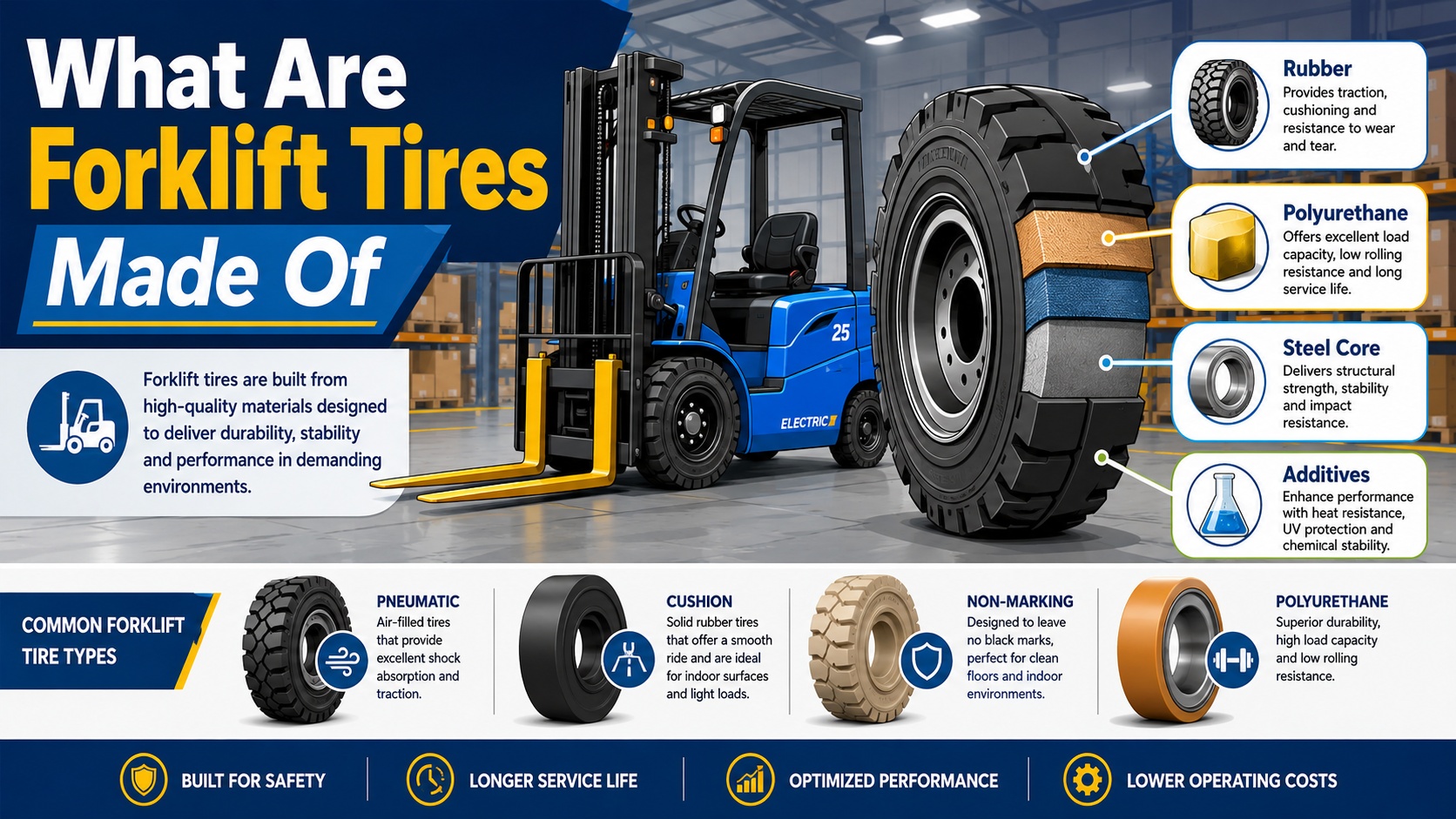
What Are Forklift Tires Made Of?
Quick Answer: Forklift tires are primarily made of rubber or polyurethane. The exact material depends on the tire type, forklift design, floor surface, load weight, and operating environment. Rubber is common in cushion, pneumatic, and solid tires, while polyurethane is often used for indoor electric forklifts on smooth warehouse floors.
Forklift tires may look simple, but they are engineered to carry heavy loads, support stability, reduce vibration, protect floors, and deliver traction in demanding environments. A tire used on a warehouse reach truck is not built the same way as a tire used on an outdoor yard forklift. The material matters because it affects safety, maintenance cost, energy use, ride comfort, and tire life.
For businesses comparing equipment such as a liftron forklift, understanding tire materials can help match the right forklift to the right application. Indoor warehouses, outdoor yards, cold storage facilities, manufacturing plants, and high-traffic docks all place different demands on tires.
The Most Common Materials Used in Forklift Tires
Most forklift tires are made from a combination of rubber, polyurethane, steel, and compound additives. Some tires use air pressure, while others are completely solid. Some are designed to reduce floor marks, while others are built for traction and puncture resistance.
| Material | Where It Is Used | Main Benefit |
|---|---|---|
| Natural and synthetic rubber | Pneumatic tires, cushion tires, and solid tires | Traction, durability, shock absorption, and outdoor performance |
| Polyurethane | Indoor electric forklifts, pallet jacks, and warehouse equipment | Low rolling resistance, long wear life, and clean floor performance |
| Steel | Rims, bands, and internal support structures | Strength, stability, and structural support |
| Carbon black and silica | Rubber compounds and non-marking tire formulas | Wear resistance, grip, durability, and floor protection |
Natural and Synthetic Rubber
Rubber is one of the most common forklift tire materials. Natural and synthetic rubber compounds are used in heavy-duty pneumatic tires, solid pneumatic tires, and cushion tires. Rubber offers strong traction, impact resistance, and flexibility, making it useful for forklifts that operate on rough or uneven surfaces.
Outdoor forklifts often use rubber-based pneumatic or solid pneumatic tires because they need traction on asphalt, gravel, packed dirt, ramps, and loading yards. Rubber also helps absorb vibration, which can improve operator comfort and reduce stress on the forklift and load.
Important Note: Rubber forklift tires are not all the same. Tire performance depends on the compound, tread pattern, hardness, load rating, and operating surface.
Polyurethane Forklift Tires
Polyurethane is common on indoor electric forklifts, pallet jacks, order pickers, and narrow-aisle warehouse equipment. It is harder than many rubber compounds and performs very well on smooth concrete floors. Polyurethane tires have low rolling resistance, which can help electric forklifts use battery power more efficiently.
Polyurethane also resists tearing and chunking on clean indoor surfaces. Because it wears slowly in the right environment, it can last longer than rubber in certain warehouse applications. However, polyurethane is not ideal for rough outdoor ground because it provides less cushioning and traction than rubber pneumatic-style tires.
Steel in Forklift Tires
Steel is used as a structural base in many forklift tire designs. Cushion tires are often molded directly onto a cylindrical steel band. Solid pneumatic tires may also use steel rims or internal support structures. This steel base helps the tire maintain shape, fit securely on the forklift, and handle heavy industrial loads.
The steel portion of the tire assembly is just as important as the tread material. If the rim, band, or mounting system is incorrect, the tire may not seat properly, and the forklift may become unsafe to operate.
Additives: Carbon Black and Silica
Rubber forklift tires include additives that change performance. Carbon black is commonly mixed into rubber compounds to improve durability, wear resistance, strength, and traction. It is also one reason many forklift tires are black.
Non-marking tires use different compounds, often including hydrated silica instead of carbon black. These tires are designed to reduce black skid marks on warehouse floors. They are useful in food facilities, retail distribution, paper operations, clean warehouses, and other locations where floor appearance matters.
Pro Tip: Choose tire material based on the work environment. Rubber is better for traction and shock absorption, while polyurethane is often better for smooth indoor floors and electric warehouse equipment.
How Forklift Tire Materials Compare
| Tire Material | Best Environment | Strengths | Limitations |
|---|---|---|---|
| Rubber | Indoor and outdoor use, depending on tire type | Good traction, cushioning, and heavy-duty durability | May leave marks unless non-marking compound is used |
| Polyurethane | Smooth indoor warehouse floors | Long wear life, low rolling resistance, battery efficiency | Not ideal for rough outdoor terrain |
| Steel band or rim | Cushion and solid tire support systems | Strong structural base and secure mounting | Must match the forklift design exactly |
| Silica-based non-marking compound | Clean warehouses, food facilities, retail operations | Reduces black floor marks | May wear differently than standard black rubber |
Step-by-Step: How to Choose the Right Forklift Tire Material
- Check the forklift data plate: Confirm approved tire size, load capacity, and manufacturer requirements before choosing a tire.
- Review the floor surface: Smooth concrete, rough asphalt, gravel, debris, and wet areas all require different tire characteristics.
- Identify the tire type: Determine whether the forklift uses cushion tires, pneumatic tires, solid pneumatic tires, or polyurethane wheels.
- Consider load weight: Heavy loads require tires with the correct load rating and compound strength.
- Evaluate operating hours: High-use facilities may need long-wearing materials that reduce downtime.
- Match the environment: Choose rubber for traction and shock absorption, polyurethane for clean indoor efficiency, or non-marking tires for floor protection.
What Type of Tires Does the Liftron Forklift Use?
The liftron forklift lineup is equipped with high-quality solid tires. These tires deliver excellent durability and stability in demanding working environments. Their puncture-proof design eliminates the risk of flats, reduces maintenance requirements, and ensures consistent performance on uneven or high-traffic surfaces.
For electric counterbalance applications, the DE SERIES, DL SERIES, and DD SERIES are designed for demanding material handling environments where durability, stability, and reduced maintenance are important.
Before selecting a liftron forklift, buyers should consider floor conditions, load weight, travel distance, tire type, and whether the forklift will work indoors, outdoors, or in mixed-use conditions.
Selection Reminder: The best forklift tire is not simply the strongest one. It is the tire material that best matches your surface, load, duty cycle, and forklift design.
Conclusion
Forklift tires are made of rubber, polyurethane, steel, and performance additives such as carbon black or silica. Rubber provides traction and cushioning, polyurethane supports efficient indoor electric operation, steel provides structural strength, and additives improve wear resistance or floor protection.
Understanding forklift tire materials helps buyers choose safer, longer-lasting, and more productive equipment. Liftron Forklift models use high-quality solid tires designed for durability, stability, and reduced downtime in demanding work environments.
Add a review
Your email address will not be published. Required fields are marked *