
How to Charge a Dead 36 Volt Forklift Battery: Step-by-Step Guide
To charge a dead 36 volt forklift battery safely, place it in a well-ventilated area, check water levels (top off only if plates are exposed), and connect a compatible 36-volt charger directly to the battery—not the forklift. If too dead for the charger to detect, use a boost function or individual 12-volt chargers on each section to revive it. Proper 36V forklift battery charging prevents damage and extends life.
Safety First
Safety is non-negotiable when handling a forklift battery. Lead-acid 36-volt forklift batteries produce hydrogen gas during charging, which is highly explosive. Always work in a designated charging station with at least six air changes per hour of ventilation. Install hydrogen gas detectors to keep levels below 25% of the lower explosive limit (LEL).
Wear full personal protective equipment (PPE): chemical-resistant gloves, safety goggles or face shield, rubber apron, and closed-toe shoes. Remove all jewelry to prevent electrical shorts or acid burns. Keep an eyewash station, spill kit with soda ash for neutralization, fire extinguisher (Class C or ABC), and emergency phone nearby. No smoking, open flames, or sparks within 6 feet. Only trained personnel should perform charging. Follow OSHA 29 CFR 1910.178 guidelines strictly to avoid severe injury, fire, or explosion.
Never charge in extreme temperatures—keep the area between 60°F and 90°F for optimal results. Inspect the battery case for cracks, bulges, or leaks before starting; damaged units require professional service.
Initial Setup
Begin by parking the forklift on level ground in your charging station. Set the parking brake and turn off the ignition. Raise the battery compartment hood or seat to allow heat and gases to escape. This step is critical for 36V forklift battery charging, as trapped heat can cause overheating and reduce lifespan.
Verify the charger matches your battery: 36 volts output and amp-hour (Ah) rating within ±10% of the battery’s label (e.g., a 750 Ah battery needs a 675–825 Ah charger). Use a charger with an automatic shut-off and equalize function. Turn the charger completely off before any connections. Disconnect the battery cable from the forklift’s power system—never charge through the truck’s wiring, as this can damage electronics or the charger itself.
Connection
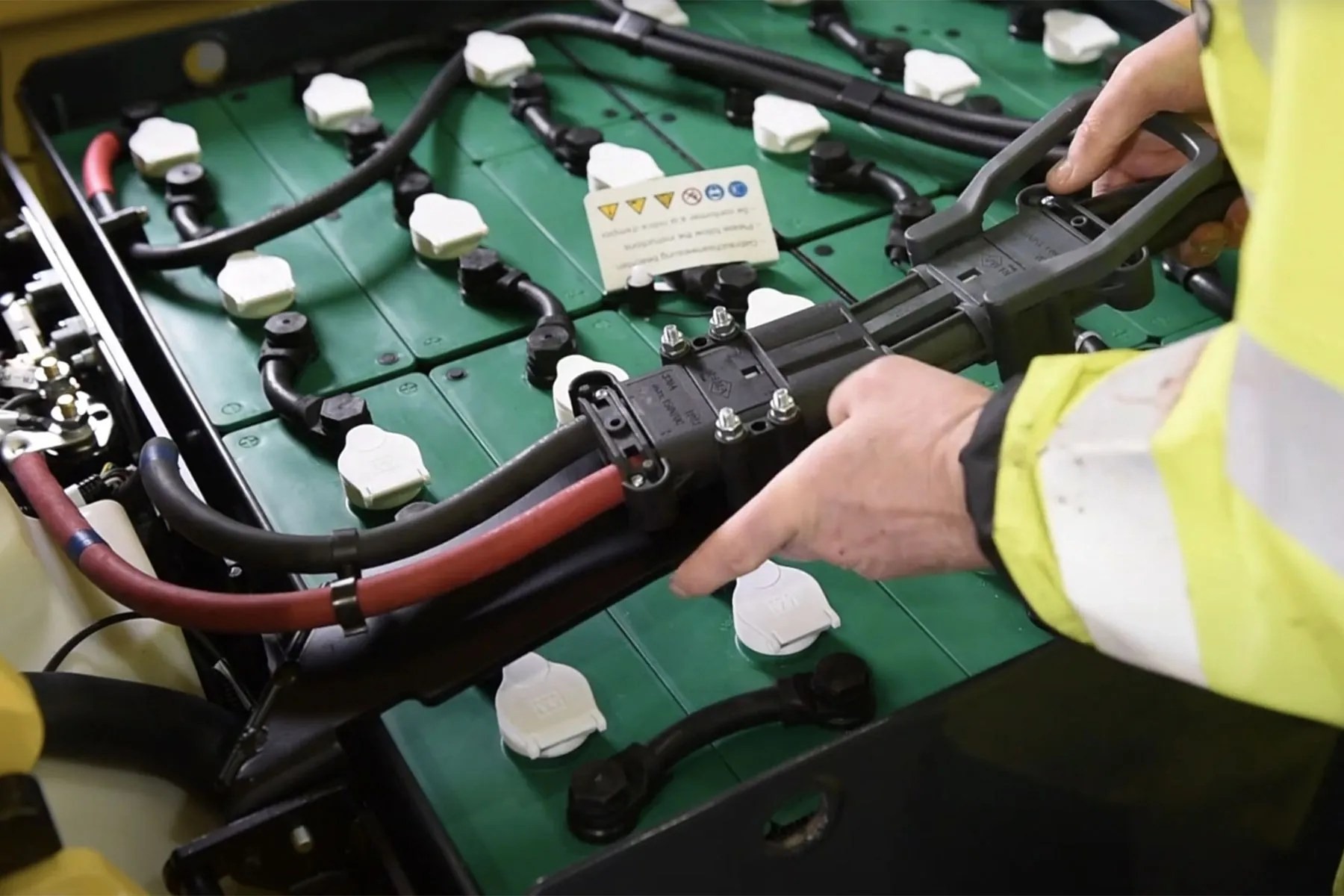
With the charger off, connect the positive (+) cable first to the battery’s positive terminal, then the negative (–). Ensure a secure, clean connection to avoid arcing. Most 36-volt forklift batteries use a large Anderson-style connector—plug the charger directly into the battery’s connector, not the forklift’s.
Double-check polarity: reversing leads can cause severe damage. Inspect cables for fraying or corrosion and replace if needed. For multi-battery setups, confirm all cells are accessible.
Charging Process
Once connected, power on the charger. For a standard 36-volt forklift battery at 20–30% charge, expect 8–10 hours for a full conventional charge, plus 6–8 hours cooling time. Opportunity or fast charging (partial top-ups) works for multi-shift operations but requires weekly equalization to prevent sulfation.
Monitor the process: slight bubbling or warming is normal, but excessive heat means stop immediately and investigate. The charger should automatically taper current and shut off at full charge (typically 2.4–2.6 volts per cell). Never interrupt a cycle midway, as each partial charge counts against the battery’s 1,500–2,000 cycle lifespan. After completion, turn off and disconnect the charger (negative first), then reconnect the battery to the forklift.
Dead Battery “Wake-Up”
If your 36-volt forklift battery is completely dead (voltage below 30V or charger won’t recognize it), don’t panic. Many modern chargers have a “boost” or “recovery” mode—activate it for a low-current initial charge to wake sulfated plates. Allow 1–2 hours before switching to normal mode.
Alternative method: Divide the 36V pack into three 12V sections (18 cells total). Use three separate 12-volt automotive or marine chargers connected in series—one per 12V group. Connect positive of first charger to positive of first section, negative to next section’s positive, and so on. Charge slowly at 2–10 amps per section for 24–48 hours until voltage rises above 10.5V per 12V group. This technique safely revives deeply discharged batteries without specialized equipment.
Warning: This requires electrical knowledge. Monitor temperature and specific gravity (target 1.265–1.285 when full). If no improvement after 72 hours, consult a professional technician.
Water Levels
Proper electrolyte levels are essential for lead-acid forklift batteries. Check water only after the battery has cooled completely (never during or right after charging—expansion can cause overflow and acid spills).
Remove vent caps and inspect each cell. Add distilled or deionized water only if plates are exposed; fill to the manufacturer’s marked level (usually ½ inch above plates). Never use tap water, as minerals cause sulfation. Overfilling leads to acid overflow during charging; underfilling exposes plates and causes permanent damage. Perform this check every 5–10 cycles or weekly in heavy use. Record maintenance for warranty compliance.
How to Charge a 36V Battery Without the Charger?
Without a dedicated 36-volt charger, you can improvise safely using three identical 12-volt chargers as described in the wake-up section above. Connect them in series across the three 12V sections. Set each to a low amp rate (5–10A) and monitor closely for 24+ hours.
Another option: Use a regulated DC power supply set to 36–42V with current limiting (10–20A max). However, this is advanced and risks damage without proper controls. Avoid car alternators or unfiltered sources—they lack regulation and can overcharge or boil the electrolyte. For temporary movement of a dead forklift, jump with three 12V deep-cycle batteries wired in series on a pallet, connected via heavy cables—but only for short distances and immediate recharging afterward. Always prioritize safety and revert to a proper charger as soon as possible.
How to Know if a Battery is Permanently Dead?
A 36V forklift battery may be permanently dead if, after 48–72 hours of slow charging, voltage stays below 36V, specific gravity readings remain under 1.100 across all cells, or cells show large voltage differences (>0.05V). Physical signs include case bulging/cracking, excessive corrosion, acid leaks, rotten-egg smell, or visible sludge at the bottom of cells.
Other indicators: no power even after full charge, rapid self-discharge, or extreme heat during charging. Test with a hydrometer and load tester—if capacity is under 80% of rated Ah, replacement is usually more cost-effective than repair. Sulfation from prolonged deep discharge is the leading cause; early intervention prevents this irreversible condition.
Maintenance Tips and Best Practices
To maximize your forklift battery lifespan (typically 5–7 years with care), charge only when discharged to 20–30%—never let it drop below 20%. Perform equalization charges monthly or per manufacturer specs to balance cells and remove sulfate. Keep terminals clean and coated with anti-corrosion grease. Store spare batteries fully charged in a cool, dry area and rotate them monthly.
Common mistakes include plugging the charger into the forklift instead of the battery, charging in confined spaces, or adding water before charging. Investing in quality chargers with smart features pays off through reduced downtime and replacement costs. When your current battery reaches end-of-life, consider upgrading to high-performance options for better efficiency.
Conclusion
Mastering how to charge a dead 36 volt forklift battery keeps your equipment running safely and efficiently. By following these detailed procedures—from safety protocols and proper connections to reviving dead units and maintaining water levels—you’ll avoid costly repairs and extend battery performance dramatically. Regular care transforms routine charging into a simple, reliable process. For premium replacement forklift battery solutions or upgrades, explore reliable suppliers that match your voltage and capacity needs.

Add a review
Your email address will not be published. Required fields are marked *