
How Many Volts Is a Forklift Battery? Complete Voltage Guide
A forklift battery typically operates at 24V, 36V, 48V, or 80V — and choosing the right voltage directly impacts productivity, safety, and total cost of ownership.
The correct voltage for any given machine depends on the equipment’s size, rated load capacity, and the demands of the operating environment. Smaller material-handling units such as electric pallet jacks may run comfortably on 24 volts, while the heavy-duty counterbalanced forklifts found in large warehouses and manufacturing facilities commonly require 48 volts or even 80 volts to move multi-ton loads reliably across every shift. Understanding how voltage is generated, what each voltage tier is designed for, and how to verify battery health are essential skills for fleet managers, maintenance technicians, and anyone responsible for keeping industrial equipment running.
How Forklift Battery Voltage Is Generated
Most industrial forklifts rely on flooded lead-acid (FLA) or sealed valve-regulated lead-acid (VRLA) battery packs. Each individual cell inside one of these packs produces a nominal voltage of 2 volts. Engineers achieve the required system voltage by connecting multiple cells in series — positive terminal to negative terminal — so that their voltages add together.
- 24V battery = 12 cells × 2V each
- 36V battery = 18 cells × 2V each
- 48V battery = 24 cells × 2V each
- 80V battery = 40 cells × 2V each
Lithium-ion (Li-ion) forklift batteries are increasingly common and use a different cell chemistry, but manufacturers still rate them at the same nominal system voltages (24V, 36V, 48V, 80V) so they remain compatible with existing chargers and onboard controllers. Li-ion packs offer faster charging, longer cycle life, and no watering requirements — but their upfront cost remains higher than lead-acid alternatives.
Common Forklift Battery Voltages and Their Applications
Each voltage tier is engineered to match a specific class of equipment. Mismatching voltage — even by one tier — can damage the forklift’s motor controller, void warranties, or create serious safety hazards. Below is a breakdown of the most widely used voltage ratings.
| Voltage | Typical Equipment | Common Use Cases |
|---|---|---|
| 24V | Electric pallet jacks, walkie stackers, walkie riders | Retail stockrooms, light manufacturing, order picking |
| 36V | Mid-sized reach trucks, narrow-aisle electric trucks | Distribution centers, high-bay warehouses |
| 48V | Large counterbalanced forklifts (3–5 ton class) | Heavy manufacturing, logistics hubs, outdoor yards |
| 80V | Heavy-duty counterbalanced forklifts (6–8 ton class) | Steel mills, paper mills, high-cycle environments |
| Up to 96V | Specialty and very large industrial trucks | Port terminals, shipping yards, maximum-power applications |
24V — Light-Duty Operations
The 24-volt system is the entry point for electric material handling. These batteries power equipment designed for loads under approximately 2,000 lbs and are ideal in environments where space is tight and travel distances are short. Because current draw is relatively low, 24V chargers are compact and inexpensive, making them a practical choice for smaller operations.
36V — Mid-Range Versatility
The 36-volt forklift battery strikes a balance between power and efficiency. Narrow-aisle reach trucks running in high-bay distribution centers frequently operate on 36V systems. The added voltage over a 24V pack translates into greater lifting height capability and the ability to handle moderate loads across full work shifts without excessive heat buildup.
48V — The Industry Standard
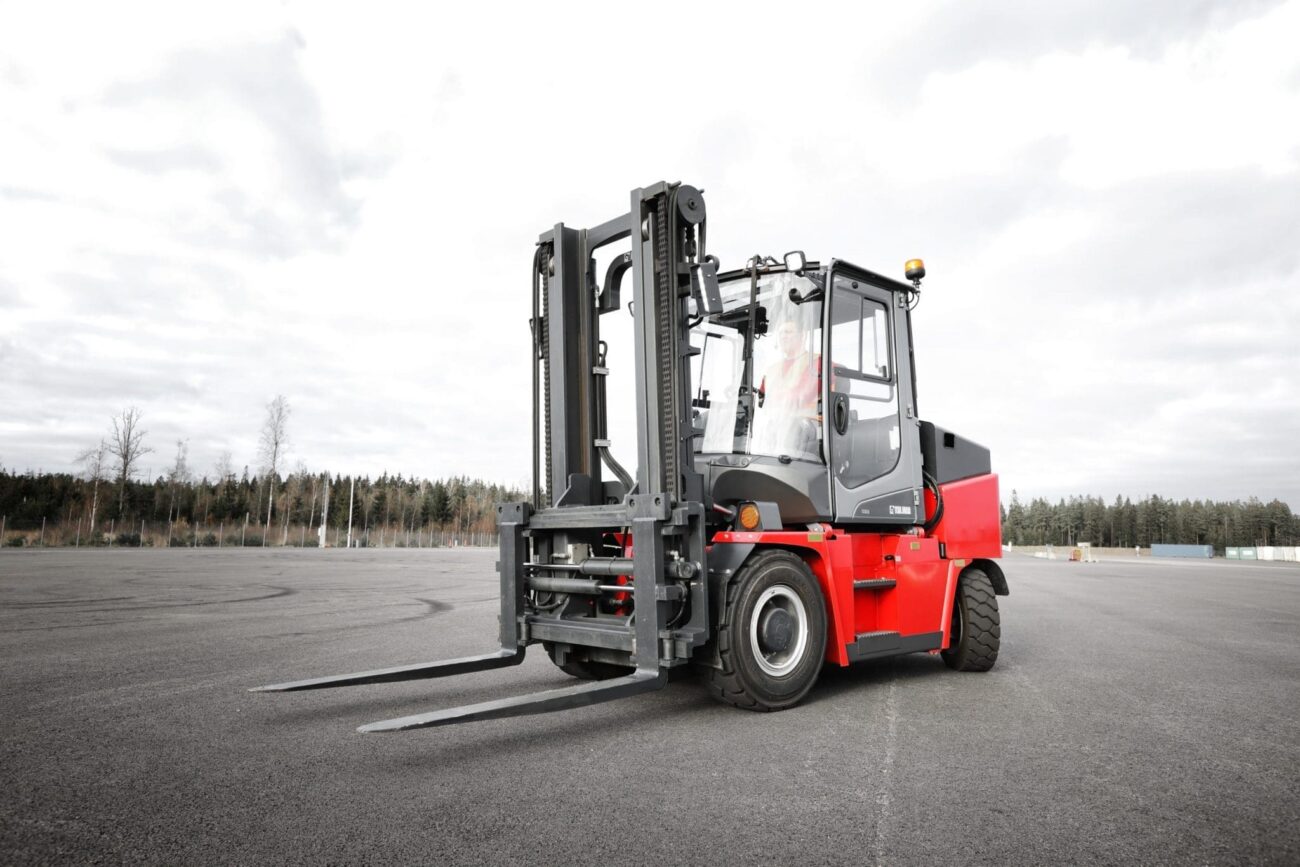
For the majority of sit-down counterbalanced forklifts found in North American and European warehouses, 48 volts has become the de-facto standard. A 48V battery pack provides enough power to handle loads ranging from 3,000 to 10,000 lbs, run multiple hydraulic functions simultaneously, and sustain performance across demanding multi-shift operations. The wide adoption of this voltage tier also means that chargers, replacement packs, and maintenance expertise are readily available.
80V and Beyond — Heavy Industrial Power
When maximum power density is non-negotiable — think steel coil handling, paper roll transport, or container yard operations — 80-volt and 96-volt systems deliver. Higher voltage enables the motor controllers to pull the same wattage at lower current, which reduces resistive losses in cabling and connectors, improves runtime efficiency, and lowers operating temperatures. The trade-off is that higher-voltage chargers and battery packs are significantly more expensive and require specialized maintenance protocols.
Which Battery Is Used in a Forklift?
Two main battery chemistries dominate the forklift market today: flooded lead-acid and lithium-ion. A third option — thin-plate pure lead (TPPL) — occupies a middle ground, offering faster recharge rates than conventional lead-acid without the full cost premium of Li-ion.
Flooded Lead-Acid (FLA)
FLA batteries remain the most common power source for electric forklifts worldwide, thanks to their low upfront cost and long track record. They require regular watering (adding distilled water to maintain electrolyte levels), temperature-controlled charging rooms, and periodic equalization charges to prevent sulfation. A properly maintained FLA pack typically delivers 1,500 charge cycles, equivalent to roughly five years of single-shift use.
Lithium-Ion (Li-Ion)
Lithium-ion forklift batteries are transforming fleet economics for high-throughput operations. They charge fully in one to two hours (versus eight hours for FLA), support opportunity charging during breaks without damaging the pack, and require zero watering or equalization. Li-ion packs also maintain a flatter discharge curve — delivering consistent power until they approach 20% charge — which improves uptime and lift performance at the end of a shift. Their cycle life typically exceeds 3,000 cycles.
Pro Tip: When evaluating total cost of ownership, factor in reduced labor for maintenance, elimination of battery-changing infrastructure, and energy savings from Li-ion’s higher charge efficiency (typically 97% vs. ~80% for FLA) before comparing sticker prices.
How to Test If a Forklift Battery Is Bad
A failing battery costs more than just a replacement pack — it reduces productivity, risks equipment damage, and can create safety hazards. Regular testing is the foundation of a proactive battery management program.
1. Visual Inspection
Before reaching for a meter, inspect the battery physically. Look for cracked or bulging cases, corrosion on terminals, loose or frayed cables, and electrolyte stains around the vent caps. Any of these symptoms indicates a battery that needs immediate service or replacement.
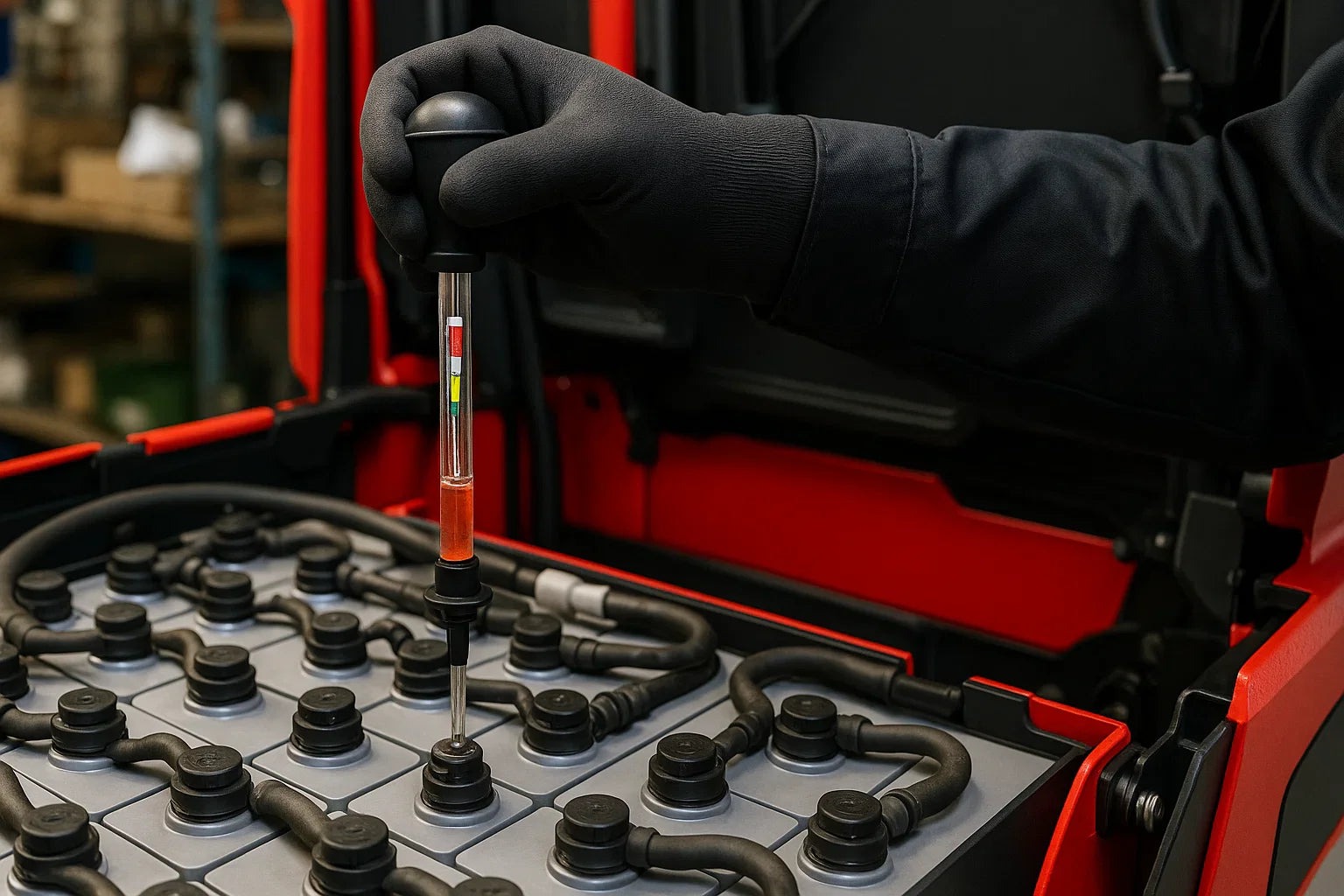
2. Specific Gravity Test (Hydrometer)
For flooded lead-acid batteries, a hydrometer measures the density of the electrolyte in each cell. A fully charged cell should read between 1.265 and 1.299 sg. A reading below 1.225 sg suggests a weak or sulfated cell. A variance of more than 0.050 sg between cells in the same pack indicates a failing cell that will drag down the entire battery.
3. Open-Circuit Voltage Test
After allowing the battery to rest for at least two hours following a full charge, measure the open-circuit voltage (OCV) across the pack terminals with a calibrated digital multimeter. A fully charged 48V FLA battery should read approximately 51–52V at rest. Significantly lower readings point to one or more weak cells or chronic undercharging.
4. Load Test (Discharge Test)
The most reliable method is a controlled discharge test using a dedicated battery analyzer. The device applies a specified load — typically 75% of the battery’s rated amp-hour (Ah) capacity — and measures how long the pack sustains voltage above a minimum threshold (usually 1.75V per cell). A battery that cannot deliver at least 80% of its rated Ah capacity under load should be flagged for replacement.
5. Impedance / Conductance Testing
Modern battery testers use high-frequency AC signals to measure internal resistance or conductance without a full discharge. High internal resistance correlates strongly with reduced capacity and impending cell failure. This method is fast (under five minutes per battery) and safe for use on both lead-acid and lithium-ion packs, making it popular in large fleets.
Warning: Never attempt to test or service a forklift battery without appropriate personal protective equipment (PPE) — including acid-resistant gloves, splash-proof goggles, and a face shield. Battery acid and hydrogen gas pose genuine hazards. Always follow the manufacturer’s service manual and OSHA guidelines.
Conclusion
Forklift battery voltage is not a one-size-fits-all specification. Whether your operation demands the compact efficiency of a 24V pallet jack battery or the raw power of an 80V heavy-duty pack, matching voltage to equipment class and duty cycle is critical for performance, safety, and battery longevity. Pair the right voltage with a disciplined testing and maintenance schedule — or consider the switch to lithium-ion for demanding multi-shift environments — and your fleet will deliver reliable uptime for years to come.

Add a review
Your email address will not be published. Required fields are marked *