
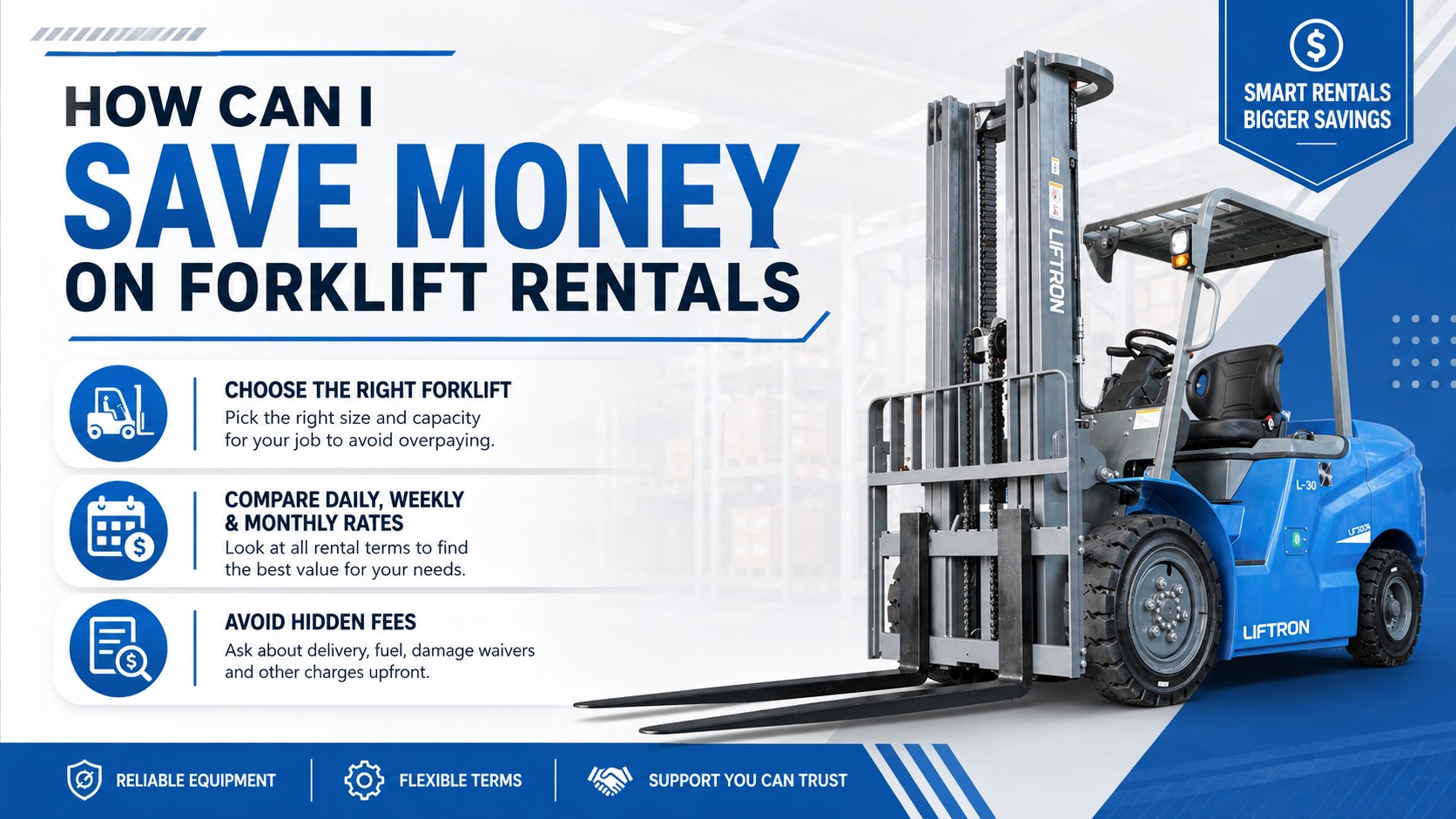
How Can I Save Money on Forklift Rentals?
Quick Answer: The best way to save money on forklift rentals is to avoid daily rates when you need the machine for several days, choose the correct forklift class, plan delivery and pickup carefully, prevent damage charges, and compare whether a weekly, monthly, lease, or purchase option is more economical.
Why Forklift Rental Costs Add Up Quickly
Forklift rentals are convenient, but the final invoice can become expensive if you do not plan carefully. The base rental rate is only one part of the cost. Delivery, pickup, fuel, battery charging, attachments, overtime, damage waivers, insurance, cleaning fees, tire damage, and late returns can all increase the total price.
Many companies rent forklifts for short-term projects, seasonal warehouse demand, moving inventory, loading containers, construction support, or temporary fleet expansion. Renting can be the right choice, but the key is to match the rental structure to your actual usage. A daily rental may look affordable at first, but if the job lasts a week or more, a weekly or monthly rate may dramatically reduce the average daily cost.
Businesses comparing short-term rental with long-term electric fleet planning may also review modern lithium-powered options from Liftron Material Handling, especially when rental costs start becoming recurring operating expenses.
The Most Effective Way to Reduce Leasing Costs
The most effective way to reduce forklift rental costs is to optimize the rental period. Rental companies usually price equipment by daily, weekly, and monthly tiers. A weekly rental is often much cheaper per day than renting the same forklift for multiple individual days. A monthly rental is usually cheaper per day than weekly rentals if your project lasts several weeks.
| Rental Strategy | How It Saves Money | Best For |
|---|---|---|
| Daily rental | Lowest commitment, but highest cost per day | One-day moves, emergency unloading, short repairs |
| Weekly rental | Lower daily cost than repeated daily rentals | Short-term warehouse projects, seasonal rushes, construction phases |
| Monthly rental | Best value for extended use | Longer projects, temporary fleet expansion, recurring material handling |
| Long-term lease | May reduce cost if usage is consistent | Regular operations without full ownership commitment |
| Purchase | Can be cheaper than renting repeatedly | Daily use, multi-shift work, long-term ownership plans |
Important Tip: If you need a forklift for more than three or four days, always compare the weekly rate. If you need it for more than two or three weeks, compare the monthly rate before booking.
Optimize for Usage Tiers
Rental companies commonly structure prices so longer rentals cost less per day. For example, a standard warehouse forklift might cost more on a daily basis than the effective daily cost of a weekly or monthly rental. If your project schedule is uncertain, ask the rental provider whether you can convert a daily rental to a weekly rental or extend into a monthly rate without penalty.
You should also avoid keeping the forklift idle. If the truck sits unused for several days, you are still paying for it. Schedule the rental to arrive when pallets, freight, staff, docks, and work areas are ready. Good scheduling can save more money than negotiating a small discount.
Select the Right Forklift Class
Renting the wrong forklift is one of the fastest ways to waste money. If you rent a larger rough-terrain unit for a smooth indoor warehouse, you may pay more than necessary. If you rent a small electric truck for heavy outdoor loads, you may lose time, damage equipment, or need to re-rent a different machine.
To choose correctly, confirm load weight, load center, lift height, aisle width, tire requirements, surface condition, and indoor/outdoor use. A compact electric warehouse forklift may be cheaper and more efficient indoors, while a pneumatic tire or rough-terrain model may be necessary outdoors.
| Need | Lower-Cost Choice | Avoid Paying Extra For |
|---|---|---|
| Indoor pallet handling | Standard electric warehouse forklift | Rough-terrain or oversized outdoor units |
| Narrow aisles | Reach truck or narrow-aisle model | Large counterbalance truck that cannot maneuver efficiently |
| Outdoor gravel or dirt | Pneumatic tire or rough-terrain forklift | Cushion tire warehouse model that may get stuck or damaged |
| Occasional light loads | Lower-capacity forklift or pallet truck | High-capacity forklift you do not need |
Pre-Plan Deliveries and Pickup
Delivery and pickup fees can add a significant amount to your rental cost. These fees vary based on distance, machine size, transport requirements, and supplier location. To save money, schedule delivery when the site is ready and pickup as soon as the job is complete.
Avoid missed delivery windows. If the driver arrives and the site cannot receive the forklift, you may be charged for waiting time, rescheduling, or an extra trip. Make sure someone is available to receive the unit, sign paperwork, inspect the machine, and confirm the condition at drop-off.
Prevent Damage Charges
Damage charges can turn a budget rental into an expensive mistake. Common damage fees come from tire cuts, bent forks, broken lights, damaged alarms, cracked overhead guards, hydraulic leaks caused by misuse, battery damage, and collision damage.
Operators should inspect the forklift at delivery and take photos of its condition. Report existing damage immediately. During the rental, use trained operators only, follow rated capacity limits, keep loads low while traveling, avoid rough surfaces unless the truck is designed for them, and never use the forklift for pushing, pulling, towing, or lifting people unless approved equipment is used.
Avoid Dealer Maintenance Penalties
Rental agreements often require renters to follow basic equipment care rules. This may include checking fluids, charging batteries correctly, keeping the machine clean, reporting defects, and avoiding unauthorized repairs. If damage occurs because the truck was misused or neglected, the renter may be responsible.
For electric forklifts, use the correct charger and follow charging instructions. For propane or diesel units, use the correct fuel and avoid contamination. For lithium-ion electric equipment, follow manufacturer charging and temperature guidelines. Modern models such as the DE SERIES, DL SERIES, and DD SERIES are designed around efficient lithium-battery operation, which can help reduce routine maintenance complexity in suitable applications.
Do I Need Insurance When Renting a Forklift?
Yes, most forklift rental companies require proof of insurance or a certificate of insurance before releasing equipment. Insurance protects against liability, property damage, theft, and equipment damage. Some rental companies may offer a damage waiver, but a waiver does not always replace full insurance coverage.
Before renting, ask your insurer whether rented heavy equipment is covered. Confirm whether your policy covers jobsite operation, loading docks, public road exposure, employee operation, third-party damage, and transportation. If you do not confirm coverage ahead of time, you may face unexpected costs after an accident.
What Types of Liftron Forklifts Are Available for Rent in the United States?
Liftron Material Handling offers four models: the DD, DE, DL, and XSCZ151 series. These models specialize in lithium-battery electric forklifts and intelligent warehousing solutions designed for modern material handling operations.
For companies that repeatedly rent electric forklifts, comparing rental costs with ownership or long-term leasing may make sense. Lithium-ion forklifts can support lower routine maintenance, fast charging, clean indoor operation, and efficient warehouse performance. If your business uses forklifts every week or every month, rental may no longer be the most cost-effective path.
Step-by-Step: How to Save Money on Forklift Rentals
- Calculate the real rental period: Estimate how many days the forklift will actually be needed and compare daily, weekly, and monthly rates.
- Match the equipment to the job: Choose the correct load capacity, tire type, lift height, and power source without over-renting.
- Plan delivery and pickup: Make sure the site, staff, docks, and freight are ready before the forklift arrives.
- Protect the equipment: Use trained operators, inspect the forklift at delivery, photograph condition, and avoid misuse.
- Review long-term alternatives: If you rent often, compare monthly rental costs with lease or purchase options from suppliers such as Liftron Material Handling.
Hidden Forklift Rental Fees to Watch For
When comparing quotes, look beyond the base rate. A quote that appears cheap may become expensive after extra charges. Ask each supplier for a complete written estimate before confirming the rental.
| Potential Fee | How to Reduce It |
|---|---|
| Delivery and pickup | Choose a nearby supplier and schedule efficiently. |
| Fuel or battery charging | Return the unit with required fuel or charge level. |
| Damage charges | Inspect and photograph the forklift before use. |
| Late return fees | Schedule pickup before the rental period ends. |
| Attachment fees | Rent only the attachment you truly need. |
| Cleaning fees | Return the forklift reasonably clean. |
When Buying May Be Cheaper Than Renting
Renting is ideal for short-term projects, seasonal demand, occasional use, or emergency support. However, if your company rents forklifts frequently, buying or leasing may be cheaper over time. A good rule is to review your rental history over the past 12 months. If you rent the same type of forklift repeatedly, ownership may reduce long-term costs.
Ownership also gives you more control over maintenance, availability, attachments, operator familiarity, and fleet planning. For companies focused on warehouse efficiency, electric lithium-battery options may offer lower operating costs compared with repeated rentals of older fuel-powered equipment.
Final Answer
To save money on forklift rentals, choose the right rental tier, avoid unnecessary daily rates, rent only the correct equipment class, plan delivery carefully, prevent damage charges, confirm insurance, and watch for hidden fees. If you rent frequently, compare rental costs with long-term leasing or purchasing. For modern electric warehouse operations, Liftron Material Handling offers lithium-battery forklift options that may be a smarter long-term solution than repeated rental costs.
Add a review
Your email address will not be published. Required fields are marked *